As the Great Wall, a great legacy of humanity, is being threatened by various factors, a growing number of rangers have been organized to protect the UNESCO World Heritage Site.
Among them, Li Yong, who grew up in an ancient village at the foot of the Great Wall, loves the national treasure from the bottom of his heart. In 2018, he gave up his city job, returned to his hometown, and became a Great Wall guardian.
"I guard 27 watchtowers. I know everything about them. What worries us most is natural collapse. See, only a bit is left in the middle here. There used to be more bricks up here. They don’t fall off all at once. This (support frame) doesn't cost much. I buy steel pipes, weld them together and take my own measurements. It's large so I break it into three parts to carry it up the mountain. Once up here I use a wrench to reassemble it," the Great Wall Guardian said.
The Great Wall, as one of the world's great wonders, was built during more than 2,000 years of continuous construction, from the Spring and Autumn Period (770 BC-221 BC) to the Ming Dynasty (1368-1644). The existing sections have a total length of over 21,000 kilometers.
To protect this historical and cultural heritage, local governments have recruited over 5,000 farmers, including Li Yong, to serve as Great Wall guardians.
In addition to patrolling the Great Wall daily, Li, with the help of Great Wall enthusiasts, has established a small exhibition hall that is open to visitors for free.
"Friends tell me that I get super excited when I talk to tourists about the Great Wall. I don’t feel it though. Maybe because my fondness for the Great Wall comes naturally. If possible, in the future, I will build an even larger Great Wall museum of 200 or even 2,000 square meters. I feel this is a great dream," said Li.
China has continued to step up efforts to protect the Great Wall. From 2015 to 2023, the country approved 289 protection and maintenance projects.
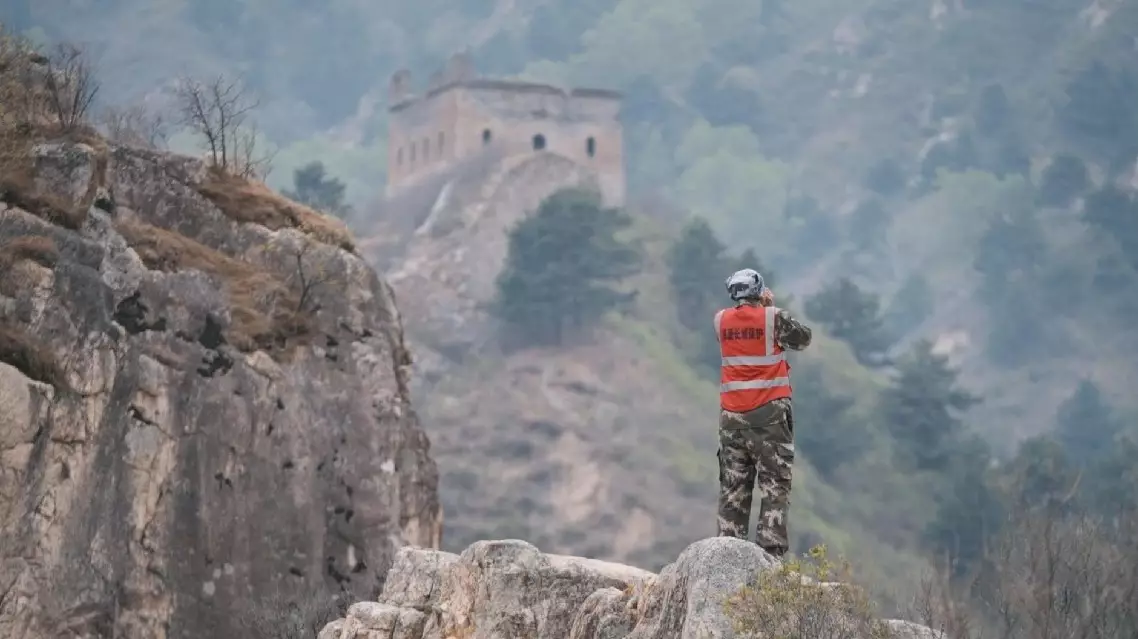
Guardians of Great Wall strive to protect great wonder
U.S. President Donald Trump said on Friday that he estimates a deal with Iran will be signed "in the next day or two."
Trump said in an interview with Israel's Channel 12 News that the United States and Iran will probably meet over the weekend to finalize a deal to end the war. "The Iranians want to meet and make a deal," he said.
He said "the naval blockade on Iran is helping to make a deal. I will not lift it until we make a deal," adding that "the biggest part of this deal is that it will make Israel safer. This deal is good for Israel."
According to the channel, one component of the deal under discussion is that the United States will release 20 billion U.S. dollars in frozen Iranian funds.
In exchange, Iran would give up its stockpile of enriched uranium, and would be only allowed to have nuclear research reactors to produce medical isotopes, all above ground.
Trump also stressed that Israel must stop the strikes on Lebanon, saying, "They can't keep blowing up buildings. I'm not going to allow that."
Also on Friday, Trump said in a phone interview with Bloomberg that a deal to end the U.S.-Israeli war with Iran is mostly complete as talks over a lasting peace deal will "probably" be held this weekend in Pakistan.
Trump said in the phone interview that Iran agreed to suspend its nuclear program indefinitely, and will not receive any frozen funds from the United States.
"Most of the main points are finalized. It'll go pretty quickly," Trump said.
Asked if he would travel to Pakistan to sign the potential deal, Trump said: "I may."
Trump again denied that the moratorium on Iran's nuclear program would expire after 20 years. "No years, unlimited," Trump said.
The United States will get all of Iran's nuclear "dust" with no money having exchanged hands "in any way, shape, or form," Trump wrote on social media earlier on Friday. Multiple Western media outlets have interpreted Trump's reference to nuclear "dust" as meaning Iran's stockpile of enriched uranium.
Iran has yet to comment on any deal beyond the reopening of the Strait of Hormuz, nor on claims made by Trump that Tehran had offered concessions, including over the key issue of its nuclear program.
If the United States continues its naval blockade of the Strait of Hormuz, Iran will consider it a violation of the ceasefire between the two countries and will close the waterway, the semi-official Tasnim news agency reported Friday, citing an informed source close to the Supreme National Security Council.
The Iranian side has yet to respond to the media report on the enriched uranium issue.
The United States and Iran had their first round of negotiations in Pakistan's Islamabad last weekend to ease tension in the Middle East. The talks, which failed to produce an agreement, took place after a ceasefire was announced on April 8 between Iran, the United States, and Israel, following 40 days of fighting.
Iran tightened control over the Strait of Hormuz after the United States and Israel launched joint attacks on the country on Feb. 28. The United States also imposed a naval blockade on the strait following the failed negotiations in Islamabad.
Earlier on Friday, both Washington and Tehran confirmed that the strait had been completely open for all commercial vessels. However, Trump said on Truth Social that the U.S. naval blockade would "remain in full force." In response, Iran warned of closing the waterway again if the U.S. blockade continues.
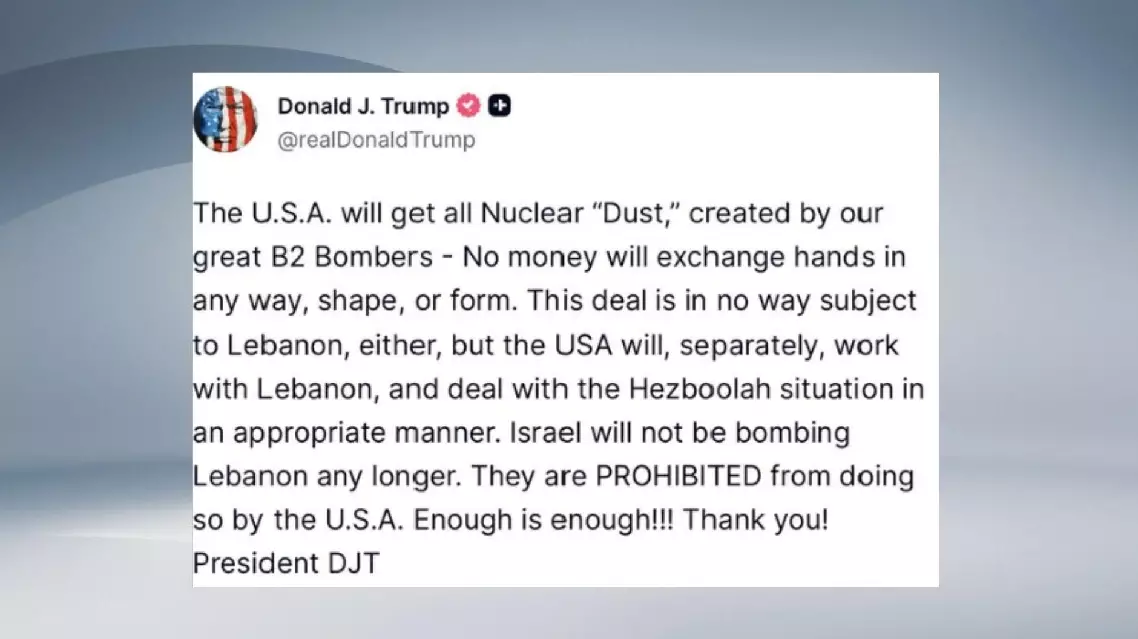
Trump says may sign deal with Iran "in the next day or two": Israeli media
Trump claims peace deal with Iran mostly complete: report