China's FAST project, a giant radio telescope in the country's south, officially launched construction on its second phase, incorporating an array of movable radio telescopes around the main parabola to enhance the project's astronomical observation capabilities.
Coinciding with the eighth anniversary of the completion of the Five-hundred-meter Aperture Spherical Telescope (FAST), the new phase will place 24 smaller telescopes within a diameter of 40 meters around the larger bowl.
Click to Gallery
China starts phase two construction of FAST radio telescope
China starts phase two construction of FAST radio telescope
China starts phase two construction of FAST radio telescope
China starts phase two construction of FAST radio telescope
This expansion aims to leverage the superior electromagnetic environment that exists within a 5-kilometer radius of the telescope due to the area's remote location and natural topography. It will form a combined aperture array, which is expected to enhance resolution and imaging capabilities.
With the strategic development of the FAST project, Chinese scientists will be capable of launching deeper investigations into various fields such as gravitational wave events, fast radio bursts, supernovae, and black hole tidal disruption events.
FAST, also known as China's "Sky Eye", began formal operation in January 2020 and officially opened for worldwide use on March 31, 2021. It is believed to be the world's most sensitive radio astronomical telescope.

China starts phase two construction of FAST radio telescope

China starts phase two construction of FAST radio telescope

China starts phase two construction of FAST radio telescope

China starts phase two construction of FAST radio telescope
People in Yemen are struggling for survival as the country continues to grapple with a deepening labor crisis after more than a decade of war, with many lamenting the lack of opportunities which are leaving the livelihoods of many hanging in the balance.
As the world marks International Workers' Day on Friday, the situation in Yemen seems all the more poignant as millions of people are finding it increasingly hard to find any work at all.
In the crowded streets of the capital Sana'a, workers gather on street corners, waiting for jobs that may never come. Ahmed Muawadah is one of the many who are sitting here, watching passing cars, desperately hoping that one will stop and offer work.
"Our suffering is that we sit here without work. Sometimes we spend a whole month without working, except for one day, or just one day every two weeks. Work is very limited, almost non-existent. I have nine children, and I only work one day a month. I cannot support them. Jobs have completely disappeared. If opportunities were opened for us, I and all the workers would work," said Muawadah.
This individual story reflects a broader reality affecting an estimated eight million workers across Yemen. Many of them are hoping to receive a daily wage, but the challenges are mounting in an increasingly strained labor market.
Activity in key sectors such as construction and services has dropped sharply, largely due to the suspension of several international initiatives, including those backed by the World Bank. As a result, income opportunities have narrowed for those who rely primarily on daily wages.
Meanwhile, the widening impact of the U.S.-Israeli war on Iran and the disruption caused along the key Strait of Hormuz -- a key shipping route for global trade -- has brought more misery in recent weeks.
"There has been a significant decline in business activity as a result of the war, the blockade, and the disruption of work. Foreign capital has also left the country, and large companies have moved out of Yemen and stopped their operations. This is one of the main reasons," said Abdul Karim Al, secretary general of the General Federation of Trade Unions in Sana'a.
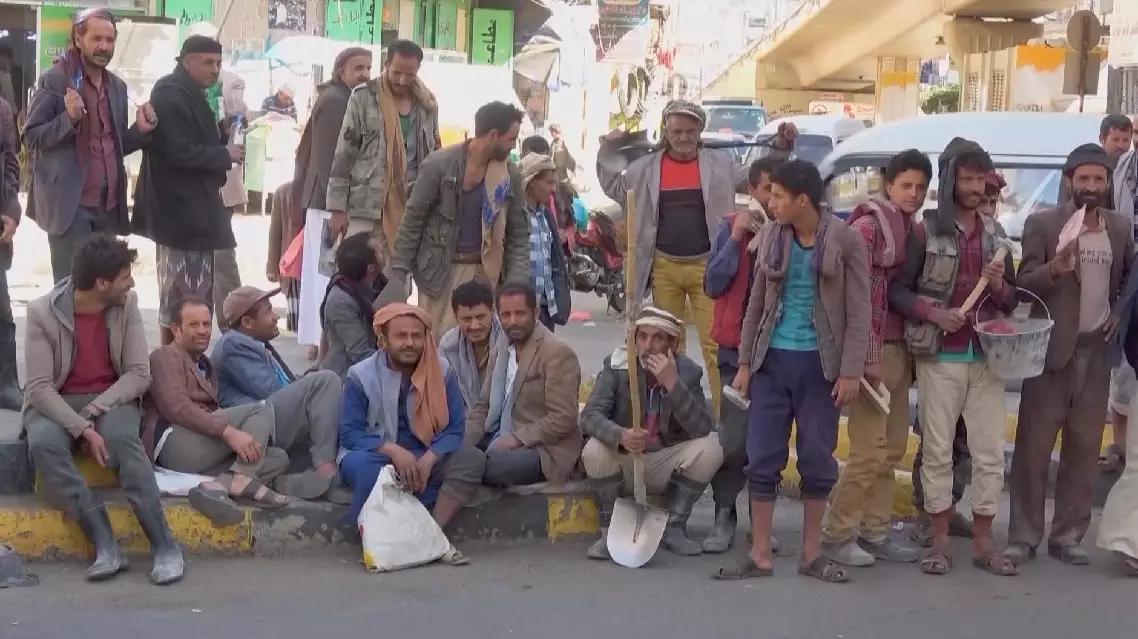
Yemen residents struggling to survive as work dries up amid deepening labor crisis