China's evolving consumer trends mean fresh opportunities for malls and shopping centers, according to Joyce Zhu, president of Ingka Centres China.
In Shanghai, Ingka Centres officially opened its 10th Livat complex in late September under the local government's 15-minute living circle initiative.
Livat Shanghai is the single largest investment project of Inga Group globally with a total investment of eight billion yuan (about 1.14 billion in U.S. dollars) and a construction volume over 430,000 square meters, or around the size of 60 soccer fields. It includes a large shopping center, an Ikea store and five office towers. Ingka Centres is a subsidiary of the Ingka Group, which also owns Ikea Retail.
Located in a pilot area of the 15-minute living circle initiative, the new complex will help enhance the quality and convenience of residents' everyday life, Zhu said in an interview with China Global Television Network (CGTN). She also expressed Ingka Centres' confidence in the Chinese consumer market.
"We also observed the consumer trend is undergoing significant changes. This will bring both new challenges but also opportunities for the consumer market. I can share a little bit of our observation. First of all, we see consumers are making more cautious and smarter choices anchored with value-for-money. At the same time there is also a growing emphasis on living a more sustainable and healthy lifestyle. And people are willing to put more emphasis on self-satisfaction and at the same time to make meaningful social belongings," she said.
Zhu said Livat Shanghai is also going to host diversified community activities, aiming to bring playfulness, innovation, and collaboration into reality.
She also emphasized that the company's other Livat shopping centers are doing well citing double-digit year-over-year growth so far in the fiscal year 2024 for total visitations and tenant sales.
"For us, it's not only about the numbers, but when we see all the people-centric approaches, and our meeting place concept has been more and more welcomed and appreciated by many customers. And when we see our Livat meeting places, no matter the new ones or the mature ones, they keep on growing with the people in the city. I think this brings us the true rewarding feelings," the regional company president said.
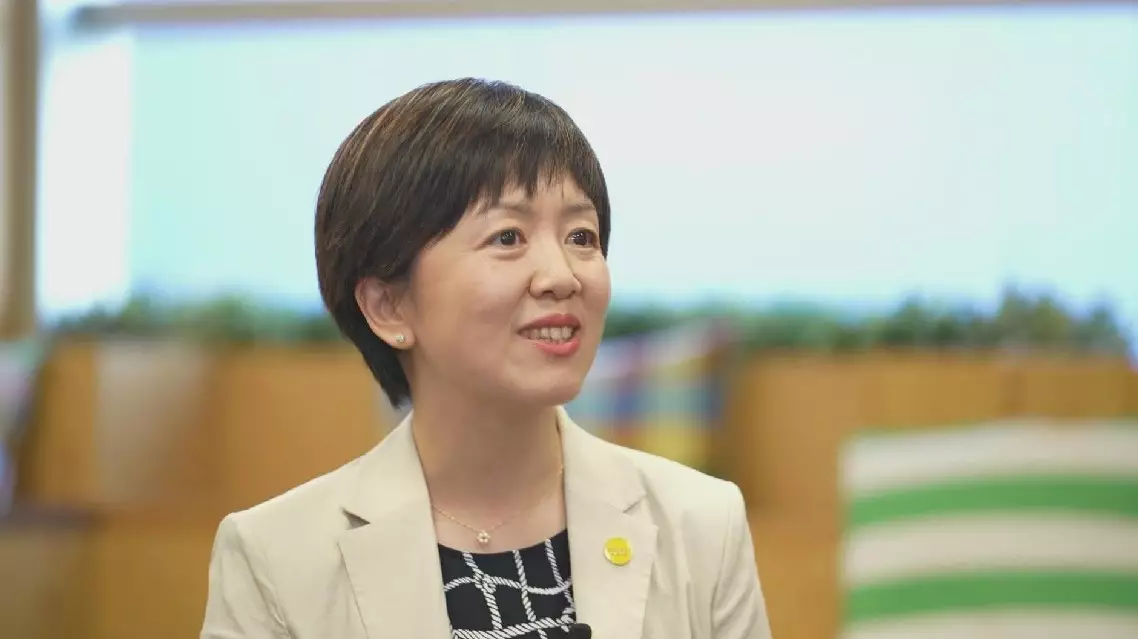
Changing consumer trends bring new opportunities for malls: Ingka executive
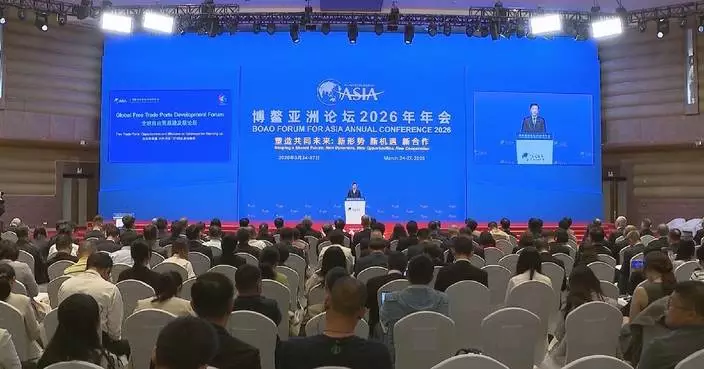
China's strategic focus on building a modern industrial system will give rise to a new phase of innovation in the country, said guests at the Boao Forum for Asia (BFA) Annual Conference 2026, which opened on Tuesday in the southern Chinese province of Hainan.
This year's BFA annual conference is unfolding in Boao, a coastal town in Hainan's Qionghai City, where leaders from government, business and academia all over the world gather to gain deeper insights into the country's 15th Five-Year Plan (2026-2030).
It comes less than two weeks after the annual session of the National People's Congress (NPC), China's top legislature, formally reviewed and adopted the plan, a sweeping blueprint to guide the country's economic and social development for the second half of this decade, amid rising geopolitical tensions, economic fragmentation, and technological changes.
Forum participants are paying strong attention to China's push toward building a modern industrial system through scientific and technological innovation, particularly in frontier areas that offer both strategic resilience and growth multipliers, such as advanced manufacturing, semiconductors, next-generation information technology, and quantum technology.
During a sub-forum on China's high-quality development on Tuesday, a Chinese economist shed light on how China strives to achieve industrial transformation and upgrading in the years ahead, while emphasizing that the country is committed to sharing development opportunities with the rest of the world.
"During the 15th Five-Year Plan period, a key focus will be on the transformation and upgrading of traditional industries, that is, by enhancing the output and competitiveness of existing industries through innovation. Therefore, I believe this represents a relatively new feature of innovation during this period: placing equal emphasis on emerging industries and on leveraging new technologies to transform traditional industries," said Jiang Xiaojuan, honorary president of the China Industrial Economics Association.
Foreign guests speaking at the forum said that China is currently among the global leaders in multiple sectors such as artificial intelligent, biopharmaceutical, and clean energy. They believe that the country will build on its existing strengths and make more sci-tech breakthroughs in these frontier fields in the coming five years, thus remaining a highly attractive destination for foreign investment.
"My advice to any foreign company, how to do business in China? It's very easy: read the Five-Year Plan. It tells you what are the sectors that the government will encourage. So, if you are a foreign company and you do semiconductor, come to China. Semiconductor, technology, new energy vehicles, batteries, study physics of matter -- this is where China welcomes," said Michele Geraci, former undersecretary of state at the Italian Ministry of Economic Development.
Another Chinese expert reaffirmed that the 15th Five-Year Plan also underscores that China will consistently deepen high-standard opening-up, pursue win-win cooperation with other countries, and remain committed to sharing the fruits of its high-quality development with the rest of the world.
"Chinese modernization has an important characteristic, which I would call 'open-source modernization.' In other words, we are following a development path that differs from those of the past. In the past, some Western countries, after achieving development, would pull up the ladder they had climbed to prevent other countries from developing, because they wanted to monopolize development for themselves. What China is doing now, however, is that after achieving its own development, it extends that ladder further out to enable, encourage and assist other nations to achieve development as well," said Zheng Yongnian, dean of the School of Public Policy at the Chinese University of Hong Kong, Shenzhen.
Since its establishment in 2001, the BFA has functioned as an international platform for China to present its domestic policy priorities to a global audience.
The theme for this year is "Shaping a Shared Future: New Dynamics, New Opportunities, New Cooperation." The event runs through Friday.
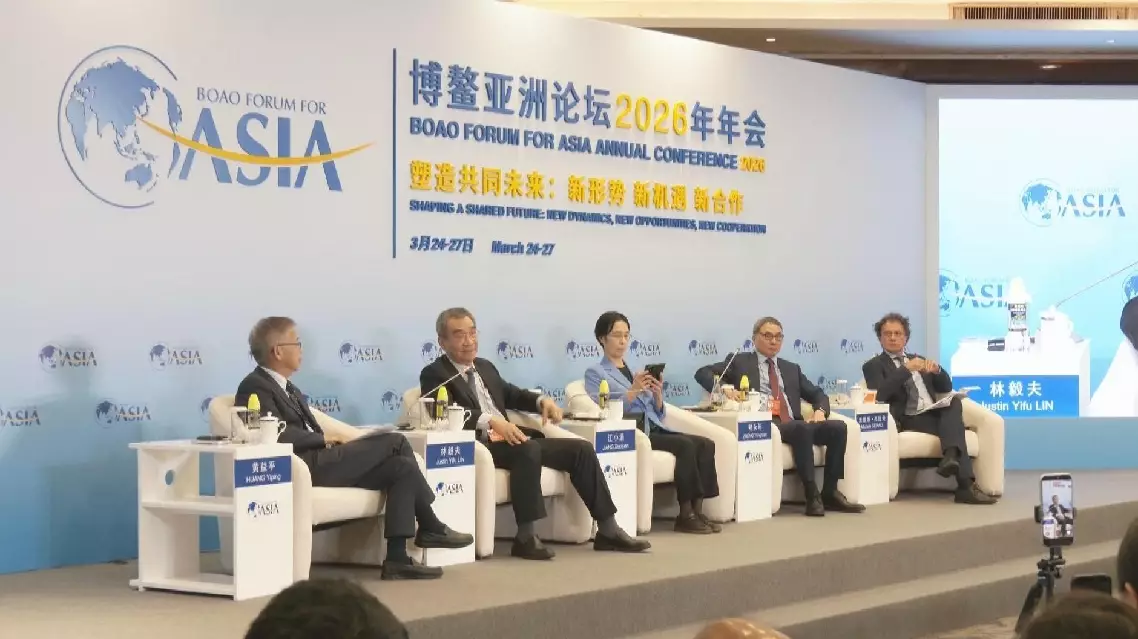
China's industrial modernization to drive new phase of innovation: Boao Forum speakers