Holiday return trips have peaked in major hub cities across China, as the week-long National Day holiday is coming to its end.
Starting from Oct 1, the National Day holiday, another "golden week" after the Spring Festival holiday, is usually one of the peak travel seasons on China's domestic tourism calendar.
According to China State Railway Group Co., Ltd., the daily railway passenger volume has exceeded 17 million for six consecutive days.
Peak return passenger flow at the Changchun Railway Station in northeast China's Jilin Province appeared on Sunday, and the station is expected to handle as many as 130,000 passenger trips on Monday, according to the railway department.
To cope with the rush, the Changchun Railway Station added temporary trains and coordinated with local transportation departments to increase bus and rail transit services to ensure smooth passenger transfer.
In north China's Hebei Province, vehicle flows have shifted from scenic spots to expressways.
A large number of vehicles started to flock into the expressway networks at 07:00 on Sunday, and the traffic volume on local expressway networks peaked at around 17:00, with about 513,000 vehicles passing per hour.
Vehicles were moving slowly on several expressway sections heading to Beijing.
"Hebei is a major transit province, so the car flows expanded gradually. Currently, the expressway networks around Beijing, Tianjin and the provincial capital Shijiazhuang are highly saturated," said Gong Shaohui, deputy director of Hebei Provincial Expressway Traffic Police Corps Command Center.
The Hebei Expressway Traffic Police Corps predicted that the traffic volume on local expressway networks will remain high on Monday.
"There will be a small peak at 11:00 or 12:00 at noon, and the peak will culminate from 14:00 to 17:00 or 18:00, when the traffic volume on the way is expected to reach 550,000 vehicles per hour, which will be concentrated in expressway sections around Beijing, Tianjin and Shijiazhuang," said Gong.
In Hubei in central China, railways, roads and civil aviation started to see travel peaks on Sunday.
At the Hankou Railway Station in the provincial capital Wuhan, long lines of passengers were seen at every ticket gate on Sunday afternoon. The passenger arrivals at the station exceeded 10,000 per hour and even breached 18,000 at round 20:00.
The three major railway stations of Wuhan, Hankou and Wuchang in the city handled more than 330,000 departing passenger trips and over 440,000 passenger arrivals on Sunday.
In order to ensure smooth passenger transit at night, subway stations connecting to railway stations have extended their operation hours.
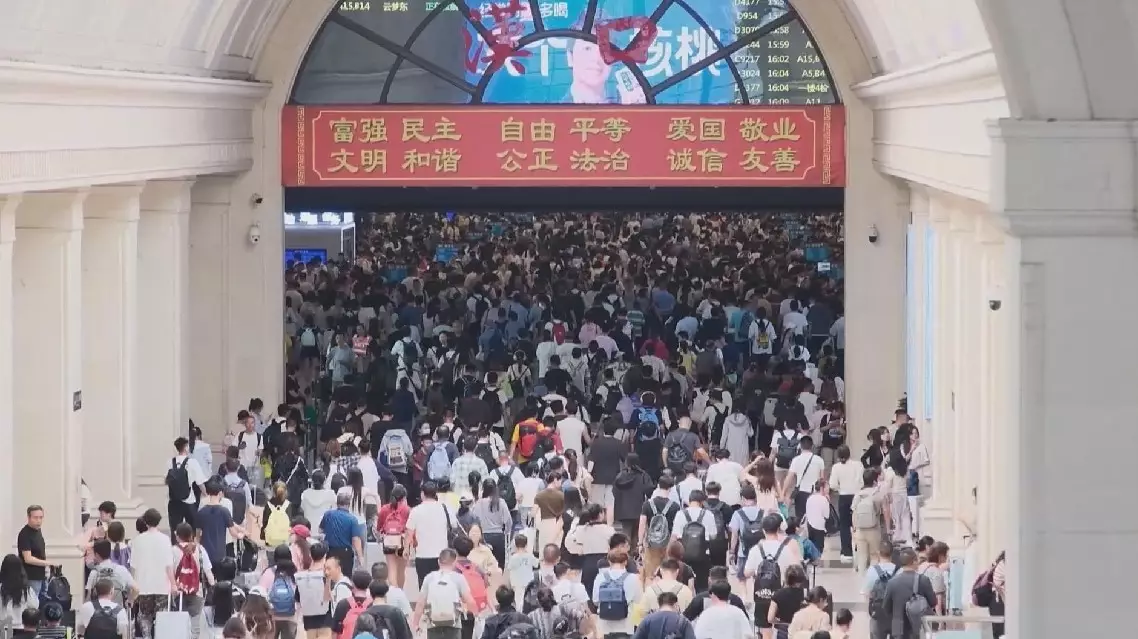
Hub cities see holiday return trips' peak