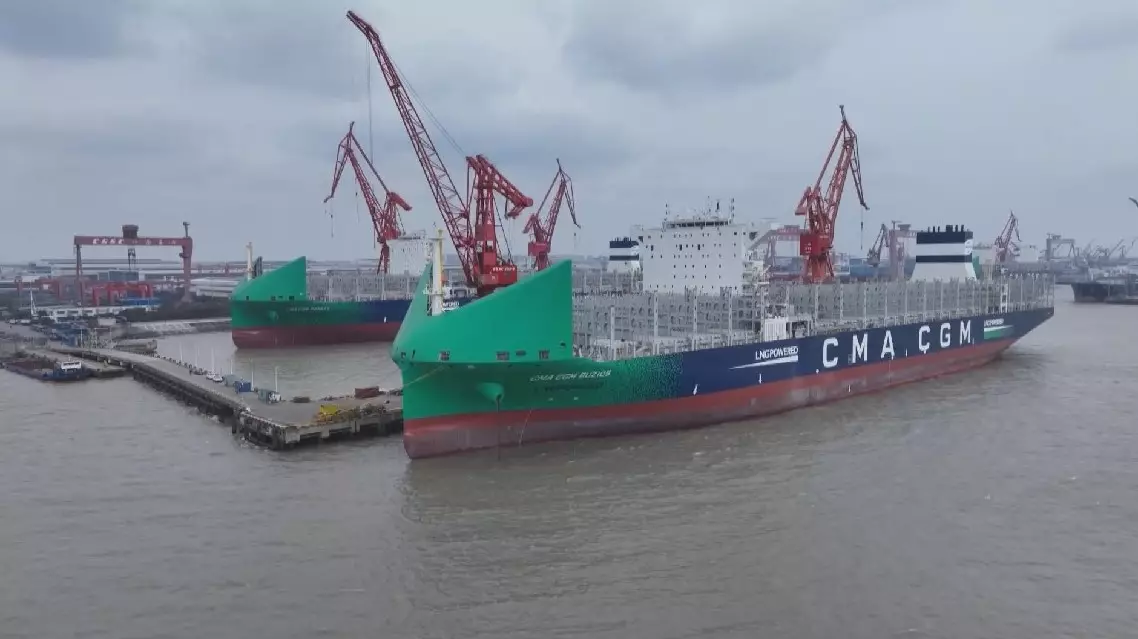
China secured more than 70 percent of global green ship orders in the first three quarters, covering all major vessel types, according to the latest data released by the Ministry of Industry and Information Technology Thursday.
During this period, China completed 36.34 million deadweight tons (DWT) in shipbuilding, an 18.2 percent increase year on year, while securing 87.11 million DWT in new orders, up 51.9 percent. By the end of September, the total orders on hand reached 193.3 million DWT, a 44.3 percent rise, data shows.
China accounted for 55.1 percent of global ship completions, 74.7 percent of new orders, and 61.4 percent of the global holding orders, according to the data. "After the green transition, the values of the three major vessel types of bulk carriers, oil tankers and container ships are all increasing. In other words, the use of new technology and fine stewardship to improve the utilization of our capabilities is an important password for the success of Chinese shipyards," said Li Yanqing, secretary-general of the China Association of the National Shipbuilding Industry.
There are two major ways of green transformation. The first is to use new green fuels such as liquefied natural gas, methanol and liquid ammonia as ship power. The other is to achieve the effect of energy saving and emission reduction by optimizing the ship power plant and using new technologies such as adding desulfurization system.
Currently, most of the new ships produced in the Dalian Shipbuilding Industry Co., Ltd. (DSIC) are ships that run on green fuels.
"Overall, the trend of green development for new shipbuilding orders is certain, and green vessel orders account for about 60 percent of the total," said Peng Guisheng, director of marketing division under the DSIC.
China released an action plan to promote green development in the shipbuilding industry last December.
By 2025, China aims to build a preliminary green development system in the industry, according to the plan, which was released by five authorities, including MIIT and the National Development and Reform Commission.
China secures 70 percent of global green ship orders in first three quarters
China's two major power grid operators -- the State Grid Corporation of China (State Grid) and China Southern Power Grid (CSG) -- reported a surge in investment in the first quarter of 2026, underscoring efforts to strengthen infrastructure construction and support high-quality socioeconomic development in China.
The State Grid said it completed fixed-asset investment worth 129 billion yuan (about 18.77 billion U.S. dollars) in the first three months of this year, up 37 percent the corresponding period of the previous year. The spending has driven more than 250 billion yuan (36 billion U.S. dollars) of investment across the wider industrial chain.
Key projects such as the Panxi ultra-high-voltage (UHV) alternating current (AC) line and the Anhui-Hubei back-to-back direct current (DC) project have seen ground broken for their construction, while several west-to-east power transmission projects have been upgraded.
Investment in connecting renewable energy generation to the grid was reported to have exceeded 10 billion yuan (1.45 billion U.S. dollars) from January to March, a year-on-year rise of more than 50 percent.
The CSG also reported robust growth in investment in the three-month period, with fixed-asset investment reaching 38.45 billion yuan (5.58 billion U.S. dollars), up about 50 percent from a year earlier.
Among its achievements, the company completed and commissioned 80 key projects, including the 220 kV cross-sea power grid interconnection project, which was officially put into operation on March 20. The project ended years of grid isolation on the Weizhou Island in south China by linking it to the main power system of the Guangxi Zhuang Autonomous Region.
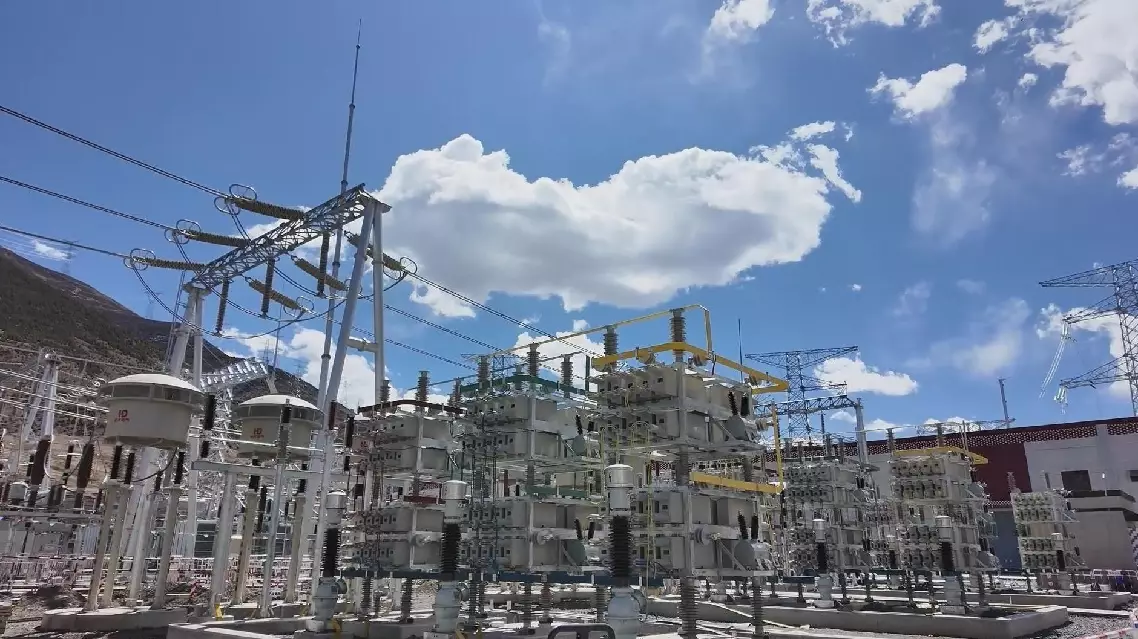
The construction of 17 other major energy projects, including one linking the power grid of the Xizang Autonomous Region in southwest China with that of Guangdong Province in south China, is advancing rapidly. These projects are expected to bolster regional industries, the maritime economy, digital collaboration and the transition to green energy.
"By accelerating major project construction, investment during the 15th Five-Year Plan period (2026-2030) is expected to approach 1 trillion yuan (145 billion U.S. dollars), driving a further 2 trillion yuan (290 billion U.S. dollars) of investment across upstream and downstream industries," said Dong Yanle, deputy general manager of the Engineering Construction Department under the China Southern Power Grid.
China ramps up power grid investment in January-March to boost growth