Skip to Content Facebook Feature Image

Concert featuring music of popular 'Black Myth: Wukong' computer game delights crowds

China

China

China

Concert featuring music of popular 'Black Myth: Wukong' computer game delights crowds

2024-10-15 07:38 Last Updated At:17:04

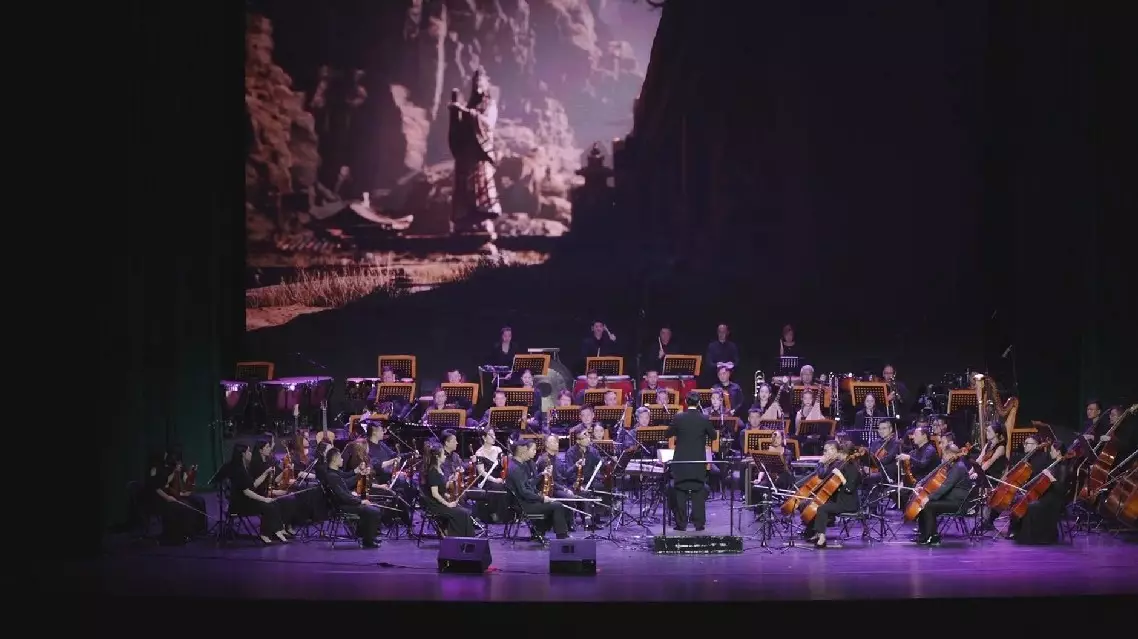
A concert featuring the soundtracks from the popular action role-playing game "Black Myth: Wukong" has left many audiences in Beijing in awe, drawing attention to the rich cultural heritages the game embodies by showcasing a harmonious blend of different musical styles.

Inspired by the classic novel "Journey to the West" the recently-released game "Black Myth: Wukong" has captivated players worldwide with its gripping gameplay, advanced graphics and stirring soundtrack.

As part of a national tour jointly organized by the game's developer Game Science and entertainment giant the Poly Culture Group, the concert series wrapped up earlier this month at the Beijing Exhibition Theater, after infusing modern elements into traditional melodies.

As the music began, the audience was transported into the game's enchanting universe, with the concert peaking with a performance by Xiong Zhuying of "Shanbei Storytelling", a much-loved folk music style from Shaanxi Province in northwest China which features in the game.

The piece, which runs for less than two minutes, quickly went viral globally, and is one of the main reasons many audience members opted to attend the concert.

"Actually, it has generated significant buzz among music critics both in China and abroad. This reflects the growing confidence in our cultural exports," said Zhu Qiuyu, an audience member.

Xiong himself noted that before his involvement with 'Black Myth: Wukong,' he was unsure if young people would appreciate folk music. Now, the long rounds of applause and palpable excitement have more than answered his question.

"It has made many young people fall in love with traditional culture, particularly the storytelling style from northern Shaanxi Province. I believe that we could continue to boldly experiment with more forms of integration, encouraging more young people to participate," he said.

Others point to the wide appeal of the music in the game which draws on a range of styles and influences.

"After listening to [the music in] 'Black Myth: Wukong,' many audience members may notice that it combines Western symphonic elements with traditional Chinese folk instruments. This crossover between gaming and art, as well as the fusion within the music itself, leaves them with a very strong impression," said Yao Rui, chairman of Poly Performance and Culture Development Company.

As the person responsible for composing the game's soundtrack, Zhai Jinyan explained how the team came up with a suitable style to match the moody world depicting in the story.

"I believe the most important aspect is the blend of modern musical styles that people are familiar with and traditional Chinese folk music. This includes orchestral arrangements, powerful and epic percussion, and certain electronic synthesizer sounds," Zhang said.

Conductor Li Bowei described the concert as a unique experience, which came following the whirlwind success of the game.

"This concert is for games and gamers, so it's less serious and more interesting so I think that was a special one for the band and conductors," he said.

Singer Gao Tianhe believed that the concert has expanded the audience for classical music, attracting newcomers who might not have shown interest in the art form before.

"Such concerts actually expand the market and audience for classical music. They are attracting new audiences who don't usually follow classical music, encouraging them to visit theaters and experience the art form. This increases the number of art enthusiasts and allows the brilliance of our classical arts to reach and inspire more people," said Gao.

For pianist Tim Zhang who grew up overseas, the concert offered him a chance to explore Chinese culture more deeply, and he expressed great pride at being a part of the project.

"For one, I'm super proud to be part of this project. I've never played a game that has Chinese culture and Chinese influence. So I feel like this is a great start. I'm so proud that everybody around the world will be able to know a little bit about Chinese culture [and] Chinese traditional music," said Zhang.
Concert featuring music of popular 'Black Myth: Wukong' computer game delights crowds

Concert featuring music of popular 'Black Myth: Wukong' computer game delights crowds

Pakistan's Interior Minister Mohsin Naqvi informed Iran's Ambassador to Pakistan Reza Amiri Moghadam on Monday that preparations for the second phase of talks in Islamabad have been completed, said the Interior Ministry. According to a statement, the minister met with the ambassador to discuss arrangements for the second round of talks, saying that foolproof security arrangements have been in place for visiting foreign delegations.

Yet the prospect of a second round of U.S.-Iran negotiations remains unclear. U.S. forces intercepted and seized an Iranian-flagged cargo ship in the Gulf of Oman, while Tehran has said it currently has no decision to send a negotiating delegation.

Despite the tensions, Pakistan, as a main mediator, continues its efforts to bring the two sides to the table, with other regional countries. On Sunday, U.S. President Donald Trump announced that U.S. negotiators would travel to Islamabad for possible talks with Iran.

He also threatened to"knock out every power plant and every bridge" in Iran if his deal is rejected.

U.S. media reported that Vice President JD Vance would lead the delegation, joined by Trump's special envoy Steve Witkoff and son-in-law Jared Kushner.

However, the Iranian side denied the potential talks in Islamabad. Iran's semi-official Tasnim news agency said Sunday that Iran currently has no decision to send a negotiating delegation, stressing that as long as the U.S. "anti-Iran" naval blockade remains in place, there will be no negotiation with Washington.

Iran's official news agency IRNA said on Sunday that the country has rejected taking part in the second round of peace talks with the United States.

Iranian Foreign Ministry spokesperson Esmaeil Baghaei said Monday that Iran currently has no plan for the second round of peace negotiations with the United States.

The United States takes actions that are in no way indicative of its seriousness in pursuing a diplomatic process, Baghaei told a weekly press conference, noting that since the ceasefire took effect on April 8, "we have been faced with the breaking of promises and nagging by the United States."

For Hanan Hussein from the global think tank Initiate Futures in Islamabad, despite the heightened tensions, the possibility of the second round of U.S.-Iran talks has not been ruled out, and he believes the negotiations are likely to move forward, though both sides face challenges in aligning expectations.

"I think the talks are going to go ahead. It's just a matter of time until we see them materializing. So, a couple of considerations lead me to that conclusion. First of all, the U.S. naval blockade is meant as a pressure tactic for Iran to come forward for a deal. Whether the deal is acceptable or not would likely be a challenge between compromises on what each side sees as doable concessions. But I think the signaling from the U.S. front, and we see the lead-up in the preparations as well, is something that the U.S. is willing to dial up the pressure, but they want to negotiate from a position of strength. From the U.S. perspective, the naval blockade will kind of suggest or add to that being a position of strength. But I think a key weakness over there is that unless Iran and the U.S. make tangible efforts to coordinate their expectations about what qualifies as a doable, workable, executable deal, any of these pressure tactics can risk upending the kind of trust surplus which both sides need in order to proceed forward, including through Pakistan's mediation," he said.

The two sides held their first round of talks in Islamabad on April 11 and 12 but failed to reach an agreement.

Hussein emphasized Pakistan's critical role as mediator, saying its proximity to both parties allows it to bridge differences and manage external shocks.

"It's critical. So for example, when you talk about a mediator, he has to have favorable proximity to both adverse parties when their positions are polarized. You need to have a country, for example, Pakistan fits the bill on many occasions, for example, when we talk about coordinating expectations with Iran, to have a strategic channel open with Washington allows you to kind of see where the constraints lie from each side's perspective. And I think, on the other front, mediation becomes critical because when we talk about tampering some of the external shocks which rise out of this conflict, it's something which the U.S. and the Iranians themselves cannot necessarily negotiate or bring to the table. I think that's where mediating parties such as Pakistan -- we've seen Egypt and Türkiye hit from the sidelines -- can create this atmosphere of shuttle diplomacy where both sides can communicate proposals, push back and forth without exactly being seen as weak in terms of public diplomacy, because obviously the temperature within the U.S. and Iran is to maintain a strong-arm posture," he said.

"So, I think from that point of view, mediation becomes critical because what happens behind closed doors is this incremental consensus-building process, which keeps diplomacy on the table. And I think, from that point forward, Pakistan's role has been demonstrated as effective over the past couple of weeks. Building on that will require regional consensus, something which allows Pakistan to also filter in the feedback from Gulf powers who've been disproportionately affected into this process. So, it remains a very multivector, and I think the mediation effort fits the bill on that front," he added.

Uncertainty clouds US-Iran talks as Pakistan prepares mediation

Uncertainty clouds US-Iran talks as Pakistan prepares mediation

Recommended Articles