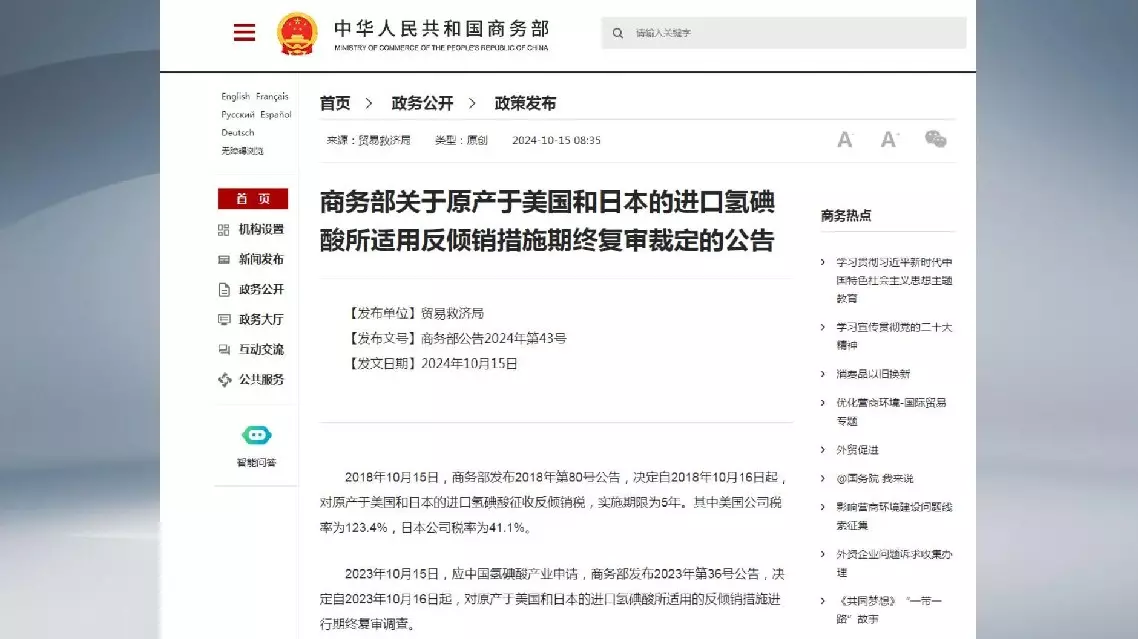
The Chinese Ministry of Commerce on Tuesday announced its decision to continue to impose anti-dumping duties on hydriodic acid originating in the United States and Japan.
China introduced the duties on Oct. 16, 2018 for a period of five years as such imports had caused substantial damage to its domestic industry.
Following the end of the term last year, the Chinese Ministry of Commerce launched investigations to review the anti-dumping at the request of the domestic industry.
The ministry said in a ruling that if the duties are terminated, the dumping practice and related damage will likely continue or reoccur.
The duties will be levied for another five years starting Wednesday, with a tax rate of 123.4 percent for U.S. companies and 41.1 percent for Japanese companies.

China continues to impose anti-dumping duties on US, Japanese hydriodic acid
China continues to impose anti-dumping duties on US, Japanese hydriodic acid
Chinese Premier Li Qiang on Thursday presided over a State Council executive meeting that studied work on building a unified national market and reviewed and approved a plan for the development of a modern emergency response system during the 15th Five-Year Plan period (2026-2030).
Noting that building a unified national market is essential to advancing high-quality development, the meeting called for deepening institutional frameworks in areas such as property rights protection, market access, fair competition, social credit and market exit mechanisms.
The meeting also urged efforts to advance high-standard connectivity of market infrastructure to facilitate smooth economic circulation and effectively reduce logistics costs across society.
Emergency management is critical to protecting people's lives and property, the meeting said. It called for accelerating the development of a modern emergency response system, deepening reform and innovation in emergency management, and improving coordinated response mechanisms.
Efforts should be made to strengthen risk prevention at the source, enhance monitoring, forecasting and early warning, and accelerate a shift in governance toward proactive prevention, according to the meeting.
A draft revision of the Law on the People's Bank of China was also discussed and approved in principle at the meeting, which decided to submit the draft to the Standing Committee of the National People's Congress for deliberation.
Chinese premier chairs State Council executive meeting