Egyptian journalist Mazen Eslam Afify Ahmed has said that he is intoxicated by the culture of the Chinese city Xi'an, which provides an important window for the mutual learning between the ancient civilizations of Egypt and China.
Ahmed was in the city to attend the Belt and Road Forum for International Think Tank Cooperation and the second Silk Road (Xi'an) International Communication Forum, which took place from Sunday to Tuesday and brought together 300 guests from both China and abroad.
As an important hub of the ancient Silk Road, Xi'an has existed for over 3,000 years and served as the capital of 13 feudal Chinese dynasties. The city holds a wealth of ancient historical sites, including imperial tombs, ancient temples, forts and city walls.
Upon landing in Xi'an, Ahmed was immediately immersed in the unique charm of the ancient city infused with modern elements.
"When I was covering news about China and Chinese cities from Egypt, I heard that Xi'an is an important city for the Belt and Road Initiative, and a famous city in Chinese history. But I never imagined Xi'an is like this, which has many excellent attractions and is worth a deep exploration," said Ahmed.
Ahmed speaks fluent Chinese due to his four years of study in Cairo about the Chinese language and culture. He is eager to learn more about China, including its history, culture, development, and modernization progress.
Although he came to China before, this is his first trip to Xi'an, during which he and other foreign guests visited the world-renowned Emperor Qinshihuang's Mausoleum Site Museum and the Great Tang All Day Mall - a comprehensive culture center and shopping mall.
Ahmed's Chinese name Luxia means "sunny way and gorgeous summer flowers", which embodies his hope that China and Egypt will always enjoy a friendly relationship.

Egyptian journalist says Xi'an provides important window for civilization exchanges
Nicaragua's co-foreign minister Valdrack Jaentschke has warned that militarism must never be allowed to rise again, as Japan's recent moves to lift its arms export ban and revise the pacifist Constitution continue to draw international concern.
This year marks the 80th anniversary of the opening of the Tokyo Trials, where Japan's Class-A war criminals from World War II were brought to justice.
In an interview with China Global Television Network (CGTN), Valdrack Jaentschke voiced his concern that today's world order is being undermined by interventionism and other challenges.
"It is necessary for us to remember that after the end of World War II, countries worked hard to build a new international order based on international law. However, regrettably, more than 80 years later, we are seeing that this once explored and attempted order is being challenged by interventionism, a confrontational mindset, and tendencies like 'might makes right.' These are precisely the conditions that gave rise to fascism and militarism in the past, which ultimately led to the tragedy of World War II," he said.
He said the international community has a responsibility to pursue a new international order -- one fundamentally grounded in peace.
"Looking back at the history more than eight decades ago and comparing it with today's reality, it is our responsibility to recognize that the world should, and must, build a new international order that is more just, fairer, rooted in international law, based on a logic of mutual benefit and shared success, and fundamentally grounded in peace," said the minister.
"Today, as we revisit the Tokyo Trials, it is meant to remind the world that such a tragedy must never be repeated -- and that we must do everything in our power to prevent it from happening again. We must stop that dark world -- born from militarism, interventionism, and fascism -- from ever returning," he said.
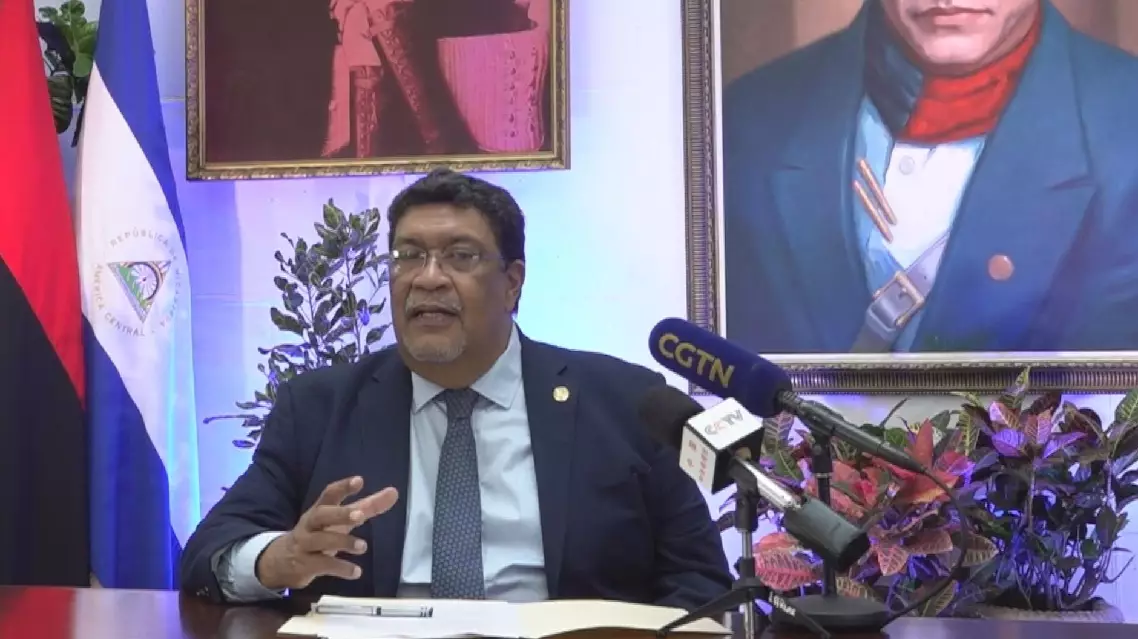
Nicaraguan FM warns of militarism revival