The Baiyun Border Inspection Station in Guangzhou, the capital of south China's Guangdong Province, recorded nearly 50,000 entry-exit trips on Saturday, marking a new high for the year.
Boosted by the grand event of the Canton Fair and Guangzhou's 144-hour visa-free transit policy, Guangzhou Baiyun International Airport has recorded over 210,000 entries and exits since the opening of the 136th Canton Fair Autumn 2024 on October 15, reflecting a 16 percent increase in passenger flow compared to the previous session.
Notably, over 60,000 foreign nationals have entered China through the airport since the fair began, highlighting the event's global appeal.
The first phase of the 136th China Import and Export Fair, commonly known as the Canton Fair, concluded on Saturday.
With the theme 'Serving High-Quality Development, Promoting High-Level Opening-Up,' the fair is set to bring together over 30,000 exhibitors, showcasing 1.15 million new products.
The recent expansion of visa-free travel to more countries is expected to maintain high passenger volumes at China's ports of entry and exit. Officials anticipate daily traffic of around 45,000 people throughout the duration of the fair.
"We have set up a sufficient number of 'Canton Fair channels' and sent more multilingual police officers to guide visitors. We continue to optimize the entry-exit procedures for cargo flights and crews to ensure that overseas exhibitors participating at the Canton Fair can arrive easily and export cargo flights can depart quickly," said Long Jiansheng, official of the No. 12 group at the Baiyun border inspection station.
Guangzhou is improving public transport and rideshare options, while organizing business travel activities, to provide quality services for both international and domestic attendees.
This edition of the Canton Fair is being held in Guangzhou in three phases from October 15 to November 4, featuring 55 exhibition areas covering 1.55 million square meters.
Representatives from over 30,000 enterprises, both domestic and international, will attend the fair in person.
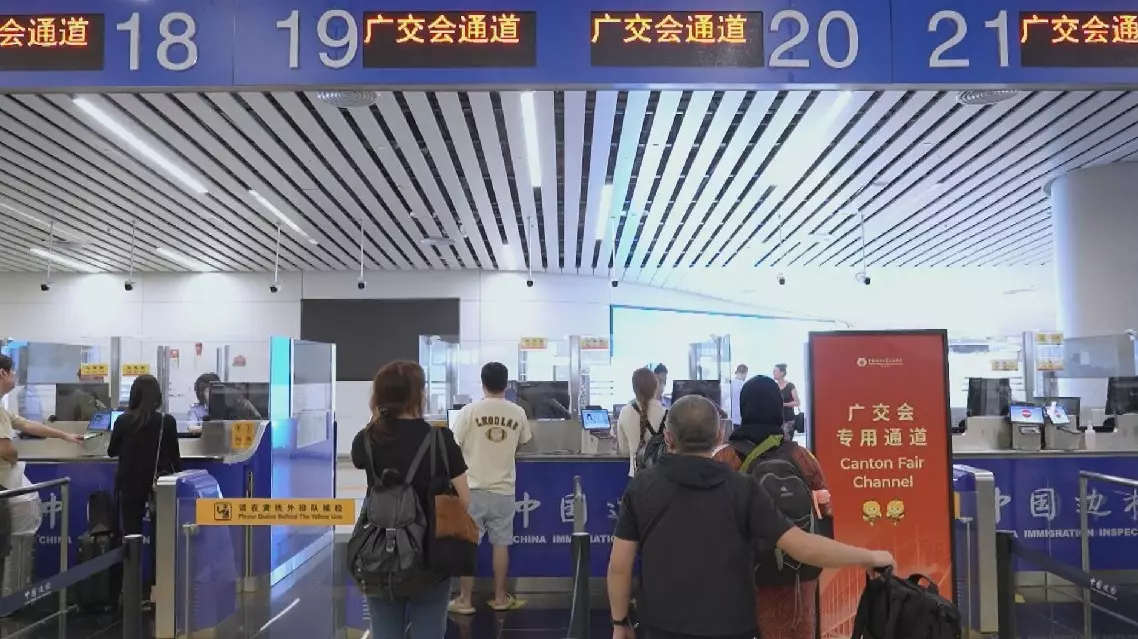
Guangzhou's Baiyun border crossing sees record high in entry-exit trips
Boarding schools have become a good choice for children whose families are living across vast grasslands and high mountain valleys to receive education in southwest China's Xizang Autonomous Region.
For years, getting an education was a major challenge for local children in Xizang's Nagqu, which sits at an average altitude of over 4,500 meters, making it one of the highest cities in the country. The students that benefit from boarding schools include 13-year-old Tenzin Lobsang, who was enjoying his vacation at a pasture, where he helped his grandparents herd the sheep, shear wool, and milk the sheep.
On the last day of his vacation, Lobsang had to prepare for school and review his lessons. His school is located at the center of Nagqu's Baingoin County, about a two-hour drive from home. He lives on campus during semesters.
Lobsang's mother Dawa Drolma said she and her husband work full-time, while Lobsang's grandparents are usually busy in the herding fields. Schools are located far from home, therefore boarding school became the best choice.
"We asked around and learned that Baingoin Sinopec Primary School is good. We also asked about the teachers. Everything is good there, including the food and dorms. So we chose that school," she said. For children like Lobsang who are from remote herding areas, boarding not only makes education possible, but also eases their parents' worries.
"We feel very much at ease. When he is at school, we never have to worry about anything going wrong. At parent-teacher meetings, we find out he gets one or two awards every single day, and the teachers are always praising him. As parents, that just makes us really happy," she said.
"By boarding at school, I want to be more independent and not rely on my parents for everything. If I kept thinking about them and calling them all the time, they would worry about how I'm settling into the dorm. I don't want them to worry," said Lobsang
After lunch, Lobsang's grandfather prepared to take him back to school by motorcycle. The farewell carried a touch of sadness, but their blessings were wrapped within the white khata, a traditional Tibetan scarf symbolizing good wishes.
Built in 2012 with investment from Sinopec, Baingoin Sinopec Primary School is widely known as "the aid-funded primary school that's closest to the sky."
"Our school has expanded from 850 students to 1,345 now. And when it comes to the school's facilities, it's not just the best in Bangoin County, but one of the best in the whole Nagqu region. You could even compare it to some schools in Lhasa," said Ngawang Wangdu, principal of the school.
The school has six student dormitories -- three for boys and three for girls -- equipped with not only winter heating systems and running water, but also abundant daily supplies such as shampoos, toothbrushes, toothpastes, soaps and face creams, according to dormitory administrator Udrup Tsomo.
With free meals for all students, food safety and balanced nutrition are top priorities.
"In addition to three meals a day, we also provide nutritional subsidies for students. So between classes, we also give them milk, bread and fruit, all carefully chosen for the students to enjoy," said Wangdu.
Alongside Mandarin, mathematics, and English, Tibetan language studies are also a compulsory part of the curriculum.
Extracurricular activities are also emphasized. Each year, the school's sponsors support around 50 students on study tours to other Chinese cities, an experience many local families consider life changing.
Lobsang was given such an opportunity, and that trip inspired him to dream beyond the grasslands. In Beijing, he visited Tian'anmen and the Old Summer Palace.
He said he was especially impressed by China Science and Technology Museum, which made him realize how powerful technology can be.
"I want to get into a better middle school. And when I grow up, I really hope to attend the National University of Defense Technology because when I scroll through videos online, I often see content about the university. It seems like they turn out a lot of outstanding talents there. I really want to get into that university, and serve in the military," said the boy, when it came to his goals in the future.
For children like Lobsang, the path ahead is no longer limited by geography or distance, but shaped by the dreams and ambitions they choose to pursue.
In old Xizang, the illiteracy rate was over 95 percent. By 2024, nearly 98 percent of students completed nine-year compulsory education, while the high school enrollment rate reached 91.56 percent.
Since 2012, Xizang has offered 15 years of free education, covering tuition, meals and boarding from kindergarten through high school.
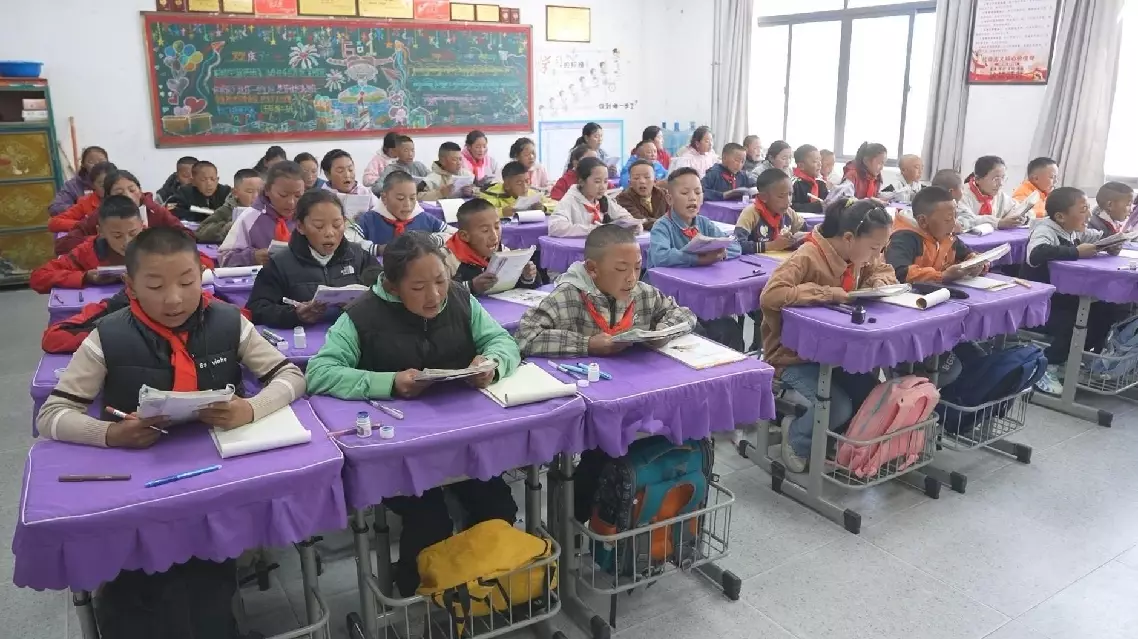
Boarding schools help Xizang students from remote areas get education