A Chinese envoy on Tuesday said at the 79th session of the Third Committee of United Nations General Assembly that China firmly opposes and totally rejects groundless accusations by a few Western countries regarding China's human rights situation.
During a general debate on human rights issues at the UN headquarters in New York, a number of countries voiced support for China's just stance and opposed the politicization of human rights issues.
The representative of Pakistan made a joint statement on behalf of 80 countries including China, emphasizing that the affairs of Xinjiang, Hong Kong, and Xizang are China's internal affairs.
"Respect for sovereignty, independence and territorial integrity of states, and non-interference in the internal affairs of sovereign states represent basic norms governing international relations. Xinjiang, Hong Kong and Xizang related issues are China's internal affairs. We oppose politicization of human rights and double standards, or interference in states' internal affairs under the pretext of human rights," said Munir Akram, Pakistan's permanent representative to UN.
Fu Cong, China's permanent representative to the UN, said that Australia and the United States, among others, resorted again to lies to provoke confrontations, which China firmly opposes and totally rejects.
"The human rights situation that should gather the most attention at the Committee this year is undoubtedly that of Gaza. Australia and the United States, among a few others, have downplayed this living hell, while unleashing attacks and smears against the peaceful and tranquil Xinjiang. They have once again refreshed the world's understanding of double standards. This revealed, once again, the true intentions of Australia and the United States to use human rights as a pretext to interfere in China's internal affairs and curb its development, and to broadly suppress developing countries that adhere to an independent and autonomous foreign policy," said Fu.
If the death of more than 40,000 civilians in Gaza and the starvation and the displacement of millions of women and children are not enough to awake the conscience of a few Western countries including Australia and the United States, prompting them to stop sending weapons and ammunition that have claimed the lives of countless Palestinian civilians, then their professed protection of human rights of Muslims is nothing but the biggest lie, said Fu.
The 80 countries, including a large number of Muslim countries, issued a joint statement in support of China, clearly opposing the interference in the internal affairs of other countries under the pretext of human rights. This fully shows that the hypocrisy of Australia, the United States, and a few others in politicizing and weaponizing human rights issues has long been seen through, that the plot of using Xinjiang to contain China has long gone bankrupt, and that the sinister intention of using anti-China rhetorics to contain China and to provoke confrontations has completely failed, said Fu.
The Third Committee of the United Nations General Assembly is mainly focused on discussing human rights and social development issues.
Since 2019, a few Western countries, including the United States, have repeatedly attacked and smeared China by exploiting so-called human rights issues, but their efforts have been strongly opposed by the overwhelming majority of countries, and have all ended in failure.
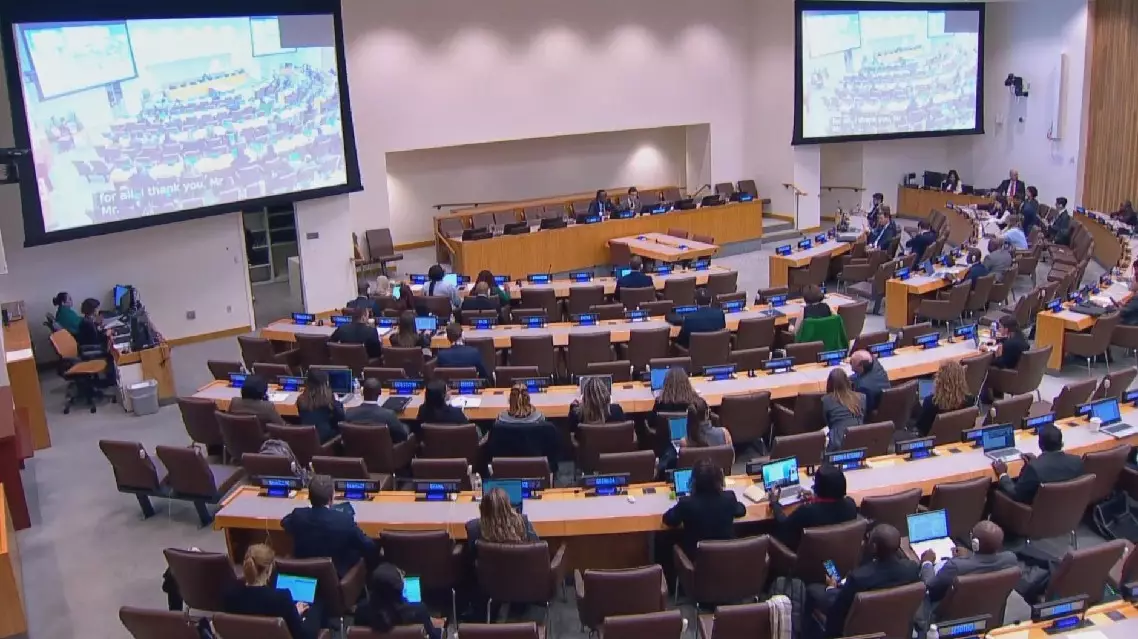
Chinese envoy refutes accusations of China's human rights situation by few Western countries