Skip to Content Facebook Feature Image

Exhibition on China's ancient Liangzhu ruins opens in Peru

China

China

China

Exhibition on China's ancient Liangzhu ruins opens in Peru

2024-11-01 04:28 Last Updated At:16:27

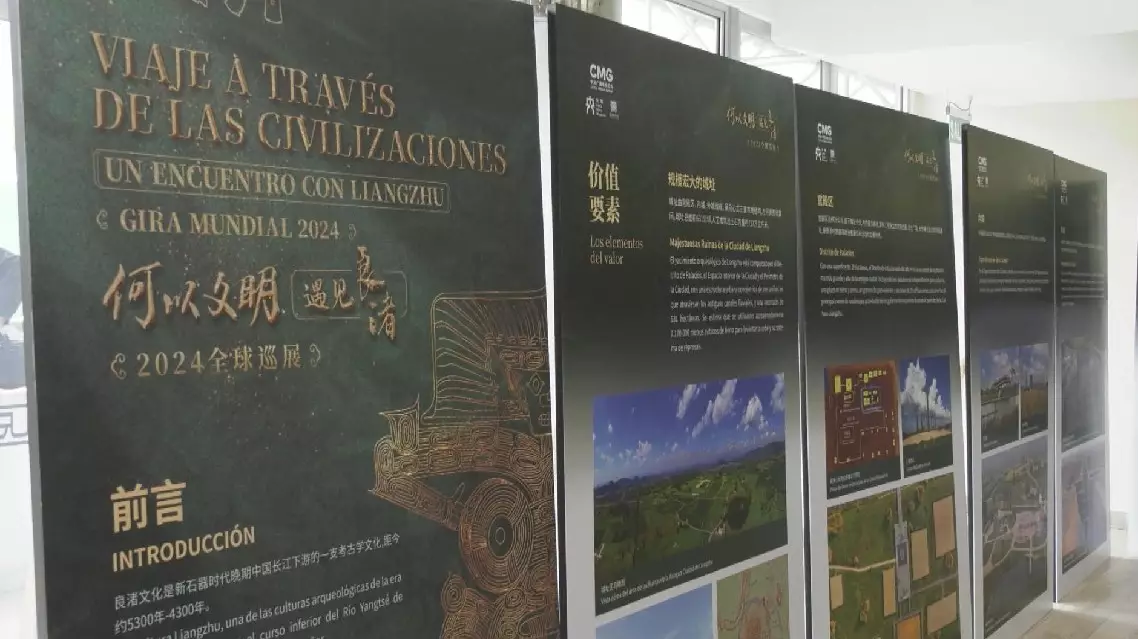
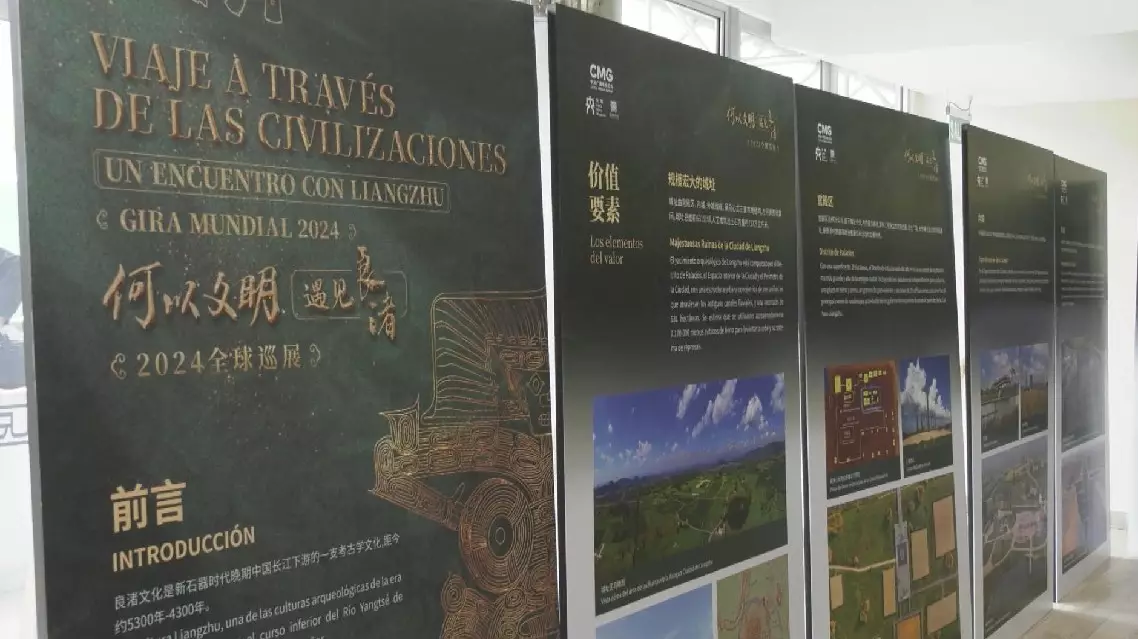
A special exhibition of China Media Group's (CMG) 'Journey Through Civilizations: An Encounter with Liangzhu' 2024 World Tour opened on Monday in Lima, the capital of Peru, offering visitors an immersive experience of ancient Chinese culture from around 5,000 years ago.

The exhibition, which has previously been held in Singapore, Ethiopia, Egypt, Japan and at the United Nations (UN) headquarters in New York City, marks its latest stop on its global tour.

Located in the Yangtze River Basin in east China's Zhejiang Province, the Liangzhu site (3300 BC–2300 BC) was first discovered in 1936 with pottery and stone artifacts, followed in the 1980s and 1990s by the uncovering of numerous tombs, altars, and large palace foundations.

The archaeological ruins reveal an early regional state with a unified belief system centered around rice cultivation in Late Neolithic China, and it has been listed as a UNESCO World Heritage Site since 2019.

The exhibition focuses on the exquisite jade artifacts of Liangzhu culture and introduces ancient city ruins, water conservancy systems, socially stratified cemeteries, and other unearthed cultural relics.

Over 150 teachers and students from the Confucius Institute at Ricardo Palma University attended the exhibition and watched a documentary about Liangzhu culture.

"After watching this documentary, I learned about the significant role Liangzhu culture plays in China's history and culture. I also discovered that its jade and pottery share many similarities with those of the Inca Empire in Peru," said Senahy Torres Rivas, a student of the university.

"I think there are many similarities between the ancient civilizations of China and Peru. For example, the artifacts discovered in Liangzhu are made of jade, while in Peru, many of our ancient artifacts are pottery. Pottery is a representative of Peru’s ancient civilization, while jade represents China’s ancient civilization," said Rosa Falla, another student of the university.

The exhibition also featured a hands-on interactive area, where teachers and students experienced a variety of cultural merchandise inspired by Liangzhu culture.

"If I have the chance to go to China, I would like to visit its museums, such as the Emperor Qinshihuang's Mausoleum Site Museum, which houses the Terracotta Warriors. It is known as the Eighth Wonder of the World. I think this might be the place I want to visit most," Torres Rivas said.

At the opening of the exhibition, Cecilla Tello, dean of the Confucius Institute at Ricardo Palma University, emphasized the value of cultural immersion for her students.

"The most important thing for our students is to be very close to the Chinese culture and this was a very nice opportunity for them to be really close, to experience in a very real way the magnificence of this culture. I think our students really enjoyed this opportunity, and they learned a lot. For our students that learn Chinese in a very professional way, because we teach Chinese for translators and interpreters, this was the most important experience that they had maybe during this year," she said.
Exhibition on China's ancient Liangzhu ruins opens in Peru
Exhibition on China's ancient Liangzhu ruins opens in Peru

Exhibition on China's ancient Liangzhu ruins opens in Peru

Exhibition on China's ancient Liangzhu ruins opens in Peru

From cutting-edge technology exhibitions to retail stores thousands of kilometers away from Europe and Southeast Asia, China-made robot vacuum cleaners are increasingly becoming a popular choice among consumers worldwide.

At electronics retailers in Berlin, Germany, Chinese brands such as Roborock and Dreame occupy prominent positions in dedicated robot vacuum sections, offering a wide range of products priced between 200 and 2,000 euros.

Many local consumers said that when purchasing smart home appliances including robot vacuum cleaners, they tend to give priority to Chinese-made products.

"It's a good price and good quality. It's also the innovation. I have a feeling that the European brands are not innovating enough," said one customer.

"I think they're always on top of the other technologies. They are getting them out faster. A lot of us are switching to the Chinese technology," another consumer said.

Germany is one of the most important overseas markets for China's floor-cleaning robots.

According to data from market research firm GfK, from January to November 2025, more than six out of 10 robot vacuum cleaners sold in Western Europe were Chinese brands.

Industry data also point to a strong global momentum.

According to the International Data Corporation (IDC), global shipments of smart robot vacuum cleaners reached 17.424 million units in the first three quarters of 2025, representing a year-on-year increase of 18.7 percent.

Chinese brands including Roborock, Ecovacs, Dreame, Xiaomi and Narwal ranked among the world's top five in terms of shipment volume, with a combined share of nearly 70 percent of the global market.

At a robot vacuum cleaner manufacturing plant in Huizhou, south China's Guangdong Province, workers were seen stepping up production of newly launched models that recently debuted at the Consumer Electronics Show in the United States, which concluded Friday in Las Vegas, Nevada.

The factory adjusted its production lines as early as December 2025 and stocked inventory in advance for overseas markets to ensure that new products could be delivered to global consumers at the earliest possible time.

"In 2025, Roborock's global shipments exceeded 7.2 million units. Since 2024, overseas revenue has accounted for more than 50 percent of our total revenue. Our products have now been sold to more than 170 countries and regions, serving more than 20 million households worldwide," said Quan Gang, president of Roborock.

At another robot vacuum cleaner manufacturing facility in Dongguan, Guangdong, rising overseas orders have prompted the company to upgrade its production lines with intelligent technologies to further boost capacity. The factory is currently operating at full load to meet a growing demand.

"For 2026, we have already obtained overseas orders worth at least 300 million to 400 million yuan (around 43 million to 57.3 million U.S. dollars). In addition, we've engaged in strategic cooperation with European home appliance group Cebos Group, and our total confirmed orders have exceeded 600 million yuan (around 86 million U.S. dollars)," said Zhang Junbin, founder and CEO of Narwal Robotics.

Chinese robot vacuum brands gain strong global traction

Chinese robot vacuum brands gain strong global traction

Recommended Articles