A once-dying forest of populus trees in Aral City, northwest China's Xinjiang Uygur Autonomous Region, is showing signs of life again after remarkable ecological conservation and restoration efforts by a team from Tarim University.
Located in the Jinyang Town, the forest of Populus Euphratica, or Huyang in Chinese, which spans more than 2,666 hectares, was discovered in a state of seemingly irreversible death in 2014 by Professor Li Zhijun and her research team from Tarim University.
Despite its vast size and the appearance of barren and skeletal trees, the team made an extraordinary discovery that changed the course of the forest's fate.
"The lower part of the roots [of some of the populus trees] is still alive, definitely alive. It's just that there is insufficient water, and without enough moisture for growth, the tree enters a dormant state, similar to how some animals hibernate in winter," said Li.
After conducting sampling of the trees, the team discovered that there were hundreds of trees in such a dormant state.
Despite no supply of water for decades, they have entered a dormant state by shedding their leaves and allowing their branches to dry out, waiting for water replenishment.
In 2014, Xinjiang implemented a special ecological conservation project aimed at restoring the Huyang forest in the Tarim River basin.
In 2016, thanks to Li's advocacy, the local government began using treated agricultural wastewater, previously deemed unsuitable for irrigation or human use, to irrigate the forest.
By 2018, the project had shown promising results, with the barren landscape slowly starting to show signs of recovery.
The survey of Li and her team on Nov. 5 this year revealed an exciting update: more than 300 trees have grown new branches.
Li said she is glad with the achievement as these trees play a crucial role in local development and people's wellbeing.
"Ninety one percent of China's Huyang trees are scattered in Xinjiang and 89 percent of them are located in the Tarim Basin, forming an oasis on the edge of the desert. The distribution of these Huyang forests almost forms a ring around the Tarim Basin, and this ring plays a vital role in the economic development and people's safety in southern Xinjiang," she said.
Looking ahead, Li and his team wish to expand this water-saving model across the region and collaborate with other cities and counties in the desert to bring life back to more drought-stricken forests, using treated agricultural wastewater as a sustainable solution.
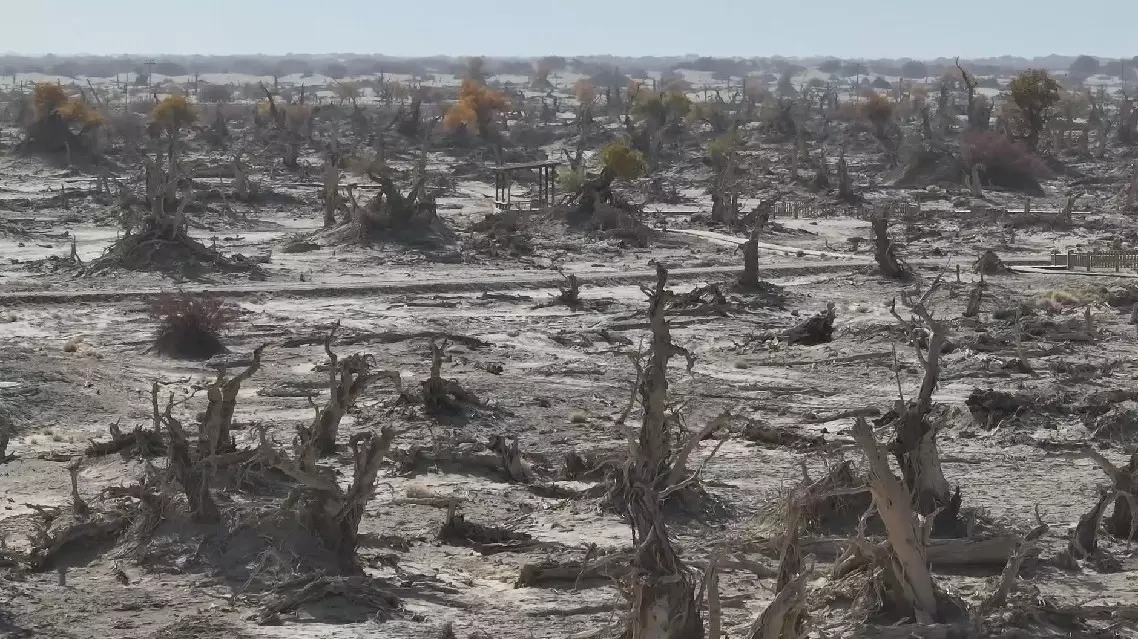
Dying desert populus forest in China's Xinjiang brought back to life with ecological restoration efforts
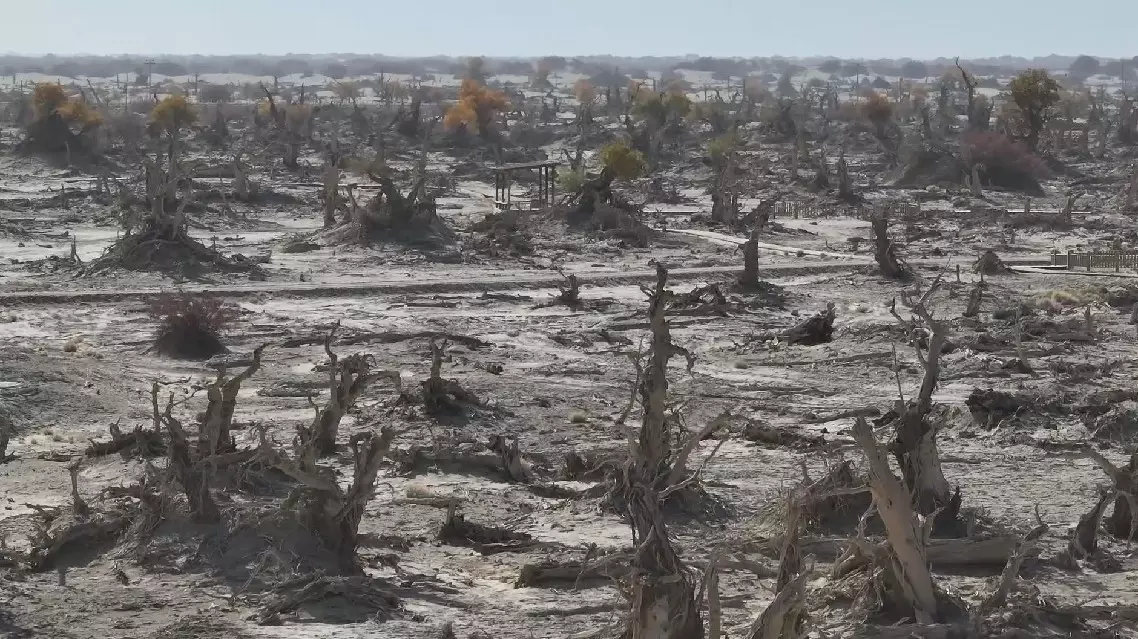
Dying desert populus forest in China's Xinjiang brought back to life with ecological restoration efforts