China, with numerous successes in combating desertification and dune fixation, has been sharing its experience with countries participating in the Belt and Road Initiative (BRI).
As a party to the United Nations Convention to Combat Desertification (UNCCD), China has in 2019 achieved the UN goal of zero growth of land degradation by 2030 ahead of schedule.
The country has set up the China-Arab and the China-Mongolia desertification control centers and established overseas demonstration bases and cooperation centers for sand control to provide technical support for related countries.
China has also engaged in multilateral policy-making dialogues, information sharing and collaboration with South Korea, Mongolia, and Russia to jointly push forward desertification prevention, land degradation control, and drought response in northeast Asia, and forged the Kubuqi International Desert Forum into a platform with international influence.
"China's experience in combating desertification is very suitable for countries participating in the Belt and Road cooperation, especially those in Africa and Central Asia. For instance, the straw checkerboard technique, a dune fixation technique in which straw is placed on the desert surface in the shape of a checkerboard, is called 'the magical China square'. Such a technique is easy to apply, good in effect, and quick in results. The chosen plants with high stress resistance, coupled with water-saving irrigation technologies, have all been greatly promoted in many countries in Central Asia and Africa," said Wu Bo, director of the Institute of Desertification Studies of the Chinese Academy of Forestry.
In Ethiopia, researchers from Xinjiang Institute of Ecology and Geography of the Chinese Academy of Sciences created a 200-hectare base for rotational grazing and bushland conservation to help in sustainable land use and combating desertification.
In Mauritania, Chinese researchers created a "green park" that covers about 2.67 hectares to address local needs for desertification prevention and sustainable livelihood development.
The park includes carefully-selected windbreak and sand-fixation materials, as well as over ten types of suitable plants and products adapted to local environmental conditions. The project can benefit the local community through the cultivation of fruit trees and vegetables, and promotes the integration of the Chinese way to prevent desertification and the technology of "Green Great Wall" .
"We hope our feasible experience and methods, such as the Shapotou anti-desertification technique to protect railways, the Dengkou dune fixation way, and the Kekeya way, can be promoted in other countries through exchanges," said Wu.
The UNCCD was adopted in 1994 to assist countries and regions affected by severe drought or desertification, with a total of 197 parties. In 2015, the United Nations incorporated desertification control into the 2030 Agenda for Sustainable Development, proposing to achieve the goal of zero growth of land degradation by 2030, forming a global consensus on combating desertification.
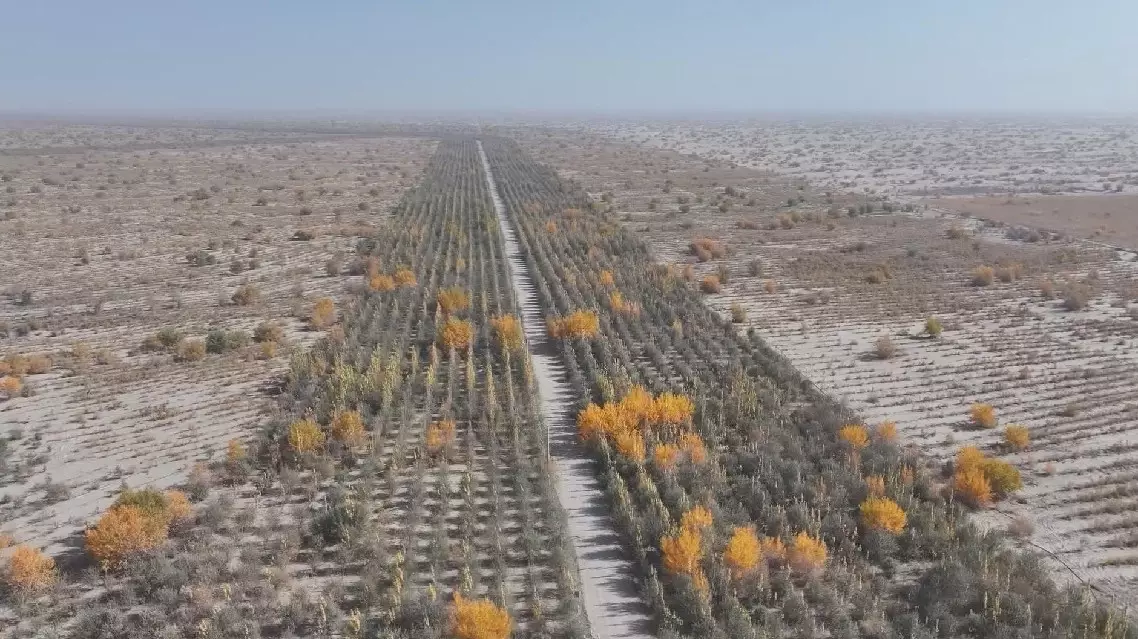
China' experience in desert control helps green BRI participating countries