Skip to Content Facebook Feature Image

China's neutrino project nears completion, unlocking secrets of universe's "ghost particles"

China

China

China

China's neutrino project nears completion, unlocking secrets of universe's "ghost particles"

2024-11-19 22:03 Last Updated At:22:47

The primary detector for the Jiangmen Underground Neutrino Observatory (JUNO) is set to be completed on Wednesday, marking a major step in the quest to comprehend these "ghost particles" and enhance our understanding of the universe.

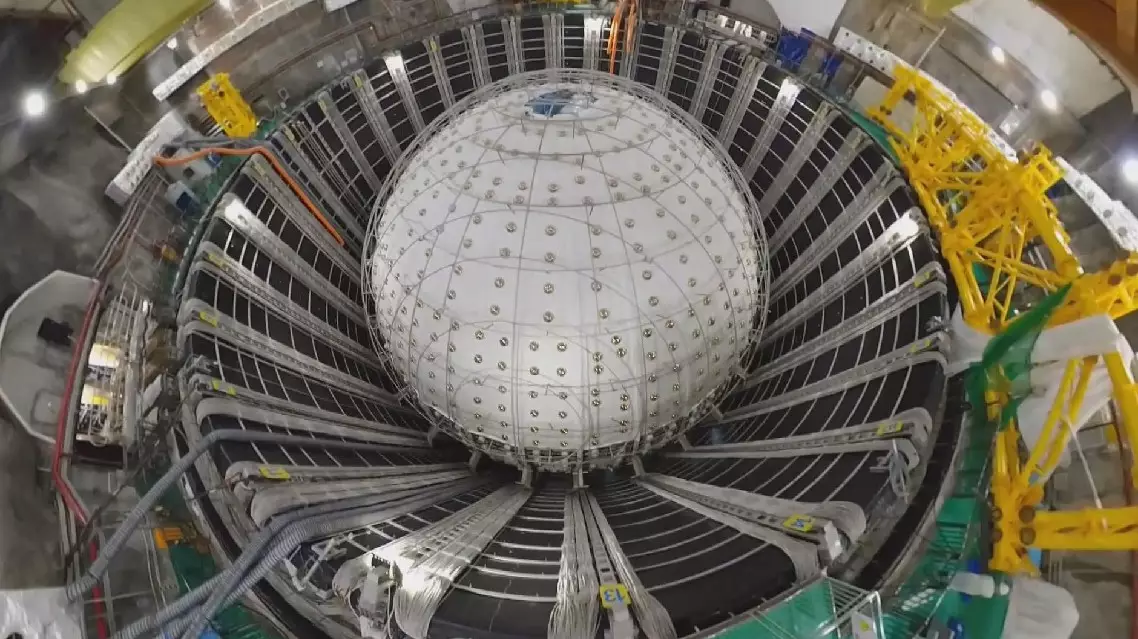
Located 700 meters underground in south China's Jiangmen City, the world's largest transparent detector is a 12-story-tall acrylic sphere with a diameter of 35.4 meters.

The gigantic sphere, weighing approximately 600 tons, composed of 265 pieces of 12-centimeter-thick acrylic panels, has been meticulously assembled from top to bottom by the construction team. Tests have demonstrated that the acrylic used in the construction of the detector exhibits exceptional tensile strength and impact resistance, ensuring its durability and effectiveness in the challenging underground environment.

The construction of the challenging project was launched by the Chinese Academy of Sciences (CAS) and the Guangdong government in 2015. Installation of the entire device is expected to be completed on Wednesday, and the full operation of the facility is scheduled for August 2025.

Neutrinos are critical components of the material universe, playing essential roles since the beginning of time. They are integral to the processes that power the sun and influence the formation of galaxies, planets, and life itself. Despite their discovery in 1956, many mysteries surrounding neutrinos remain unsolved due to their elusive nature.

Historically, atoms were once considered the smallest building blocks of matter. However, ongoing research has revealed that the universe is made up of six types of quarks and six types of leptons, among which neutrinos exist in three forms: electron neutrinos, muon neutrinos, and tau neutrinos. They are capable of transforming into one another, a phenomenon known as neutrino oscillation.

"Neutrinos are incredibly abundant in the universe, having originated at its inception. The term 'ghost particle' highlights their extreme difficulty of detection, as they interact with matter so rarely that blocking them is nearly impossible. Their ability to penetrate matter is extraordinarily high, making them exceedingly challenging to study," said Heng Yuekun, a researcher at the Institute of High Energy Physics (IHEP) of the CAS.

The new neutrino detector's underground location allows it to effectively shield itself from cosmic rays and other external interferences, ensuring that neutrinos can be captured and studied without obstruction.

"We aim to determine the absolute mass of neutrinos while exploring their oscillations to understand the relative mass differences between them. Through this mass research, we can construct a theoretical framework for our understanding of the material world, which can also be linked to the evolution of the universe. This will help us comprehend both the universe and the material world," said Wang Yifang, chief scientist of the project.

Once completed, JUNO is expected to capture approximately 40 reactor neutrinos, several atmospheric neutrinos, one geoneutrino and thousands of solar neutrinos every day.

JUNO is the second China-based neutrino project, following the Daya Bay Reactor Neutrino Experiment in Guangdong. Chinese and foreign physicists announced in 2012 that they had measured a third type of neutrino oscillation in the Daya Bay experiment. The scale of JUNO is much larger than the Daya Bay experiment with more sensitive detection.

Over 700 scientists from 74 institutions in 17 countries and regions including France, Italy, Russia, Germany and Belgium have joined the JUNO international collaboration.

Experts emphasize that neutrino research falls within the realm of fundamental science and represents one of the most advanced scientific fields globally. While the implications of this research may not yield immediate changes in daily life over the next decade or two, its long-term potential is significant.

Similar to how James Clerk Maxwell's theories in the 1860s predicted the existence of electromagnetic waves, laying the groundwork for the electrical age, current neutrino research could eventually reshape our understanding of the cosmos.
China's neutrino project nears completion, unlocking secrets of universe's "ghost particles"

China's neutrino project nears completion, unlocking secrets of universe's "ghost particles"

A video featuring a former member of Unit 731, a notorious Japanese germ-warfare unit during World War II (WWII), was released on Thursday in northeast China's Harbin, revealing details of how the unit used meteorological data to conduct horrific bacterial experiments on human beings.

The video was released by the Exhibition Hall of Evidence of Crimes Committed by Unit 731 of the Japanese Imperial Army, in which former Unit 731 member Tsuruo Nishijima detailed how the unit used meteorological data to carry out a bacterial dispersal experiment.

The video was recorded in 1997 by Japanese scholar Fuyuko Nishisato and donated to the exhibition hall in 2019, according to the hall, which was built on the former site of the headquarters of Unit 731 in Harbin, the capital city of Heilongjiang Province.

Jin Shicheng, director of the Department of Publicity, Education and Exhibition of the exhibition hall, said that Nishijima joined Unit 731 in October 1938 and served in the unit's meteorological squad. The squad was not a simple observation section but rather an auxiliary force supporting the unit's field human experiments by measuring wind direction, wind speed, and other conditions to ensure optimal experimental results, according to Jin.

Nishijima confirmed in the footage that "the meteorological squad had to be present at every field experiment." He testified to the "rainfall experiments" conducted by Unit 731, which involved aircraft releasing bacterial agents at extremely low altitudes.

At a field-testing site in Anda City, Heilongjiang, Unit 731 aircraft descended to about 50 meters above the ground. They sprayed bacterial culture liquids onto "maruta" -- human test subjects -- who were tied to wooden stakes. Each experiment involved about 30 people, spaced roughly 5 meters apart. After the experiments, the victims were loaded into sealed trucks and transported back to the unit, where their symptoms and disease progression were recorded over a period of several days.

"Unit 731's bacterial weapons were dropped by aircraft from a height of 50 meters in the open air. Therefore, the meteorological squad needed to observe wind direction and speed, which directly affected the precision and accuracy of the bacterial weapons deployment," said Jin.

Nishijima recounted the harrowing experience of the human test subjects.

"They were fully aware that inhaling the substances would certainly lead to death, so they closed their eyes and held their breath to avoid breathing them in. Their resistance prevented the experiment from proceeding. To compel them to comply, they were forced at gunpoint to open their mouths and lift their heads," said Nishijima.

These experiments, disguised as "scientific research," were in fact systematic tests of biological warfare weapons conducted by the Japanese military. The data generated from these inhumane activities became "research findings" shared among the Japanese army medical school, the medical community, and the military at large.

"At that time, the entire Japanese medical community tacitly approved, encouraged, and even participated in the criminal acts of Unit 731. The unit comprised members from Japan's medical and academic sectors who served the Japanese war of aggression against China. Thus, Unit 731 was not just a military unit but represented an organized and systematic criminal enterprise operating from the top down," said Jin.

Unit 731 was a top-secret biological and chemical warfare research base established in Harbin as the nerve center for Japanese biological warfare in China and Southeast Asia during WWII.

At least 3,000 people were used for human experiments by Unit 731, and Japan's biological weapons killed more than 300,000 people in China.

Video offers details of Japan's germ-warfare crimes in northeast China

Video offers details of Japan's germ-warfare crimes in northeast China

Recommended Articles