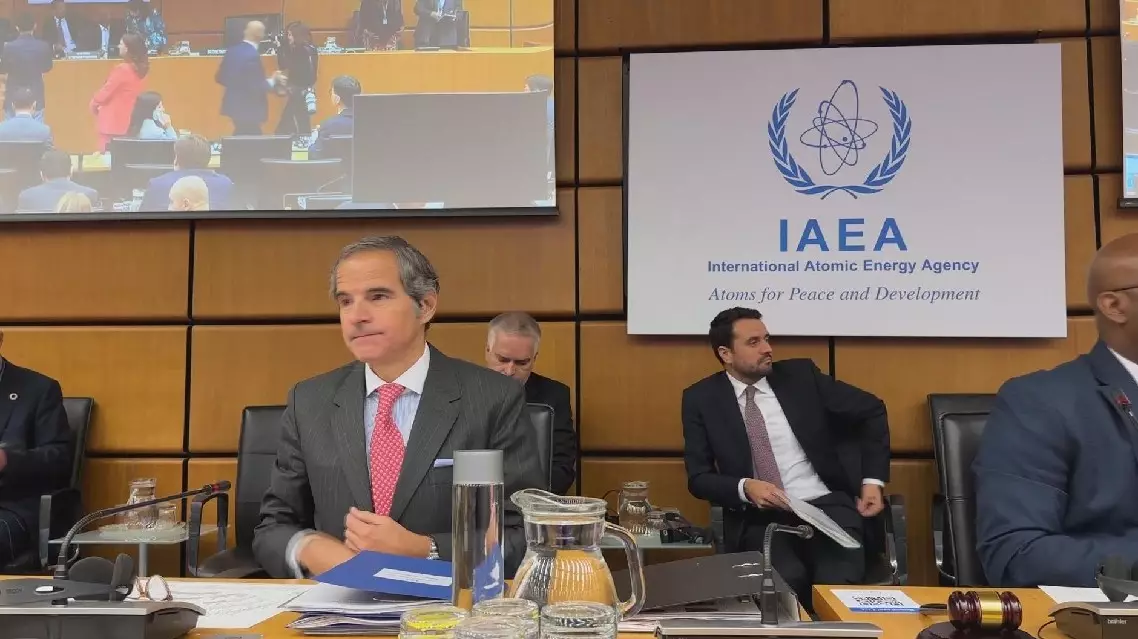
Director General of the International Atomic Energy Agency (IAEA) Rafael Grossi on Wednesday welcomed Iran's move towards capping its stockpile of highly enriched uranium.
Grossi briefed a quarterly meeting of the IAEA Board of Governors earlier in the day about his visit to Iran last week.
Grossi said although Iran's stockpile of uranium enriched up to 60 percent U-235 had grown since his last report on the country's nuclear program, Iran has agreed to not further expand its stockpile, and begun implementing the preparatory measures to cap the highly enriched uranium.
He also expressed concern about the potential targeting of Iran's nuclear facilities by Israel.
Regarding the Ukrainian crisis, Grossi said that the ongoing conflict continues to pose a threat to the safety of nuclear facilities. Currently, all six reactor units at the Zaporizhzhia Nuclear Power Plant are in a cold shutdown.
Since the outbreak of the conflict, the IAEA has deployed 155 working groups and provided nuclear safety and security equipment worth 12 million euros, he added.
On the issue of Japan's discharge of nuclear-contaminated water from the Fukushima Daiichi Nuclear Power Station, Grossi said that the IAEA will continue to conduct monitoring with the participation of the international community.
IAEA chief welcomes Iran's plan to cap enriched uranium stockpile
IAEA chief welcomes Iran's plan to cap enriched uranium stockpile
IAEA chief welcomes Iran's plan to cap enriched uranium stockpile
From cutting-edge technology exhibitions to retail stores thousands of kilometers away from Europe and Southeast Asia, China-made robot vacuum cleaners are increasingly becoming a popular choice among consumers worldwide.
At electronics retailers in Berlin, Germany, Chinese brands such as Roborock and Dreame occupy prominent positions in dedicated robot vacuum sections, offering a wide range of products priced between 200 and 2,000 euros.
Many local consumers said that when purchasing smart home appliances including robot vacuum cleaners, they tend to give priority to Chinese-made products.
"It's a good price and good quality. It's also the innovation. I have a feeling that the European brands are not innovating enough," said one customer.
"I think they're always on top of the other technologies. They are getting them out faster. A lot of us are switching to the Chinese technology," another consumer said.
Germany is one of the most important overseas markets for China's floor-cleaning robots.
According to data from market research firm GfK, from January to November 2025, more than six out of 10 robot vacuum cleaners sold in Western Europe were Chinese brands.
Industry data also point to a strong global momentum.
According to the International Data Corporation (IDC), global shipments of smart robot vacuum cleaners reached 17.424 million units in the first three quarters of 2025, representing a year-on-year increase of 18.7 percent.
Chinese brands including Roborock, Ecovacs, Dreame, Xiaomi and Narwal ranked among the world's top five in terms of shipment volume, with a combined share of nearly 70 percent of the global market.
At a robot vacuum cleaner manufacturing plant in Huizhou, south China's Guangdong Province, workers were seen stepping up production of newly launched models that recently debuted at the Consumer Electronics Show in the United States, which concluded Friday in Las Vegas, Nevada.
The factory adjusted its production lines as early as December 2025 and stocked inventory in advance for overseas markets to ensure that new products could be delivered to global consumers at the earliest possible time.
"In 2025, Roborock's global shipments exceeded 7.2 million units. Since 2024, overseas revenue has accounted for more than 50 percent of our total revenue. Our products have now been sold to more than 170 countries and regions, serving more than 20 million households worldwide," said Quan Gang, president of Roborock.
At another robot vacuum cleaner manufacturing facility in Dongguan, Guangdong, rising overseas orders have prompted the company to upgrade its production lines with intelligent technologies to further boost capacity. The factory is currently operating at full load to meet a growing demand.
"For 2026, we have already obtained overseas orders worth at least 300 million to 400 million yuan (around 43 million to 57.3 million U.S. dollars). In addition, we've engaged in strategic cooperation with European home appliance group Cebos Group, and our total confirmed orders have exceeded 600 million yuan (around 86 million U.S. dollars)," said Zhang Junbin, founder and CEO of Narwal Robotics.
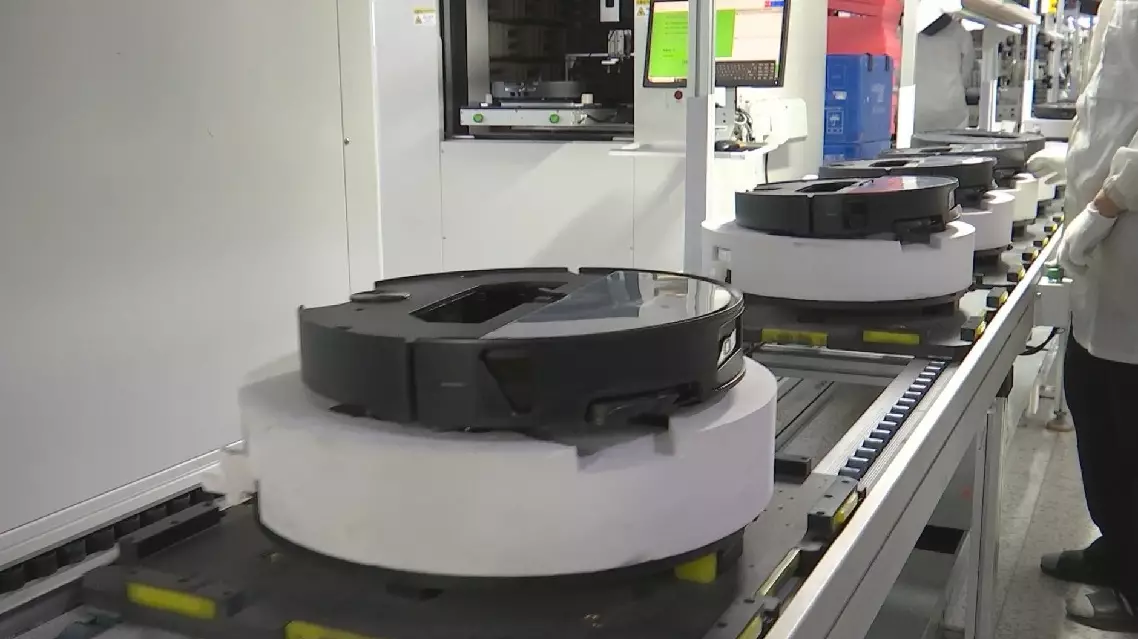
Chinese robot vacuum brands gain strong global traction