The Aksai Huidong New Energy solar farm, China's largest solar power tower project, was connected to the power grid at full capacity on Saturday.
Located in Aksai Kazakh Autonomous County in northwest China's Gansu Province, this cutting-edge project sets itself apart by employing Chinese-initiated pentagonal heliostats, each weighing up to 1.2 tons and covering 48 square meters, to receive focused sunlight through the tower.
Altogether, the project boasts a substantial 750 MW installed gross capacity, including 110 MW of solar thermal power and 640 MW of photovoltaic power, with the latter connected to the grid in mid-August.
To reduce power plant costs and address issues such as fluctuations and intermittent blackouts, the project introduced a solution called intelligent coupling -- the integration of various smart technologies to enhance efficiency and monitoring.
"During the day, while the photovoltaic panels continue to generate electricity, the heliostats installed at the solar thermal area collects sunlight and send it to the surface of the heat absorber on the top of the tower to heat the fused slat for storage of the thermal energy. The energy will be released at night to generate steam, which can drive the generator sets to generate electricity. The mode makes it possible to generate electricity for eight hours stably at night, coping with the fluctuations and intermittency of a single photovoltaic power plant and significantly improving the economy of the power station," said Fang Jun, manager of the project.
The solar farm is expected to generate 1.7 billion kWh of power annually.

China's largest solar power tower project linked to power grid
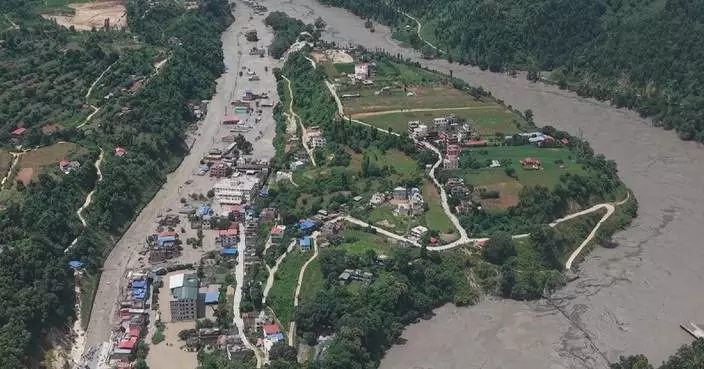
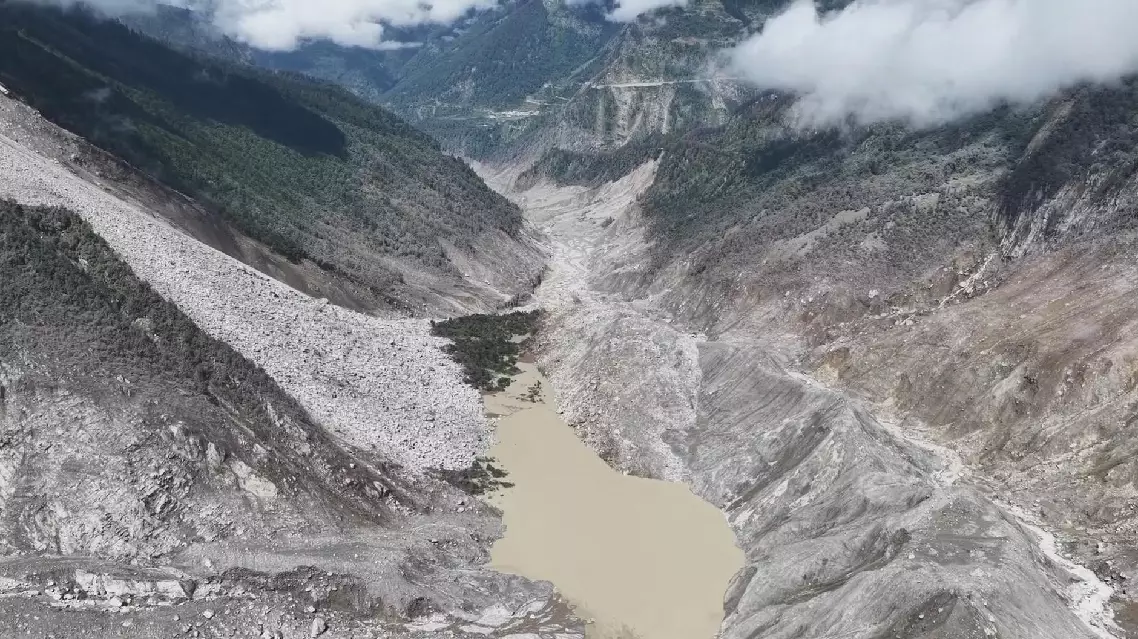
The threat of the barrier lake formed after Wednesday's catastrophic mudslide at the Gyirong Port, a major China-Nepal land border crossing in southwest China's Xizang Autonomous Region, continues to subside, with the lake's size steadily shrinking, according to an on-site monitoring team.
In the wake of the disaster, which has claimed at least seven lives and left more than 550 others missing in Gyirong, China Anneng -- a state-owned engineering and rescue enterprise -- has deployed teams to the disaster zone to support the search and rescue operations.
One of the teams tasked with monitoring the barrier lake, which sits over 10 kilometers upstream from the port, said real-time surveillance footage showed the lake was continuing to drain out.
"Our task today is to find a stable monitoring point on the opposite bank and install our detection equipment there to monitor the displacement of the landslide body and guard against the risks of a secondary collapse," said Chen Hanxiao, a member of the monitoring team from the Lhasa base of China Anneng.
The 15-member monitoring team have brought with it drones, satellite stations, and communication gear.
"A comparison of today's imagery with yesterday's shows that the water level here has dropped by about one-third. The receding water poses no further threat to the dam's structural integrity, buying valuable time for the rescue crews to carry out critical hazard mitigation work," said Hu Bo, head of the monitoring team.
However, Hu cautioned that despite the encouraging signs, the situation remains unpredictable given the region's complex glacial environment and changeable weather conditions. He stressed that real-time surveillance and data analysis are vital to assessing the barrier lake's stability and supporting follow-up operations.
The mudslide was triggered by a high-altitude glacier collapse on the Nepalese side, where the disaster had killed more than 620 people and left over 2,400 others missing, as of Saturday morning, according to the country's national disaster risk reduction and management authority.
Threat of barrier lake waning after massive mudslide near China-Nepal border