Skip to Content Facebook Feature Image

Diversion project helps improve water quality, people's livelihood in Baiyangdian

China

China

China

Diversion project helps improve water quality, people's livelihood in Baiyangdian

2024-12-12 17:56 Last Updated At:18:07

China's South-to-North Water Diversion Project has helped replenish Baiyangdian, the largest freshwater wetland in northern China, improving its water quality and benefiting local residents.

Baiyangdian, located in Xiong'an New Area in Hebei Province, is along the middle route of the diversion project. In total the project features three routes -- east, middle and west. The middle route, which is the most prominent one, begins at the Danjiangkou Reservoir in central China's Hubei Province and runs through Henan and Hebei before reaching Beijing and Tianjin.

The first phase of the middle route project has transferred over 21.7 billion cubic meters of water to Hebei since it began supplying water in 2014.

In the 1970s and 1980s, Baiyangdian's ecological environment plunged to its worst with the water quality constantly deteriorating. Over the past decade, the diversion project, along with local environmental sustainability efforts, has bolstered the area's rehabilitation and conservation activities, and the water quality in Baiyangdian has improved from Level V -- the lowest in China's five-tier water assessment system -- to Level III.

"Now the dissolved oxygen in the water in our lake area is 11.63 mg/L, suggesting that the dissolved oxygen content here is relatively high. It indirectly proves that our water quality is relatively clean," said Zhu Tianzhe, a water quality analyst of Xiongan New Area Ecological Environment Monitoring Center.

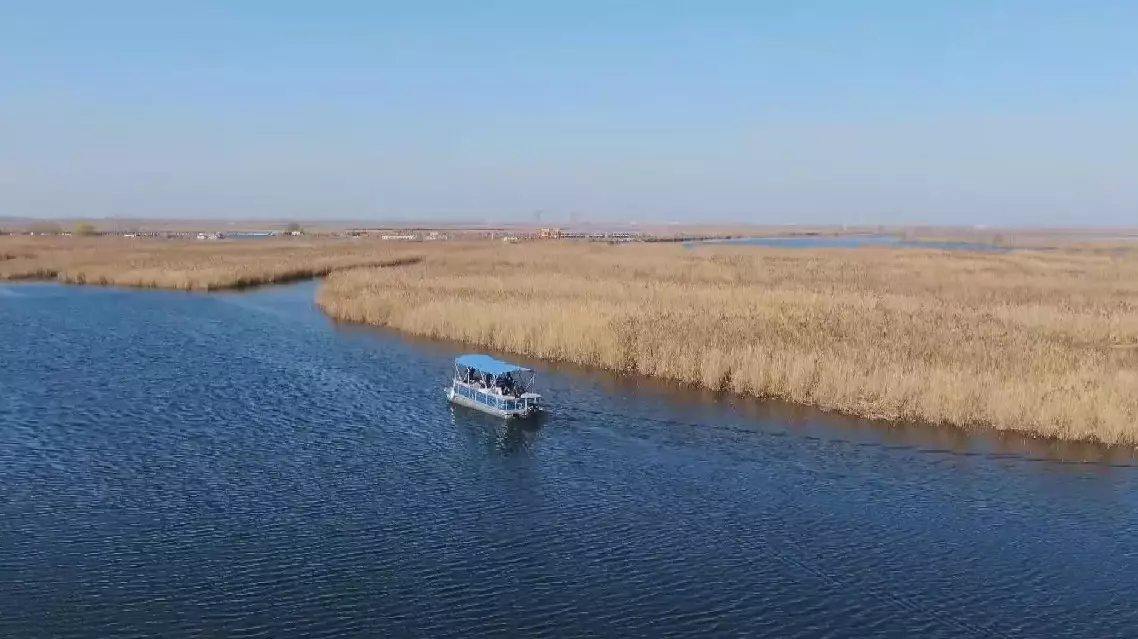
Increasing numbers of wild creatures are returning to Baiyangdian as the water quality improves, and the lake has steadily evolved into a haven for lotuses, reeds and abundant fish species.

Over the past 10 years, the middle route of the South-to-North Water Diversion Project has continuously replenished the rivers and lakes and also benefited the people along the route.

Now Baiyangdian, with its constantly improved ecological environment, is receiving increasingly more tourists on weekends and holidays, and many local villagers have joined the efforts to develop rural tourism. Wang Jun, Party chief of Wangjiazhai Village, the only village in Xiong'an that is surrounded by water and not accessible by road, said, "In recent years, the cultural and tourism industry in our village has developed rapidly. There are more than 100 homestay inns which create 600 to 700 jobs every year. Now we have courtyards like these, which are small courtyards built in the style of water towns in regions south of Yangtze River. Our village receives many tourists every year and can earn up to 1 million yuan a month in a normal year."
Diversion project helps improve water quality, people's livelihood in Baiyangdian


Diversion project helps improve water quality, people's livelihood in Baiyangdian
Iran on Monday publicly rejected a core U.S. demand to cease all uranium enrichment, while projecting a dual-track strategy of guarded diplomatic engagement and reinforced military preparedness.

The moves came as the indirect Iran-US talks in Oman's Muscat last week yielded no breakthrough and regional tensions continued to simmer.

On Monday, Mohammad Eslami, president of the Atomic Energy Organization of Iran, said that while Iran could consider diluting its 60-percent enriched uranium, it would only do so if all international sanctions were first lifted.

Eslami also dismissed past proposals to ship the material abroad for safekeeping.

Iranian President Masoud Pezeshkian and Foreign Minister Seyed Abbas Araghchi echoed this line on Monday, reaffirming Tehran's strategy of engaging in talks while refusing to concede on what Iran views as sovereign rights.

Pezeshkian and Araghchi have described the Muscat talks as a "good start" but warned that diplomacy must be based on "respect, not coercion."

In a televised speech on Monday, Iran's Supreme Leader Ali Khamenei urged Iranians to show unity and "disappoint the enemy" ahead of the 47th anniversary of the 1979 Islamic Revolution, amid rising tensions with the United States.

Meanwhile, Ali Larijani, secretary of Iran's Supreme National Security Council, is set to lead a delegation to visit mediator Oman on Tuesday.

Simultaneously, Iran has signaled a shift toward greater military opacity. Iran's state news agency IRNA said in a report on Sunday that the Defense Ministry has halted all public displays of new weaponry "for security reasons and to safeguard the principle of surprise," a move widely interpreted as preparing for potential conflict.

Positions from the United States and Israel have appeared equally firm. A report on Sunday by Israel's Channel 15 said the United States had privately messaged Iran, seeking Iran's "concessions" in the next round of talks, and expecting "serious and meaningful content."

On Monday, The Jerusalem Post, citing Israeli defense officials, reported that Israel has warned the U.S. it "will strike alone" if Iran crosses its "red lines" on ballistic missiles.

Israeli Prime Minister Benjamin Netanyahu's office said on Sunday that he will meet with U.S. President Donald Trump on Feb 11 in Washington, and will discuss the U.S.-Iran negotiations.

Netanyahu is expected to demand that the U.S. promote the transfer of Iran's enriched uranium out of the country and restrict Iran's ballistic missile capabilities.

Iran rejects zero enrichment, projects dual-track posture amid stalled talks with U.S.

Iran rejects zero enrichment, projects dual-track posture amid stalled talks with U.S.

Recommended Articles