Skip to Content Facebook Feature Image

China's Three Gorges Dam boosts emergency response with digital integration

China

China

China

China's Three Gorges Dam boosts emergency response with digital integration

2024-12-15 18:28 Last Updated At:19:27

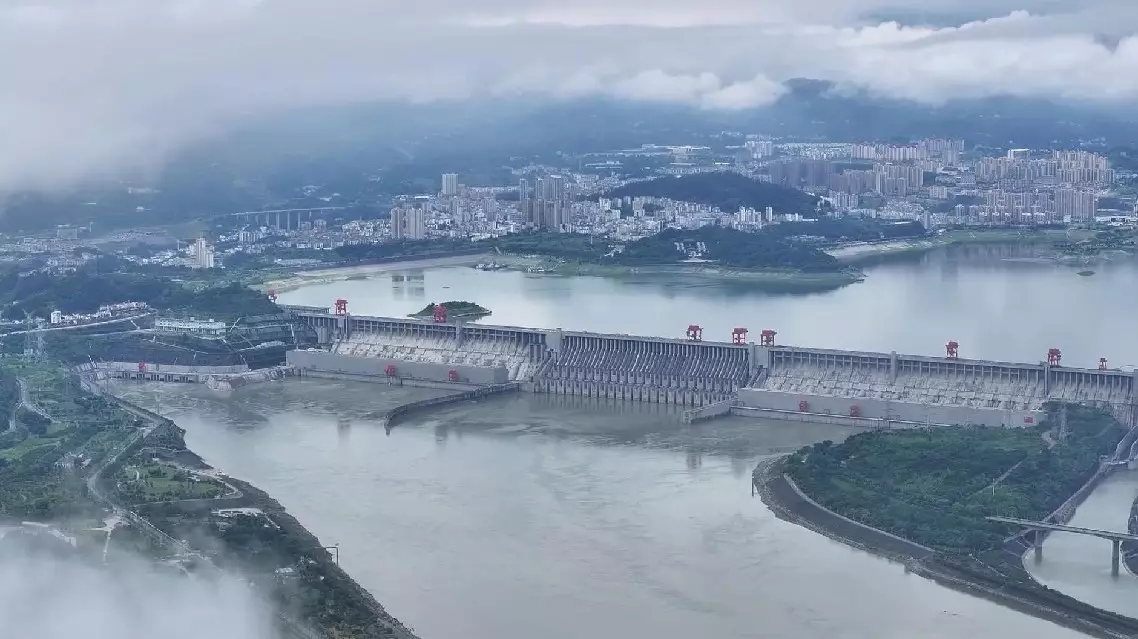
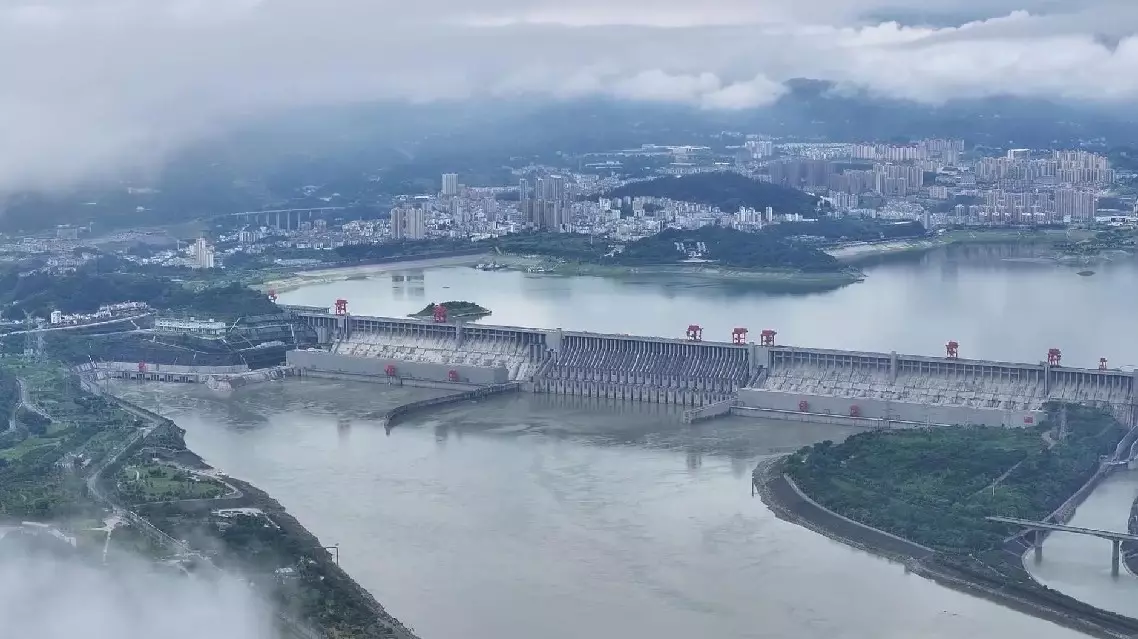
China's Three Gorges Dam, the world's largest water control and hydroelectric project, is integrating digital technologies with its flood control system to ensure swift and effective emergency responses, safeguarding downstream communities during extreme weather events. Hailed as a symbol of China's hydraulic engineering prowess, the Three Gorges Dam in central China's Hubei began to take shape in 1994 and was put into operation to generate power in 2003.

Beyond generating electricity, the Three Gorges Dam has also played a critical role in flood control. The massive concrete structure was built at the junction of the upper and middle reaches of the Yangtze River, the third longest river in the world, to safeguard flood-prone regions.

"Since the Three Gorges Reservoir began storing water in 2003 and up until September 2024, it has intercepted floods nearly 70 times, diverting over 220 billion cubic meters of water and effectively protecting downstream areas," said Gong Wenting, an engineer from the China Three Gorges Corporation.

Moreover, the need for rapid and effective responses has grown increasingly urgent as extreme weather events becoming more frequent in recent years.

To better predict water conditions, the Three Gorges Corporation has developed one of the largest telemetry system in China to gather real-time data.

"Our system collects and analyzes data from over 1,600 hydrological stations and more than 20,000 meteorological sites, covering nearly 80 percent of the Yangtze's upper basin. Within just 10 minutes, we can gather critical information from key stations and reservoirs, providing essential support for forecasting and decision-making," said Shu Weimin, an employee from China Yangtze Power, a joint stock limited company established by the China Three Gorges Corporation.

In 2020, an advanced rainfall estimation and forecasting system for the Yangtze River Basin was developed by the company. It features a spatial resolution of up to five kilometers and a temporal resolution of three hours, with forecasts extending up to 10 days, according to Shu.

To enhance flood forecasting and control operations, the Three Gorges project also plans to integrate cutting-edge technologies like "digital twin" simulations based on constantly changing data collected from the real environment through sensors.
China's Three Gorges Dam boosts emergency response with digital integration
China's Three Gorges Dam boosts emergency response with digital integration


China's Three Gorges Dam boosts emergency response with digital integration

China's Three Gorges Dam boosts emergency response with digital integration
Iran on Monday publicly rejected a core U.S. demand to cease all uranium enrichment, while projecting a dual-track strategy of guarded diplomatic engagement and reinforced military preparedness.

The moves came as the indirect Iran-US talks in Oman's Muscat last week yielded no breakthrough and regional tensions continued to simmer.

On Monday, Mohammad Eslami, president of the Atomic Energy Organization of Iran, said that while Iran could consider diluting its 60-percent enriched uranium, it would only do so if all international sanctions were first lifted.

Eslami also dismissed past proposals to ship the material abroad for safekeeping.

Iranian President Masoud Pezeshkian and Foreign Minister Seyed Abbas Araghchi echoed this line on Monday, reaffirming Tehran's strategy of engaging in talks while refusing to concede on what Iran views as sovereign rights.

Pezeshkian and Araghchi have described the Muscat talks as a "good start" but warned that diplomacy must be based on "respect, not coercion."

In a televised speech on Monday, Iran's Supreme Leader Ali Khamenei urged Iranians to show unity and "disappoint the enemy" ahead of the 47th anniversary of the 1979 Islamic Revolution, amid rising tensions with the United States.

Meanwhile, Ali Larijani, secretary of Iran's Supreme National Security Council, is set to lead a delegation to visit mediator Oman on Tuesday.

Simultaneously, Iran has signaled a shift toward greater military opacity. Iran's state news agency IRNA said in a report on Sunday that the Defense Ministry has halted all public displays of new weaponry "for security reasons and to safeguard the principle of surprise," a move widely interpreted as preparing for potential conflict.

Positions from the United States and Israel have appeared equally firm. A report on Sunday by Israel's Channel 15 said the United States had privately messaged Iran, seeking Iran's "concessions" in the next round of talks, and expecting "serious and meaningful content."

On Monday, The Jerusalem Post, citing Israeli defense officials, reported that Israel has warned the U.S. it "will strike alone" if Iran crosses its "red lines" on ballistic missiles.

Israeli Prime Minister Benjamin Netanyahu's office said on Sunday that he will meet with U.S. President Donald Trump on Feb 11 in Washington, and will discuss the U.S.-Iran negotiations.

Netanyahu is expected to demand that the U.S. promote the transfer of Iran's enriched uranium out of the country and restrict Iran's ballistic missile capabilities.

Iran rejects zero enrichment, projects dual-track posture amid stalled talks with U.S.

Iran rejects zero enrichment, projects dual-track posture amid stalled talks with U.S.

Recommended Articles