The United Nations Refugee Agency (UNHCR) on Tuesday called on the international community to provide humanitarian assistance and support the reconstruction efforts in Syria following the ousting of former president Bashar al-Assad.
In a press conference held in Geneva, Switzerland, Rema Jamous Imseis, the UNHCR director for the Middle East and North Africa, stated that while many Syrian refugees are returning to their homes following the recent development, a significant number continue to flee the country.
The UN estimates that around one million refugees will return to Syria in the first half of 2025. However, Imseis said the ongoing unrest in the country has led to the displacement of over a million people in the past three weeks alone, the majority of whom are women and children.
"We've seen so far returns from Türkiye, from Lebanon, and smaller numbers from Jordan. But we've also seen outflows as well. And it's important to recall that these people are actually returning to a country that has been devastated by 14 years of civil war. We have over seven million internally displaced Syrians in the country, and over 90 percent of the population is living below the poverty line and reliant on some form of humanitarian assistance to survive," she said.
Imseis also emphasized that the recent changes in Syria do not signify the end of the ongoing humanitarian crisis. She urged countries hosting Syrian refugees not to hastily repatriate them and reaffirmed that Syrian refugees should continue to retain the right to seek asylum.
UN agencies have now resumed aid and support projects in Syria, the official added.
An alliance led by the Hayat Tahrir al-Sham (HTS) militant group launched a major military operation starting in northern Syria on Nov. 27, sweeping southward through government-held areas and capturing the capital Damascus within 12 days.
Following the offensive, the Al-Assad government collapsed, while the ousted former president later arrived in Russia for asylum.

UNHCR calls on int’l community to support Syria’s reconstruction
China is witnessing the deep integration of film-related technologies into various sectors, creating diverse application scenarios and innovative experiences, and this cross-industry fusion is effectively stimulating economic growth by driving investment, boosting consumption, and expanding exports.
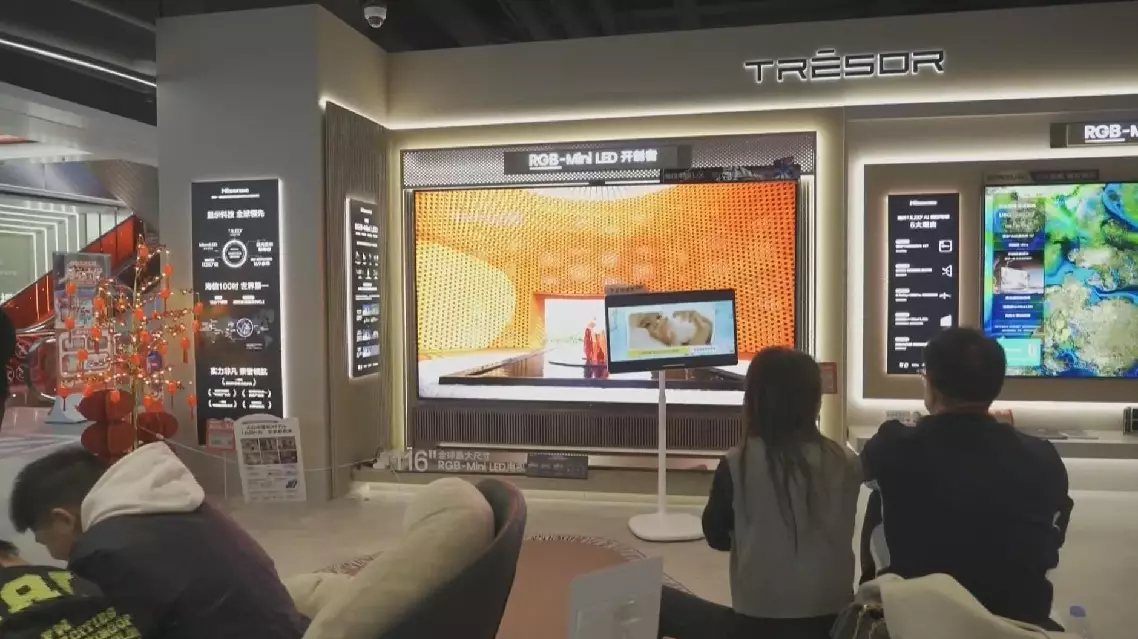
The continuous improvement in cinematic picture quality and audio effects is steadily propelling the evolution and upgrading of consumer electronics products. In major shopping malls across China, an increasing number of consumer electronics devices supporting high-end film playback features are made available to the public, including 120fps (frames per second) high-frame-rate equipment and 4K HDR (high dynamic range) players.
By incorporating HDR imaging technology, these products deliver brighter highlights, richer shadow detail, and faithfully reproduce the true colors and lighting nuances captured during filming.
"Contemporary laser televisions have incorporated a lot of cinematic technologies, offering larger screens, better picture quality, and superior sound effects. This allows consumers to enjoy a true cinema-like viewing experience in the comfort of their homes, directly boosting our store sales by 100 percent," said Li Xinghua, sales manager of a Chinese e-commerce giant Suning's super experience store located in the Xinjiekou business district in Nanjing City, east China's Jiangsu Province.
In addition, as China’s new energy vehicle market continues to expand, more consumers are now able to enjoy the immersive experience of a mobile cinema on the go.
The deep integration of film audio-visual technologies with smart automotive cabins of new energy vehicles enable films to interact with ambient lighting, seat movement, and air conditioning, generating an immersive viewing experience inside the car. This not only adds entertainment options for long-haul trips but also drives innovation and upgrades in the automotive industry.
"By incorporating advanced cinematic audio technologies,the vehicle features comprehensive sound insulation upgrades at more than 30 key locations throughout the cabin. This is complemented by over 200 targeted noise optimizations and the application of more than 120 innovative acoustic materials. These enhancements create a profoundly quieter interior environment while delivering the distinctive Dolby Atmos immersive sound experience, previously exclusive to cinemas. Leveraging a cinema-inspired sound field layout, the system ensures that passengers in every seat enjoy identical, fully enveloping audio immersion," said Chen Xianling, an engineer from Xiaomi Auto.
Moreover, with the widespread adoption of mobile smart devices and Chinese viewers' rising expectations for high-quality cinematic content, more film production techniques are now being applied to the short drama industry.
This has enabled short drama -- a sector once defined by low cost and fast turnover -- to achieve a leap forward in visual quality, narrative pacing, and audiovisual experience. It helps the sector to shift from a focus on quick traffic gains to a model centered on high-quality content, creating a new growth driver in China's cultural and entertainment market.
"Film technology is quietly yet powerfully reshaping a wide range of industries, bringing sustained innovation and added value far beyond the screen," said Deng Guiyao, director of the audiovisual center under the industrial culture development center of China's Ministry of Industry and Information Technology (MIIT).
Film technologies drive cross-industry growth in China