JUNO, the world's largest transparent spherical neutrino detector, started filling with ultrapure water Wednesday, signifying that its construction has reached its last critical stage.
Since neutrinos -- tiny, almost weightless particles -- rarely interact with ordinary matter, they can easily zip through our bodies, buildings or the entire Earth without being felt, hence earning the nickname "ghost particles." Due to their elusive nature, neutrinos are the least understood fundamental particles. Yet, scientists seek to better understand these particles, because they could shed light on important cosmic phenomenon like dark matter.
Detecting neutrinos typically involves huge detectors buried deep underground or in large amounts of water, because greater amounts of matter increase the chance of a particle interaction. Water's transparency allows researchers to see the special type of light produced by such an interaction called called Cherenkov light.
The ultrapure water used in JUNO, or the Jiangmen Underground Neutrino Observatory, has been filtered through multiple stages of the water purification system. The water is injected at a flow rate of 100 tonnes per hour into the detector pool, according to the Institute of High Energy Physics under the Chinese Academy of Sciences, the project's leading institution.
At the detector's core a liquid scintillator detector immersed in a 44-meter-deep cylindrical pool in the underground hall buried deep in a granite layer of a hill in Kaiping, Jiangmen City, in south China's Guangdong Province. The detector is supported by a stainless steel mesh shell with a diameter of 41.1 meters, which holds an acrylic sphere with a diameter of 35.4 meters to be filled with 20,000 tonnes of liquid scintillator.
JUNO is equipped with 20,000 photomultiplier tubes of 20 inches and 25,000 photomultiplier tubes of three inches, as well as cables, magnetic shielding coils, light baffles and other components.
The pool housing the detector serves as a water Cherenkov detector and a shield, with a 1,000-square-meter cosmic ray tracker at its top. This detector and the cosmic ray tracker work together to detect cosmic rays, thereby eliminating the impact of cosmic rays on neutrino detection.
The water in the pool also shields the interference of natural radioactivity from the surrounding rock and a large number of secondary particles produced by cosmic rays in nearby rocks.
"The (ultrapure) water outside the acrylic sphere is used to shield against the radioactivity within the rock, while also serving to identify and remove the muons from cosmic rays. The ultrapure water inside the acrylic sphere is primarily used to displace the air inside, as well as to clean the acrylic sphere itself," said Wang Yifang, chief scientist of JUNO and the director of the Institute of High Energy Physics, Chinese Academy of Sciences.
The liquid-filling process is divided into two steps. The pool and the space inside the acrylic sphere will be filled with ultrapure water in the first two months. After that, the water inside the acrylic sphere will be replaced with a liquid scintillator in six months.
The entire filling process is expected to be completed in August 2025, followed by the formal operation and data collection.
Neutrinos, the smallest and lightest among the 12 elementary particles that make up the material world, are electrically neutral and travel at a speed close to light. Since the Big Bang, they have permeated the entire universe and generated various phenomena, such as nuclear reactions inside stars, supernova explosions, the operation of nuclear reactors, and the radioactive decay of substances in rocks.
JUNO aims to measure the neutrino mass hierarchy as its primary scientific goal and will conduct several other cutting-edge research projects. The JUNO team comprises more than 700 members from 17 countries and regions.
The detector is expected to become an important facility for international neutrino research, along with the Hyper-Kamiokande neutrino experiment in Japan and the Deep Underground Neutrino Experiment in the United States, which are currently under construction.
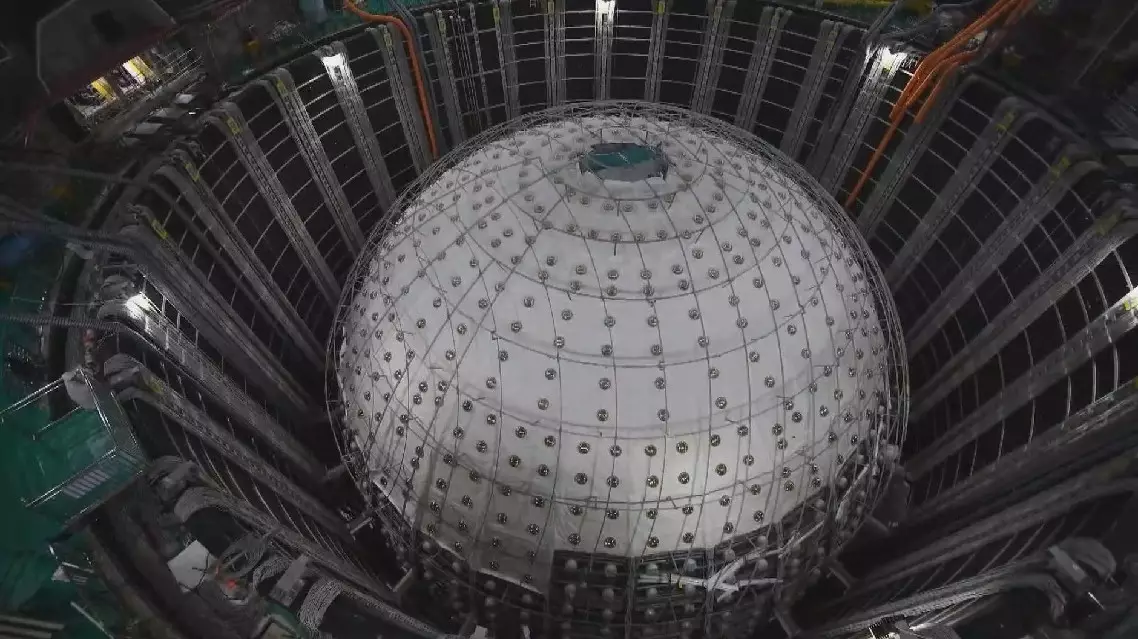
World's largest transparent spherical neutrino detector starts filling with ultrapure water