A German expat who has lived in China for half a century and has witnessed the country's profound changes and increasingly closer contact with the rest of the world, said he hopes that people-to-people exchanges could continue to grow stronger in the future.
In an interview with the China Global Television Network (CGTN), Uwe Krauter, who has been called the "Marco Polo of our times" for his pioneering role in bridging cultures, looked back on his remarkable life in China.
Krauter first came to work in Beijing in 1974, back when there were few foreigners on the Chinese mainland. He said he had initially become curious about China during his childhood, after his grandfather, a sailor who had been to China, told him stories about the country.
An opportunity to go to China himself materialized when he was majoring in sociology at Heidelberg University. His friends, a Swiss couple who were working in Beijing for the Foreign Languages Press, told him their two-year contract with the organization was about to end and asked if he'd like to fill the vacancy.
When the publishing house contacted Krauter, he agreed and soon embarked on his life-defining journey.
"If China invites me and opens the doors, I will certainly go," he said while recalling his decision, adding that life in China was very different to life back home at that time.
In the 1980s, Krauter played a key role in organizing the first overseas tour of the classic Chinese drama Teahouse, introducing it to European audiences.
"People asked me to become the simultaneous translator for all [of] the around 60 roles. We went in Germany to 12 or 14 cities, and afterwards to Switzerland and to France. It was a huge success and when we came back to China, we were heroes," Krauter said.
While working in the translation field and cultural circles of China, Krauter went on to marry the well-known Chinese actress Shen Danping in 1984.
Over the years, Krauter has played an important role in cultural exchanges between Germany and China, building a bridge of friendship between the people of the two countries.
"China's history and cultural heritage [are] the base of the Chinese people, the strengths of the Chinese people and the pride of the Chinese people," he said.
Living in China for 50 years, Krauter has witnessed first-hand the astonishing changes that have taken place, driven by the country's reform and opening-up to its continued modernization in the present era.
"When I came here, we foreigners looked at everything in the streets wherever we went, and we were astonished because it was different from our countries, but the contact with the foreign world that did indeed change. Life [became] modernized, not only in terms of what they were wearing, but they got more and more used to the presence of foreigners and to talk with foreigners. We are getting more and more near to each other. And I do hope this [will] continue strongly," Krauter said.
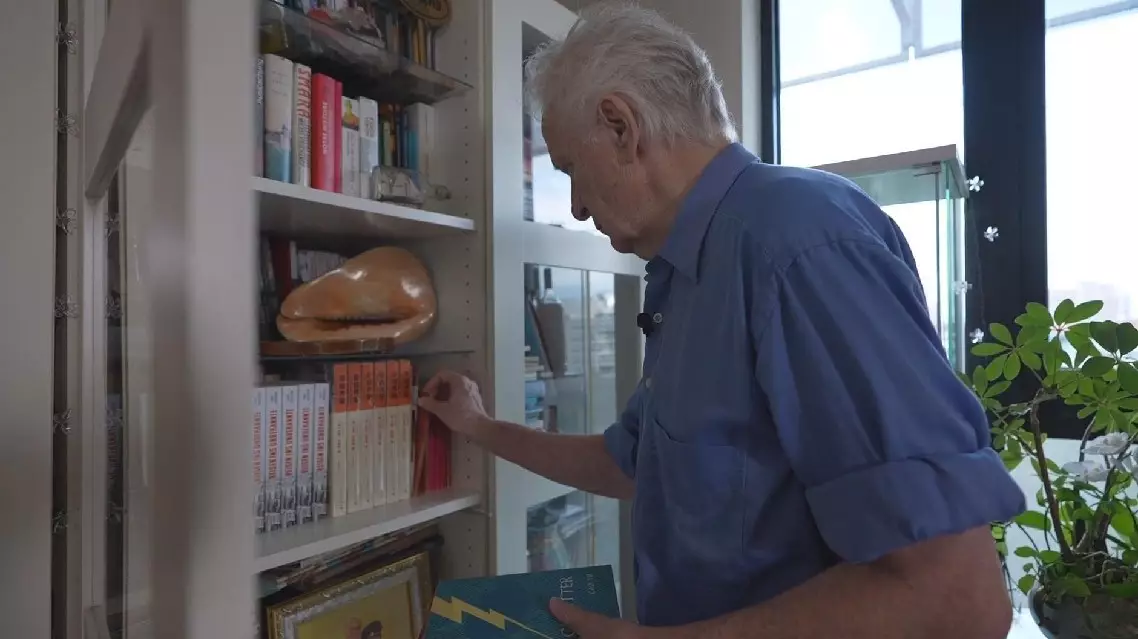
German expat witnesses remarkable changes after spending half century in China