The growing demand for industrial robots has been a key driver of technological innovation in China, positioning the country at the forefront of robot design and development.
In 2024, China maintained its position as the world's largest industrial robot market for the 11th consecutive year, accounting for over half of global new robot deployments, according to the World Robotics Association.
In China's capital Beijing, numerous robot technology companies have developed robotic arms with a variety of functions.
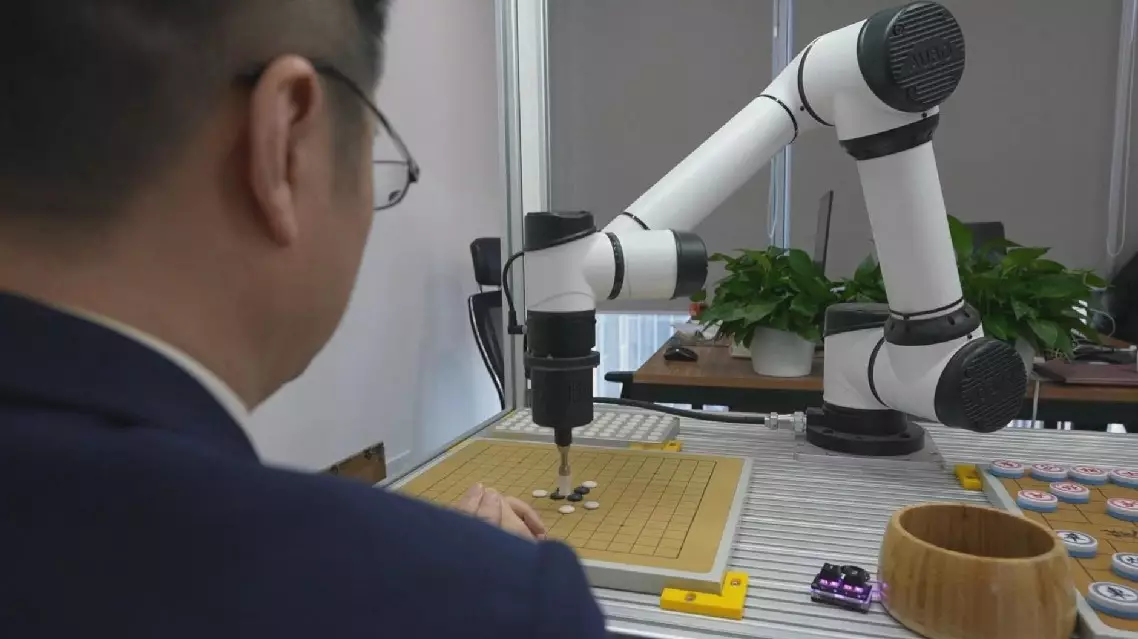
Aubo, a Beijing-based robot maker, has designed robotic arms capable of making coffee, performing massages, painting, and playing chess.
Andy Mok, a professor at Beijing Foreign Studies University, believes that form follows function in the robotics industry.
According to Mok, humanoid robots are unlikely to become the dominant form, but there will still be a place for them alongside robots with four legs or wheels. In the future, people will encounter robots in a variety of forms," he said.
"You mentioned robotic arms. In many manufacturing settings, it really is about moving an object from one point to another or doing some work on it, whether that's carving it, polishing it, whatever. And there the ideal form would be an arm, versus a humanoid form factor with not only two arms but also two legs and a head," said Mok.
The robots named “D2,” indoor delivery robots with the letter “D” in their name referring to “delivery,” have been deployed in hotels across Beijing to provide services to consumers.
"D2 is very useful for us. Because we have a lot of requests from guests for 'Kuaidi' [referring to express deliveries], 'Waimai' [referring to takeaway foods], medicine, or they need an extra toothbrush, slippers, so this really helps us to be very efficient. The guests are quite enjoying to interact with the robot as well," said Aymeric Le Boucher, general manager of the Renaissance Beijing Haidian Hotel.
A study by Frost and Sullivan, a consulting firm specializing in industry transformation and growth opportunities, projects that the global service robot market will expand from three billion yuan (approximately 410.99 million U.S. dollars) in 2024 to 10 billion yuan (around 1.36 billion U.S. dollars) by 2030, achieving an annual growth rate of 20 percent.
Another robot maker, Mech Mind, has developed robotic arms capable of playing mahjong, a traditional Chinese table game, with humans.
The machine uses a camera to scan the game field, calculates the odds with artificial intelligence (AI), and places the tiles on the table.
Mech Mind has deployed over 10,000 AI-powered cameras across more than 50 economies, including Germany and Japan.
Shao Tianlan, founder and CEO of Mech Mind, believes that robotics holds significant potential for improvement.
When discussing the ultimate direction of robot development, Shao said: 'It will be like in the movie Wall-E: robots of every form. But I think many of them can share common brain and eyes. No matter whether the robot has one arm, two arms, two legs, or no leg, its eyes and brain—many things are in common. So I think that can be standardized somehow.”
Rising demand for industrial robots drives China's leadership in innovation