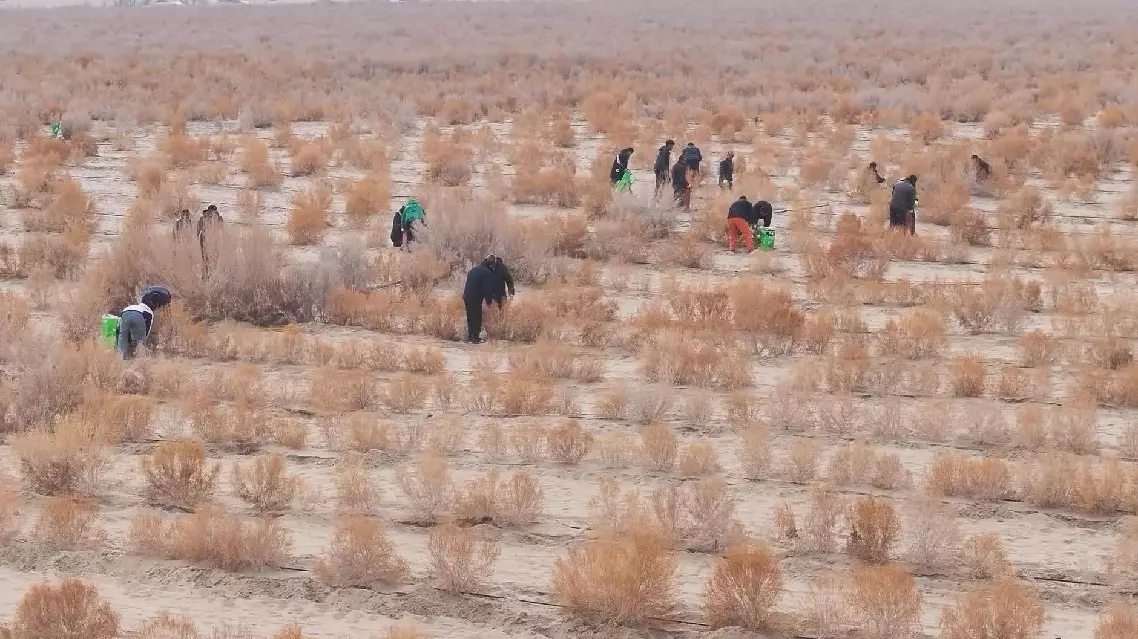
A new chapter has been opened in the decades-old campaign of fighting desertification in northwest China's Xinjiang Uygur Autonomous Region as the 3,046-km green belt encircling the Taklimakan Desert in the region was completed on November 28, 2024.
The Taklimakan Desert, once known as the "sea of death," covers 337,600 square kilometers and its circumference measures 3,046 km, making it the largest desert in China and the second-largest drifting desert in the world.
It has taken more than 40 years to fully enclose the desert with a green belt. This incredible achievement is part of China's Three-North Shelterbelt Forest Program, the world's largest afforestation initiative. The program was launched in 1978 and is scheduled to be completed by 2050.
Xinjiang's commitment to fighting desertification did not waver following the green belt's completion. Instead, the region is continuing to expand and fortify the belt to achieve broader ecological management objectives.
Despite subzero temperatures and recent snowfall, the relentless work at the sand control site persists.
In Yutian County on the edge of the Taklimakan Desert, workers are busy leveling a 530-hectare piece of sandy land for the forthcoming ecological conservation endeavors.
"It's been almost a month, and we'll work for another three or four days, and then we'll have leveled it out here," said a bulldozer driver working on-site.
In Luopu County also on the edge of the Taklimakan Desert, workers are preparing red willow branches in nurseries for planting across more than 400 hectares of desert in the coming spring. Indigenous sand-fixing plants like sacsaoul and red willow are poised to assume important roles in fighting desertification the upcoming year.
The green belt surrounding the Taklimakan Desert not only emphasizes ecological conservation but also highlights economic progress. Through photovoltaic projects, the region is pioneering a novel ecological management strategy aimed at achieving dual objectives of environmental preservation and economic prosperity. This approach not only aids in fighting desertification, but also promises economic benefits, propelling sustainable development in the area.
Presently, the construction of a photovoltaic project within the Taklimakan Desert is busy underway, with workers installing solar panels. By spring, sand fixing plants like alfalfa and Chinese fountain grass will be planted below these panels, making the project a good example for the exploration of a new win-win model of ecological governance and economic development in Xinjiang.
Xinjiang opens new chapter in fighting desertification