Many regions across China are continuing or increasing incentives for trade-in program into the near year, with consumers enjoying more discounts in their major move-up purchases.
In Shanghai, consumers can enjoy a 15 to 20 percent discount on eight categories of products such as television sets, washing machines, and range hoods in the new round of trade-in promotion. Coupons are available online, which can be used for discounts both in physical stores and on e-commerce platforms.
"I've come here to buy a water heater, and the discount is quite good. Without the national subsidy scheme, it would have cost over 3,000 yuan (roughly 410 in U.S. dollars), but now it's 600 to 700 yuan (82 to 96 U.S. dollars) cheaper. It's a great deal," said a resident in a downtown mall.
In south China's Guangxi Zhuang Autonomous Region, the regional department of commerce announced that the amount of subsidy for automobiles, home appliances, and electric bicycles will remain basically at the same levels as in 2024 until new trade-in related measures roll out, while the size of subsidy for products such as mobile phones, tablets, and smart bracelets is expected to be unveiled soon.
The trade-in program is part of China's efforts to boost domestic demand and support economic growth.
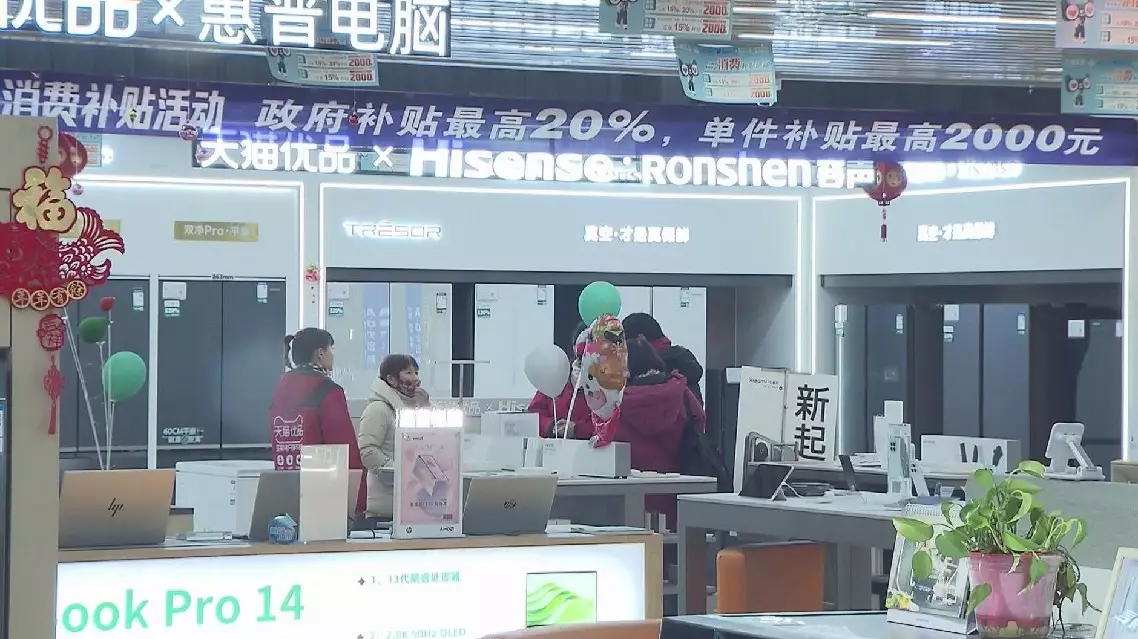
Trade-in program continue spurring consumer spending in new year

From hammering nails to unpacking boxes, the ongoing Second World Humanoid Robot Games in Beijing are putting machines' practical skills to the test, accelerating their deployment in real-world industrial scenarios.
This year's event introduced a dedicated dexterous-hand competition featuring eight high-precision tasks.
Multiple teams relied on the same dexterous hand developed by the Shanghai-based AGILINK.
"In yesterday's competition, our robot completed bean-picking, powder weighing and block-building events fully autonomously, securing gold medals in all three. The challenges serve as an excellent starting point, proving that the dexterous hand's capabilities can indeed meet the demands of real-world applications," said Qiao Tianjie, CEO of AGILINK.
The robotic hand also demonstrated remarkable capability in more advanced challenges, including hammering nails, unpacking boxes, connecting flexible cables and prying open bottle caps.
The nail-driving event requires robots to hammer nails fully into a corkboard with no protruding heads or obvious bending, with the final score determined by the number of valid nails hammered within a five-minute window.
The challenge closely mirrors real-world complexities: a slight misalignment causes a crooked nail; too little force fails to drive it in, while too much sends it flying. The robot's vision must be precise, its hand steady, and the force feedback of the hammer strike accurate to the millisecond.
Similarly, in the box-unpacking challenge, robots have five minutes to slice open a cardboard box's sealing tape and extract its contents. Points are awarded only if the items remain undamaged and the box shows no significant tears, with the final score based on the total number of successful unpacks.
Beyond the spectacle of the arena, however, a more pragmatic hurdle remains: while competitions test robots' peak performance over a few minutes, industrial environments demand stable, reliable operation over hundreds or even thousands of hours.
"Currently, through advanced learning algorithms, robots can achieve a perception accuracy of up to 0.1 millimeters in a spatial perception event. However, in real-world scenarios, they must execute tasks consistently over long periods with high efficiency and high precision. Only then can they truly create value," said Jiang Zhihong, a professor specializing in intelligent robotic systems at the Beijing Institute of Technology.
Running from Saturday to Wednesday, the games have attracted 666 teams and 2,056 robots from 16 countries and regions across six continents, with team participation quadrupling from the inaugural edition last year.
The event features 51 competition items divided into two main categories: competitive matches and scenario-based challenges.
The competitive category includes athletics, football, gymnastics, weightlifting, martial arts, street dance, and tug of war, while the scenario-based category is set in real-world environments, namely factories, hotels, homes, emergency response sites, hospitals, and retail spaces.
Humanoid Robot Games in Beijing test machines' real-world industrial skills