China's "artificial sun" maintained a steady-state high-confinement plasma operation for a remarkable 1,066 seconds on Monday, setting a new world record and marking a breakthrough in the quest for fusion power generation.
The equipment, China's Experimental Advanced Superconducting Tokamak (EAST) in Hefei City, east China's Anhui Province, is designed to replicate the nuclear fusion process that powers the sun, where hydrogen atoms combine under extreme heat and pressure to release vast amounts of energy.
The ultimate goal of an artificial sun is to create nuclear fusion like the sun, providing humanity with an endless, clean energy source, and enabling space exploration beyond the solar system.
Fusion energy offers several key advantages: it uses abundant raw materials like seawater, produces minimal carbon emissions, and is inherently safe and efficient. For example, the energy released from fusing one liter of seawater-derived deuterium and tritium is equivalent to burning 300 liters of gasoline.
The EAST reactor has been operational since 2006, with researchers steadily pushing the boundaries of high-temperature and long-pulse plasma operations. Achieving a 1,000-second milestone means that scientists have successfully simulated the conditions necessary for a future fusion power plant to operate efficiently and sustainably.
Over the years, the EAST team has made several breakthroughs, including sustaining plasma for 30 seconds in 2012, 60 seconds in 2016, and 403 seconds in 2023. These incremental achievements laid the groundwork for the latest record.
Researchers said the progress is a sustainable and environmentally friendly alternative to fossil fuels for humanity.
"This project could really put fusion energy to use for humanity. We're really harnessing fusion energy. Future reactors will have to operate based on the duration of 1,000 seconds. This result is a major breakthrough for the EAST and for the entire magnetic confinement fusion community. It marks a crucial milestone in Tokamak's transitioning from fundamental research to engineering applications," said Gong Xianzu, head of the division of the EAST Physics and Experimental Operations at the Hefei Institutes of Physical Science, Chinese Academy of Sciences.
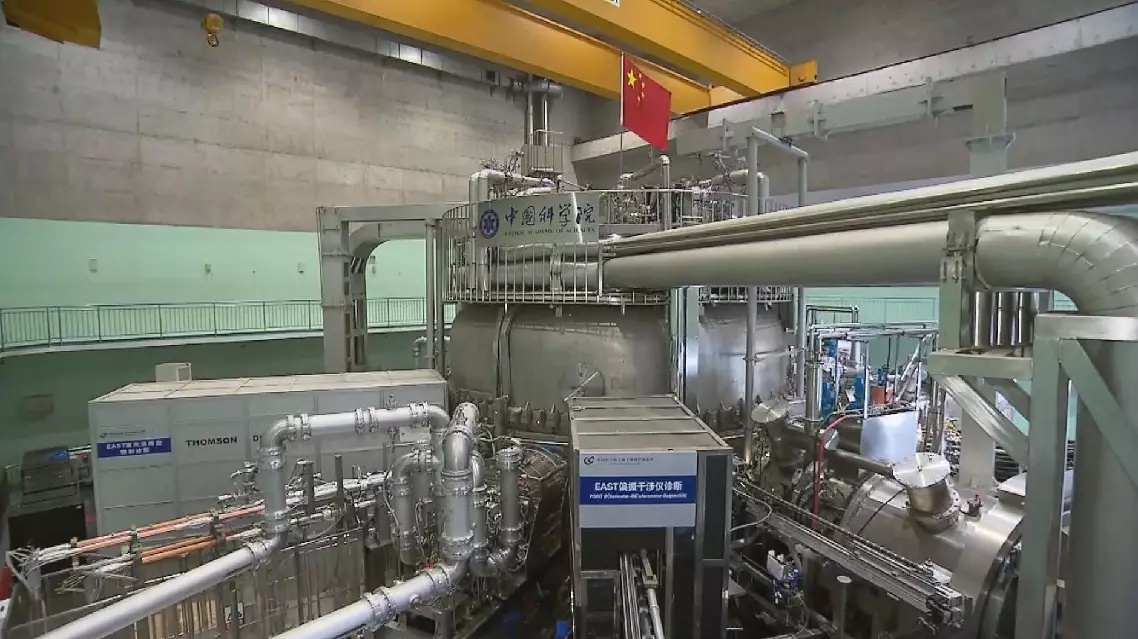
Chinese "artificial sun" sets new record in milestone step toward fusion power generation