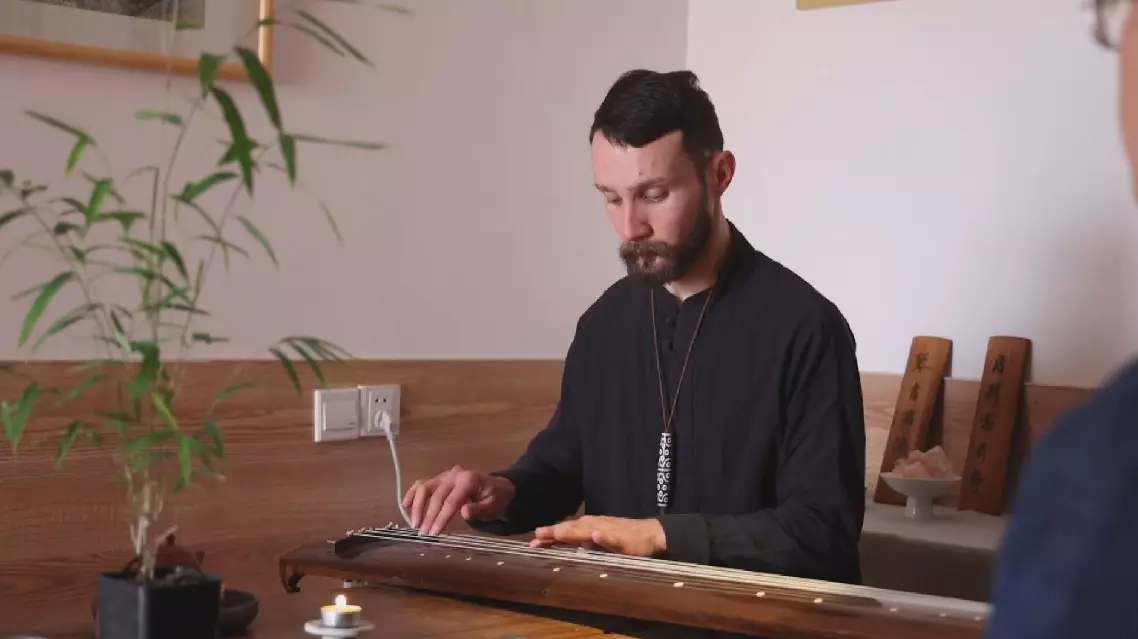
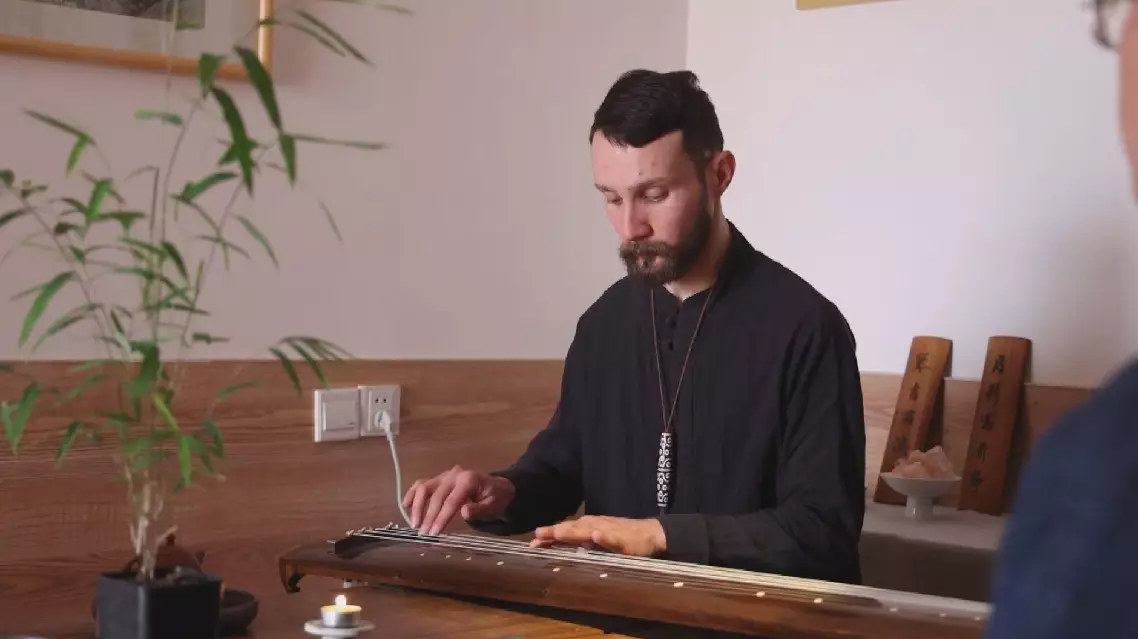
Captivated by the unique charm of the guqin, an ancient Chinese plucked instrument with a history spanning over 3,000 years, a young Frenchman crossed the ocean to Nanchang, east China's Jiangxi Province, to pursue his passion for mastering the instrument.
In 2018, Thomas embarked on his journey to learn the guqin and began a new chapter in Jiangxi, where he now resides as a foreign teacher at Jiangxi College of Foreign Studies.
"I began to gain an understanding of China's philosophy and culture when I was a college student. In my opinion, an important part of Chinese culture is Qin (guqin), Qi (the game of go), Shu (calligraphy), and Hua (painting). Among these, guqin holds the top position, so I started learning it and Chinese traditional culture," he said.
Qin, Qi, Shu and Hua are considered as the four arts revered by ancient Chinese scholars.
Thomas noted that guqin culture is profound, but in France, he could only study its theoretical aspects through books, which felt insufficient. In 2018, he embarked on a journey to China to deepen his understanding, with Jiangxi—one of the cradles of guqin culture - as his first destination.
"I take learning the guqin seriously. When I learn a music, I always start by finding out who composed it. I want to understand what they felt and what they intended to convey at the time," he said.
Every month, the Frenchman joins the guqin club's gatherings, where he shares his passion for the ancient instrument with fellow enthusiasts, exchanging techniques and insights on guqin culture.
"My favorite piece is 'Who Is Singing'. Every time I play it, I feel as if I am connecting with someone from 2,000 years ago. This piece is truly unique because of its enduring legacy. Today, the guqin has seven strings, but 'Who Is Singing' uses only five, reflecting the instrument's ancient form. By playing it, we can gain insight into how people in antiquity performed guqin music. Its profound history allows me to deeply engage with Chinese heritage as I play," he said.
Thomas revealed that his initial fascination with guqin culture led him to China, but he was thrilled to discover cultural riches that exceeded his expectations.
"I enjoy traditional elements such as the Pavilion of Prince Teng, Shengjin Tower, and Bada Shanren. For example, when I learned 'High Mountains and Flowing Water', I liked visiting high mountains and watching flowing water. I traveled to places like Meiling, Sanqing Mountain, and Wugong Mountain in Jiangxi. I often climb mountains because everything I do is aimed at self-improvement. Learning the guqin is challenging, just like climbing mountains, running, and learning Chinese, but I enjoy challenges. I plan to dedicate several years to studying the guqin so I can play it better," he said.
As a teacher, Thomas often shares his life with his students.
"Whenever I do something interesting, I post about it on WeChat Moments. Naturally, my students often see it and ask, 'What did you play yesterday?' or 'What did you do yesterday?' This leads to conversations about Chinese culture, traditions, and philosophy. I truly enjoy these moments," he said.
He recently married a Chinese woman and his family will be heading to China to visit the newlyweds after the Spring Festival.
"They will stay for one or two weeks, and since I have my own car, I plan to take them on a tour around Jiangxi - perhaps to Lushan Mountain, Shengjin Tower, and Wanshou Palace. Since this is their first time in China, I believe it will be fascinating for them to experience traditional Chinese culture," Thomas said.
French teacher in Jiangxi pursues mastery of ancient Chinese musical instrument
French teacher in Jiangxi pursues mastery of ancient Chinese musical instrument