The production team of "Nezha: Demon Child Conquers the Sea" or "Ne Zha 2", a Chinese animated fantasy and the current box-office revenue leader during the 2025 Spring Festival holiday, has gone above and beyond to deliver groundbreaking visual effects that captivate audiences.
The week-long Spring Festival holiday, running from Jan. 28 to Feb. 4 in 2025, is traditionally China's most lucrative moviegoing window. This year, a stellar lineup has been presented to audiences, including "Ne Zha 2", the detective thriller "Detective Chinatown 1900", and the fantasy film "Creation of the Gods II: Demon Force".
The animated feature "Ne Zha 2", the sequel to the 2019 animated blockbuster "Ne Zha", draws inspiration from the tale of a mythological figure of the same name from the Ming Dynasty (1368-1644) novel "Fengshen Yanyi", or "The Investiture of the Gods".
The first "Ne Zha" generated an impressive 5 billion yuan (about 695 million U.S. dollars) at the box office, while also winning numerous accolades.
This year, the second installment surpassed 3.3 billion yuan (about 458 million U.S. dollars) in just six days.
Continuing the story from the first film, "Ne Zha 2" delves into the reconstructing of the bodies of Ne Zha and Ao Bing, the son of the Dragon King.
The visual effects have been notably enhanced, offering an even more immersive experience than before.
"The total number of shots with special visual effects in Ne Zha 2 exceeds the entire shot count of the first movie. With a total of 34 major scenes, the movie delivers a small climax as early as the seventh scene," said Chen Changjiang, executive producer of Ne Zha 2.
This pivotal moment centers on the overwhelming presence of a massive horde of mythical sea creatures. The chains binding all these monsters play a crucial role in this scene. However, if the production team aims to create the effect of all the monsters being connected by chains, it would likely not only disrupt the composition of the shot, but also place enormous pressure on the special effects team, potentially causing production delays.
At one point, the production team and director found themselves at odds.
"Those chains were non-negotiable for me, as they were essential to the plot's core logic. Each monster in the vast army had to be bound by a chain. Our effects team had never faced such a task, so it required a lot of trial and error. It was a research and development process," said director Yang Yu, who goes by the nickname Jiaozi.
In response, the entire team worked tirelessly, refining their approach to meet the director's requirements.
"We invested a significant amount of time in developing these complex effects. Our goal was to create something that audiences had never seen before, something that would deliver a strong visual impact and offer a fresh artistic expression. This is the kind of work we believe is truly worth doing," Yang added.
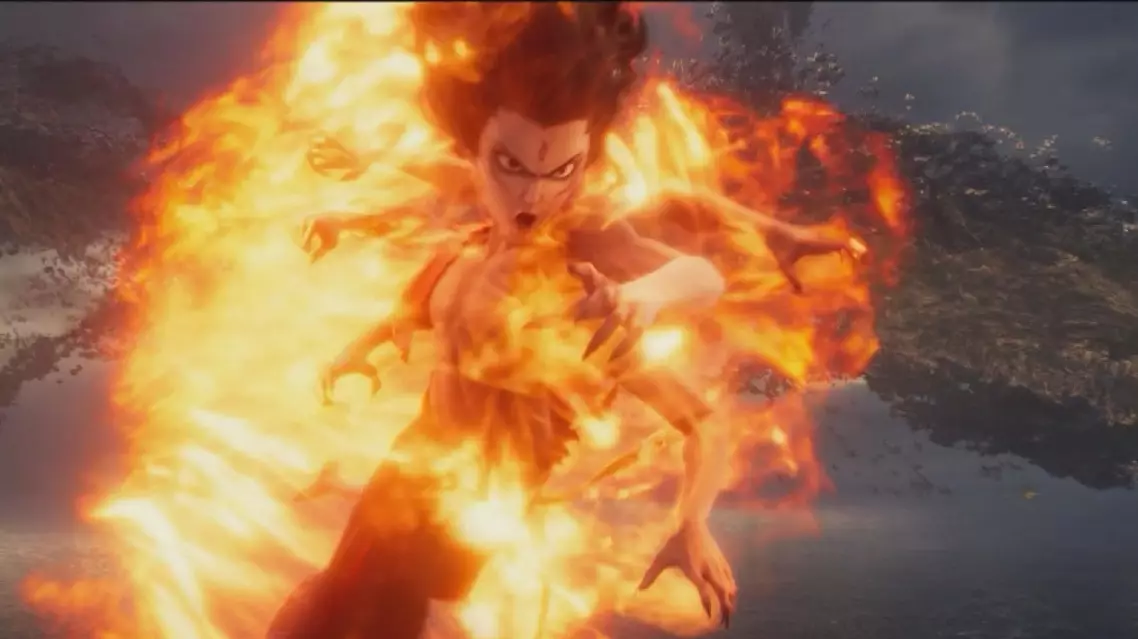
"Ne Zha 2" sets box office ablaze with dazzling visual effects
Eighteen sets of precious archival materials related to David Nelson Sutton, a U.S. assistant prosecutor at the Tokyo Trials and one of the earliest international prosecutors to investigate the Nanjing Massacre, were officially donated on Wednesday to the Memorial Hall of the Victims in Nanjing Massacre by Japanese Invaders.
Sunday marks the 80th anniversary of the opening of the International Military Tribunal for the Far East (IMTFE, also known as the Tokyo Trials). To commemorate the milestone, six diaries written by Sutton between 1946 and 1948, when he was conducting investigations for the tribunal, were donated together with a series of reports titled Reports from China.
"It is necessary to let more Chinese, even people all over the world, to see these archival materials. Let all the world know why the Tokyo Trials 80 years ago were described as a trial of justice, and how the Nanjing Massacre nearly 90 years ago was unprecedentedly brutal and tragic beyond compare," said Zou Dehuai, the donor.
From May 3, 1946 to Nov 12, 1948, the International Military Tribunal for the Far East was held in Tokyo by 11 countries, including the United States, China, Britain and the Soviet Union, to try Japan's Class-A war criminals after World War II.
"Why do we say the Tokyo Trials were a trial of justice? It was a trial witnessed by the world, with judges from 11 countries. Major war criminals, such as Iwane Matsui, a crime culprit for the Nanjing Massacre, and Hideki Tojo, all ultimately received the punishment they deserved. That is why the Tokyo Trials are called a trial of justice. These archives are of immense importance," Zou said.
Sutton came to China with the International Prosecution Section in 1946 and was tasked with investigating Japanese war crimes in China, with a particular focus on collecting evidence related to the Nanjing Massacre.
The six diaries recorded many details of Sutton's work during the Tokyo Trials. In one entry, dated March 9, he wrote that he had received formal orders to go to Shanghai, Nanking (Nanjing), Peiping (Beijing) and other sites in the China theater to investigate war crimes and gather evidence. Another entry recorded his arrival in Nanjing at 11:20 on April 2. On May 3, the day the trial opened, he described the defendants as looking like "insignificant beaten men."
The donated materials also include Sutton's "Reports from China," which further exposed Japanese wartime atrocities in China, including mass killings, violence against civilians, germ warfare and the coercion of Chinese people into opium cultivation.
Zou is a collector born in the 1990s who has long searched for wartime historical evidence. He first found the Sutton materials in November 2025 on a U.S.-based auction website specialized in military artifacts. After confirming Sutton's identity and reviewing preview images that indicated the items were original archival materials, Zou placed a bid for the collection and later, ultimately paying a price nearly 100,000 U.S. dollars, far more than his original budget. And he arranged for its return to China, with assistance from others.
At the donation ceremony, Zou received a donation certificate. He said the Sutton archives were the most expensive items he had acquired in a decade of collecting. "These archives, these ironclad evidences, expose the crimes committed by the invading Japanese army in China and serve as a warning to all humanity. When you look at these documents, you cannot imagine that a human army could commit such massive and horrible atrocities. I believe that any Japanese person with conscience, after reading the Sutton archives, would firmly recognize what kind of a massacre took place in Nanjing. For the young people of future China, Japan and the United States, we must tell them the truth of history, and why we must cherish the hard-won peace, and how heavy the cost of peace truly was," Zou said.
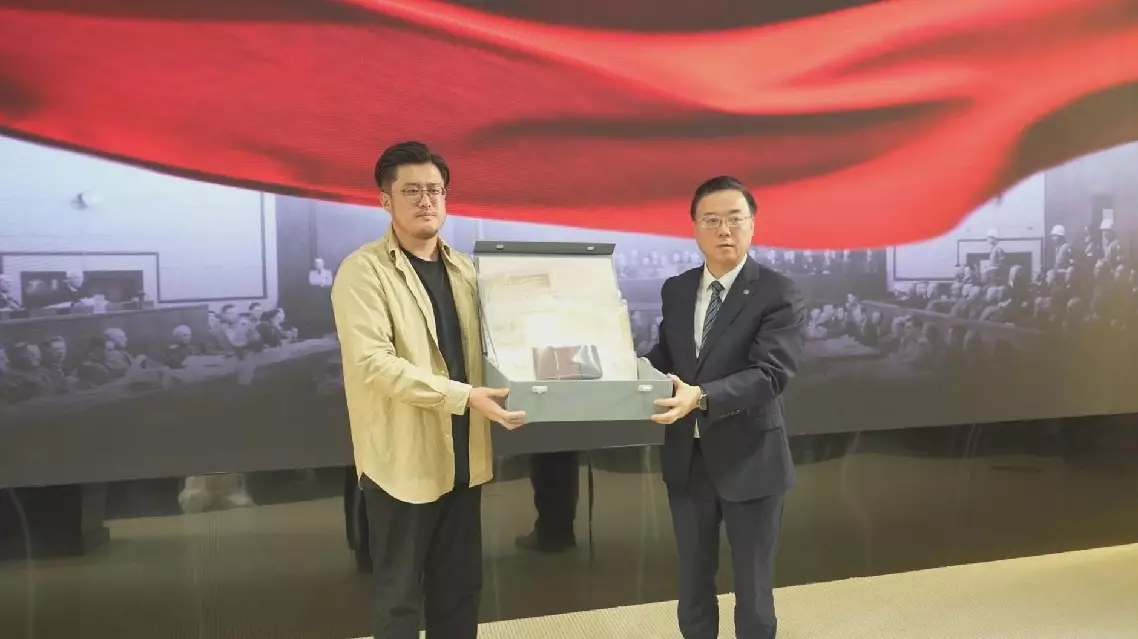
Tokyo Trials prosecutor's diaries donated to Nanjing Massacre memorial hall