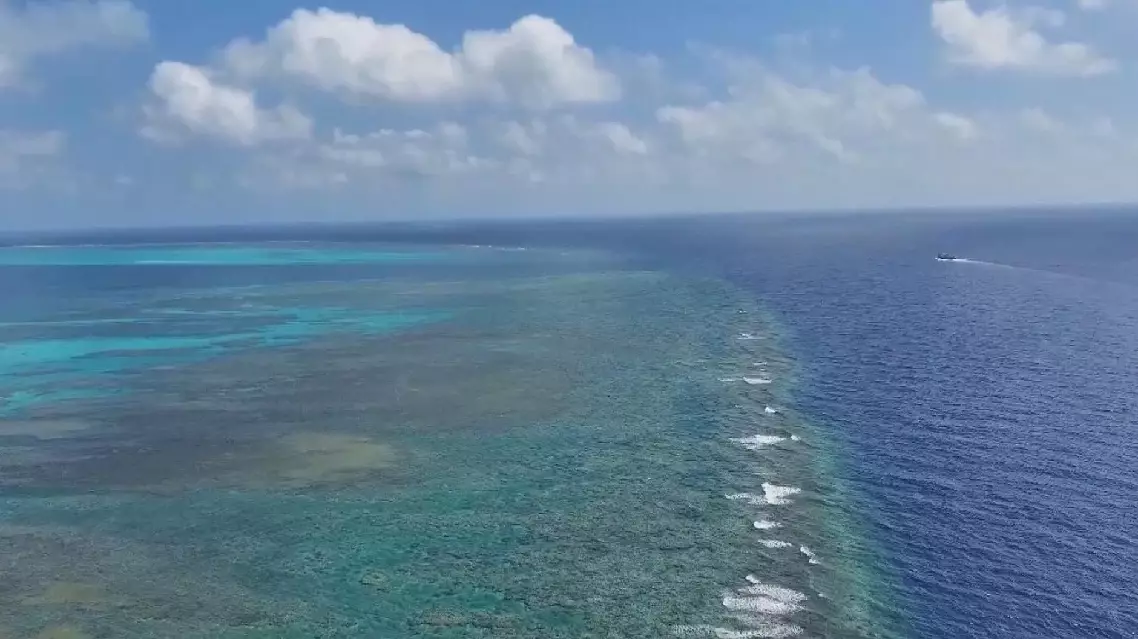
The deployment of U.S. missile in the Philippines would fuel tensions and raise concerns in the South China Sea region, thus harming regional peace and security, and sparking condemnation from the Chinese side, according to experts.
The U.S. installed the Typhon missile system in the northern Philippines in April 2024 as part of joint U.S.-Philippines military drills. The Philippines promised that the deployment would be "temporary", and that the system would be withdrawn following the conclusion of the military exercises.
However, the Philippines has repeatedly reneged on its commitment and even plans to "procure" the system to increase its deterrence capabilities. The Philippine side also said that it would return the Typhon system to the United States so long as China stops its territorial claims.
"In fact, the U.S. military presence in the South China Sea region, including deploying this missile in the Philippines, was continuously disturbing and deteriorating China's strategic security environment and its neighborhood. Well, actually, the deployment of land-based mid-range missiles is a very sensitive issue and that relevant countries, including Japan and Australia have been very cautious about deploying U.S. missiles in their countries in the past. The United States is hoping to improve its ability to respond to the so-called 'China threat' by deploying these missiles near the First Island Chain. The position of the United States on the South China Sea issue is no longer neutral. It now stands by the Philippines, no matter what it did and tries to deny China's legitimate claims and rights in the South China Sea. And I think this is the most disturbing and important factor for the instability for the South China Sea," said Yan Yan, director of the Research Center of Oceans Law and Policy in the National Institute for South China Sea Studies.
Yan also mentioned that the negotiations between China and ASEAN member states on a Code of Conduct (CoC) for the South China Sea has been ongoing, and stressed the importance of the CoC as a "crisis management mechanism," which is not intended to resolve territorial disputes, but rather to establish rules for states in the region to manage tensions.
In a separate interview, Seun Sam, a policy researcher at the Royal Academy of Cambodia, said the South China Sea issue is not a matter for the entire ASEAN bloc, but rather for individual countries with claims to resolve directly with China, which should not involve a third party.
"I think the best way to solve that problem is all related countries, they should have the bilateral relations with China, because that is not the problem between the whole ASEAN, but some members. So, I think the related countries should talk bilaterally with China to understand each other. We cannot let a third country to interfere or to intervene in the issue. So, if all the related countries in the South China Sea would like to peacefully discuss and solve that problem and see that all countries are win-win partners, that should be only the best way and only the best solution in the South China Sea," he said.
He also pointed out that some powerful countries, including the United States, are using the South China Sea issue to "expand their power", as he questioned the fairness of U.S. involvement in enforcing maritime rules.
US missile deployment in Philippines fuels South China Sea tension: experts