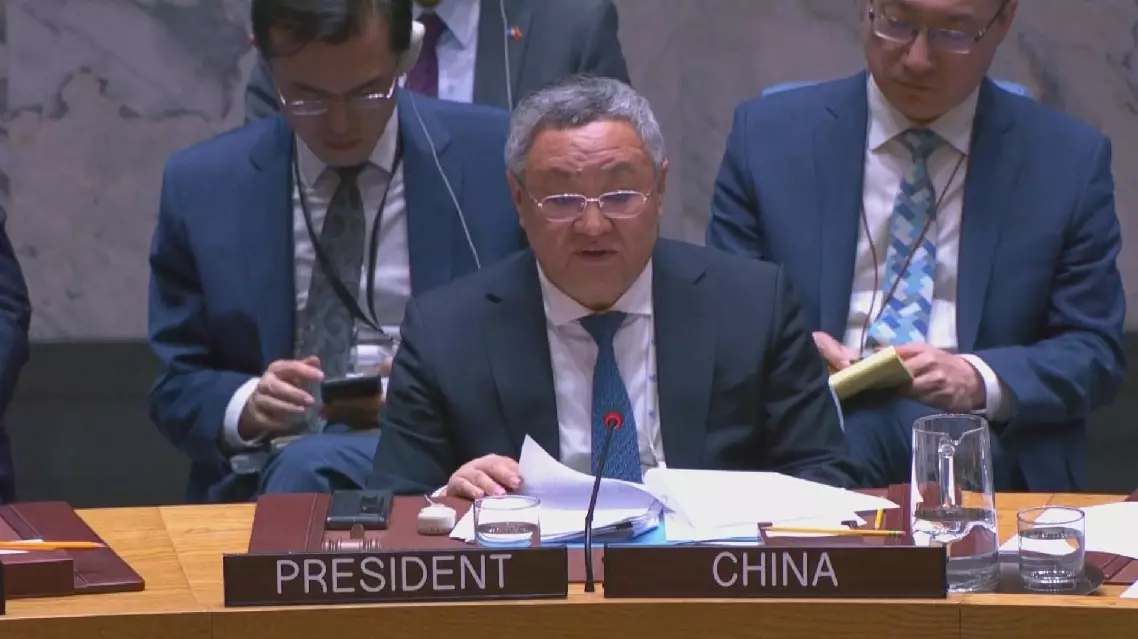
China called for a comprehensive implementation of the ceasefire deal at the Gaza Strip and urged swift progress on the second phase of negotiations at a United Nations Security Council (UNSC) meeting on Tuesday.
Fu Cong, China's permanent representative to the United Nations, voiced deep concern over the immense humanitarian crisis caused by 15 months of conflict in Gaza.
He called for the immediate release of all hostages and stressed the need to ensure that the 2 million surviving residents in Gaza are not trapped in further violence.
Fu underscored that the ceasefire agreement must be fully upheld to achieve lasting peace.
"Violations of the ceasefire agreement have occurred frequently in recent days. We are gravely concerned and strongly urge all parties to fully implement the ceasefire agreement. Particularly in ensuring humanitarian aid access and the release of hostages, the terms of the ceasefire must be strictly honored with sincerity and seriousness. The international community should encourage and support parties concerned to speed up negotiations. In particular, countries with significant influence over the parties involved, should play their role to this end," he said.
Fu also expressed concern over Israel's large-scale military operations in the West Bank, which have continued for over a month.
He noted that this has led to the largest displacement of Palestinians since 1967.
Warning against further escalation, Fu criticized Israel's plan to maintain a long-term military presence in the West Bank and urged an immediate halt to military actions, settlement expansion and settler violence to prevent further deterioration of the situation.
Emphasizing that the root cause of the prolonged crisis is the failure to implement the two-state solution, Fu called for Gaza's post-war governance to be led by Palestinians.
He urged the international community to support Gaza's reconstruction and safeguard the irreplaceable role of the UN Relief and Works Agency for Palestine Refugees in the Near East (UNRWA) in humanitarian aid and rebuilding efforts.
China, he affirmed, will continue working with the international community to seek a comprehensive, just and lasting resolution to the Palestinian issue and broader Middle East peace.
China urges full implementation of ceasefire deal in Gaza
Iran on Monday publicly rejected a core U.S. demand to cease all uranium enrichment, while projecting a dual-track strategy of guarded diplomatic engagement and reinforced military preparedness.
The moves came as the indirect Iran-US talks in Oman's Muscat last week yielded no breakthrough and regional tensions continued to simmer.
On Monday, Mohammad Eslami, president of the Atomic Energy Organization of Iran, said that while Iran could consider diluting its 60-percent enriched uranium, it would only do so if all international sanctions were first lifted.
Eslami also dismissed past proposals to ship the material abroad for safekeeping.
Iranian President Masoud Pezeshkian and Foreign Minister Seyed Abbas Araghchi echoed this line on Monday, reaffirming Tehran's strategy of engaging in talks while refusing to concede on what Iran views as sovereign rights.
Pezeshkian and Araghchi have described the Muscat talks as a "good start" but warned that diplomacy must be based on "respect, not coercion."
In a televised speech on Monday, Iran's Supreme Leader Ali Khamenei urged Iranians to show unity and "disappoint the enemy" ahead of the 47th anniversary of the 1979 Islamic Revolution, amid rising tensions with the United States.
Meanwhile, Ali Larijani, secretary of Iran's Supreme National Security Council, is set to lead a delegation to visit mediator Oman on Tuesday.
Simultaneously, Iran has signaled a shift toward greater military opacity. Iran's state news agency IRNA said in a report on Sunday that the Defense Ministry has halted all public displays of new weaponry "for security reasons and to safeguard the principle of surprise," a move widely interpreted as preparing for potential conflict.
Positions from the United States and Israel have appeared equally firm. A report on Sunday by Israel's Channel 15 said the United States had privately messaged Iran, seeking Iran's "concessions" in the next round of talks, and expecting "serious and meaningful content."
On Monday, The Jerusalem Post, citing Israeli defense officials, reported that Israel has warned the U.S. it "will strike alone" if Iran crosses its "red lines" on ballistic missiles.
Israeli Prime Minister Benjamin Netanyahu's office said on Sunday that he will meet with U.S. President Donald Trump on Feb 11 in Washington, and will discuss the U.S.-Iran negotiations.
Netanyahu is expected to demand that the U.S. promote the transfer of Iran's enriched uranium out of the country and restrict Iran's ballistic missile capabilities.
Iran rejects zero enrichment, projects dual-track posture amid stalled talks with U.S.