Skip to Content Facebook Feature Image

Supportive policies, efficient industrial chain boost China’s EV development

China

China

China

Supportive policies, efficient industrial chain boost China’s EV development

2025-03-02 17:16 Last Updated At:20:47

China's supportive government policies and its efficient industrial chain have driven the further development of China's electric vehicles (EVs).

Carmakers worldwide are finding it difficult to compete with Chinese brands in EV market.

Guangzhou City of south China's Guangdong Province, the hotbed of EV development, demonstrated how advanced the sector has grown in the country.

In cities across China, thousands of cars have distinctive green registration plates, showing they are electric vehicles. In Guangzhou, they are as many as one in five.

Government policy has been key to creating the right conditions for new energy vehicles to flourish.

"Government policy definitely plays a big part. If I remember correctly, China is the only country in the world that has all the industrial categories [defined] by the United Nations. So, everything from raw material procurement to after sales, you can just have everything in China. Then, we don't have to rely on any other country," said Emma Meng, an EV consultant and influencer.

Guangzhou-based car manufacturer, GAC, which launched the Aion electric car brand in 2017, is a good example.

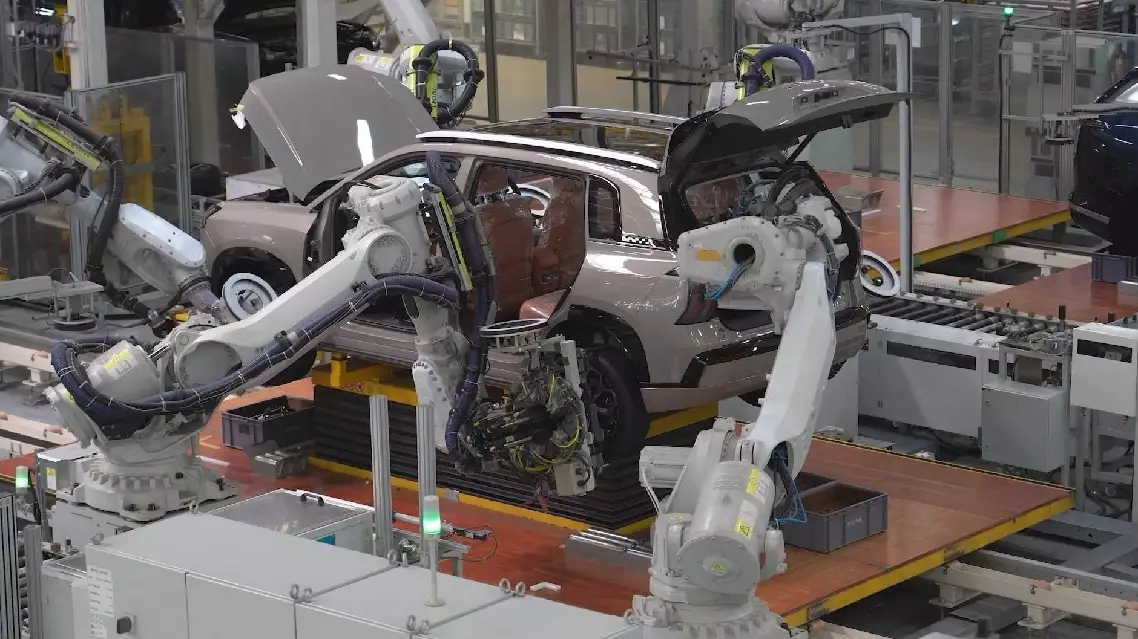
The GAC Intelligent Networking New Energy Industry Park includes facilities for battery research and production, joint ventures with battery and electric drive system companies, and even a battery recycling center.

The car factory produces zero carbon emissions and is partly powered by 85,000 square meters of solar panels.

It has a fully automated production line capable of producing up to 1200 cars per day.

The complex is a "lighthouse factory" recognized by the World Economic Forum for its cutting-edge design and focus on new energy technologies.

The model is something GAC-Aion hopes to promote to the world.

"When we export, it is not just the export of products or technology, but the export of an entire industrial chain or ecosystem. We have already laid out sales networks in more than 20 countries and regions around the world. This year, in addition to the launch of 10 models in Europe, we also plan to determine the location of our first factory in Europe," said Wang Yunlong, PR director of GAC Aion's brand.

With recent breakthroughs in artificial intelligence, advanced technologies like autonomous driving are expected to further boost the appeal of Chinese EVs - both at home and abroad.
Supportive policies, efficient industrial chain boost China’s EV development


Supportive policies, efficient industrial chain boost China’s EV development
An increasing number of age-friendly products have hit the Chinese market and made life easier for senior citizens, as part of a nationwide effort to serve rapidly growing elderly population.

In an old residential building in Beijing's northern suburb, the first thing 78-year-old Gong Meilin does when she gets home every day is sitting on the armrest-equipped shoe-changing bench in the entryway, before standing up with the help of the handles.

"Every time I enter the house, I sit right here. I find this chair very convenient, and it has two armrests. When I get up, I can stand up easily by holding them," she said.

Previously, she used a small round stool instead, which, she said, was not quite unstable.

In addition to the armrest-equipped shoe-changing bench, a shower chair and toilet grab bars have been set up in Gong's house, which are very helpful, she said.

"Only after actually using them did I realize how convenient they are for elderly people, and they are truly necessary," she said.

According to Chinese Center for Disease Control and Prevention (China CDC), on average, three to four out of every 10 people over 65 years of age have experienced falls, with over half occurring in bathrooms or toilets.

Although home age-friendly modifications are becoming an urgent necessity, many seniors know little about the items, dare not buy them, or don't know where to buy.

To address the elderly consumers' concerns, Wang Youguang, chairman of Jiazi Elderly Care Services, opened an offline experience store displaying 15,000 age-friendly products in 10 major categories. Among them are mobility aids and cleaning supplies.

Customers can try using them, and feel their convenience. The items range from anti-slip shoes and handrails at dozens of yuan to nursing beds priced over 1,000 yuan.

"Look, this handrail is only 30 yuan, this one only 60 yuan. Basically, these are the most people-friendly prices in our industry," said Wang.

In 2025, six ministries including the Ministry of Commerce announced to include age-friendly products in the country's subsidy program, with some regions offering up to 30 percent subsidies for eligible elderly items.

Age-friendly products make life easier for seniors

Age-friendly products make life easier for seniors

Recommended Articles