Skip to Content Facebook Feature Image

China makes new breakthroughs in clinical use of brain-computer interfaces

China

China

China

China makes new breakthroughs in clinical use of brain-computer interfaces

2025-03-13 00:21 Last Updated At:03:37

China's brain-computer interface (BCI) industry is fast moving towards clinical usage as innovation and policy support ramps up.

The emerging technology uses implanted devices to collect and process electrical signals generated by neural activities in the patients' cerebral cortex and turns them into signals that can be recognized by a computer, allowing for interconnection and communication between humans, machines and the external environment.

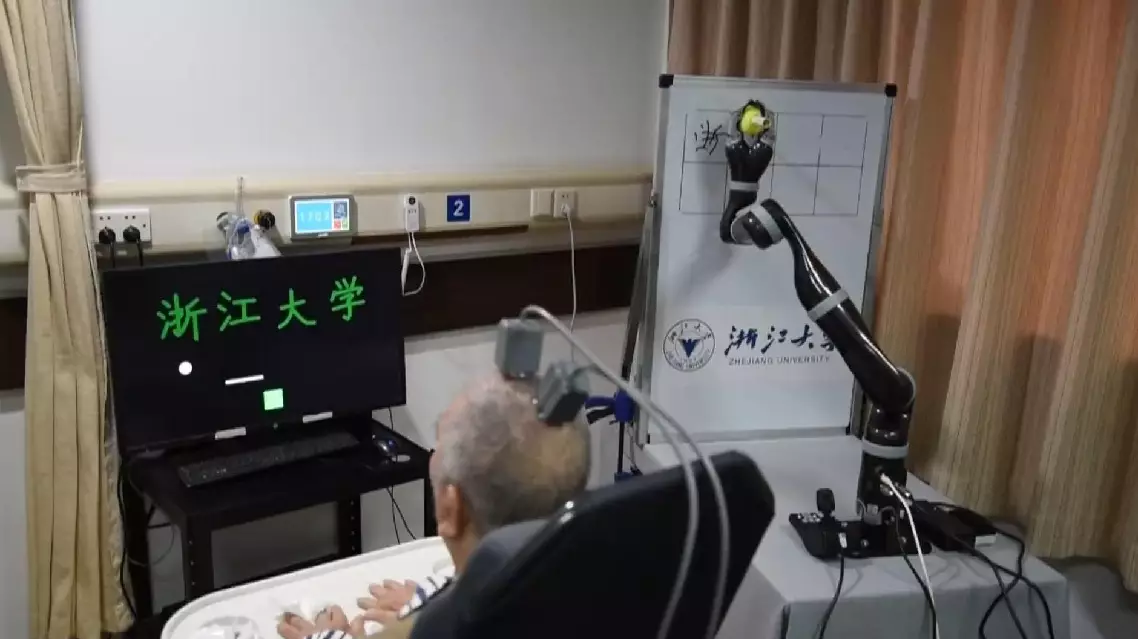
At the Second Affiliated Hospital of Zhejiang University School of Medicine in east China's Hangzhou City, BCI technology has enabled a 77-year-old patient with high-level paraplegia to write by controlling a robotic arm through a chip inserted in his brain.

"The semi-invasive brain chip is the most accurate in extracting electroencephalograms. We have overcome the most difficult challenge of decoding fine finger movements. Patients with trauma, stroke, or amyotrophic lateral sclerosis can control external mechanical devices and write the characters they want," said Zhang Jianmin, a neurosurgery expert at the hospital.

Another successful example of BCI being used in clinical settings is an implantable device, called Neural Electronic Opportunity (NEO), developed by a group of scientists from Tsinghua University.

At Xuanwu Hospital in Beijing, a Chinese clinical team has implanted a minimally-invasive, wireless BCI processor, about the size of two coins, into a participant's skull and successfully acquired the nerve signals in his brain region that control the sensory and motor functions.

After three months of home training, the patient, who has been paralyzed in all four limbs for 14 years, is now capable of fetching a bottle of water on his own via an air-filled glove driven by brain waves, with his grasping accuracy rate exceeding 90 percent.

"We ask the patient to take the bottle to these eight different positions, and then we calculate a time to assess his use of the BCI device. Currently, the patient can, on average, take this water bottle or our object to the designated position within 10 seconds," said Liu Dingkun, a doctoral student at the School of Biomedical Engineering at Tsinghua University.

At Shanghai's Zhongshan Hospital, a patient who is paralyzed following a spinal cord injury is able to stand and walk independently, following the implantation of a brain-spine interface device.

This technology employs epidural electrical stimulation to establish a connection between the brain and the spinal cord, transforming motor goals into muscle activation stimuli. On the first day after surgery, the patient's legs were able to move.

"This technology enables patients to control their legs to take steps with their minds. It is a very important technology for us, because it can help completely paralyzed patients regain the ability to walk," said Ding Jing, director of Neurology Department at Zhongshan Hospital affiliated to Fudan University.

China's National Healthcare Security Administration (NHSA) has released a pricing guideline for neural system care services, specifying brain-computer interfaces (BCIs) as an independent category.

According to the NHSA, this move will boost the clinical use of the cutting-edge technology to benefit patients in need, against the backdrop of BCIs' rapid development over recent years.

The guideline also outlines the pricing of invasive and non-invasive BCIs respectively based on the distinctive features of the two BCI approaches.
China makes new breakthroughs in clinical use of brain-computer interfaces
China makes new breakthroughs in clinical use of brain-computer interfaces

International guests who have dedicated their lives to historical truth joined China's 12th national memorial event honoring the hundreds of thousands of victims killed by Japanese troops in the Nanjing Massacre during World War II.

The memorial was held on Saturday at the public square of the Memorial Hall of the Victims in Nanjing Massacre by Japanese Invaders in Nanjing, capital of east China's Jiangsu Province. China's national flag was flown at half-mast in the presence the crowd that included survivors of the massacre, local students, and international guests.

In one of the most barbaric episodes during WWII, the Nanjing Massacre took place when Japanese troops captured the then-Chinese capital Nanjing on Dec 13, 1937. Over the course of six weeks, they proceeded to kill approximately 300,000 Chinese civilians and unarmed soldiers.

Joining the crowd was Christoph Reinhardt, the great-grandson of John Rabe (1882-1950) who was then a representative of German conglomerate Siemens in the war-ravaged Nanjing. During the Nanjing Massacre, Rabe set up an international safety zone with other foreigners, and they together saved the lives of around 250,000 Chinese people between 1937 and 1938 from the Japanese invaders.

Throughout the massacre, Rabe continued to keep a diary. To this day, all his pages remain one of the most comprehensive historical records of the atrocities committed by the Japanese aggressors.

Sayoko Yamauchi, who was also in the crowd of mourners, arrived in Nanjing on Friday from Japan's Osaka to attend Saturday's ceremony, just as she has done almost every year since China designated Dec 13 as the National Memorial Day for the Victims of the Nanjing Massacre in 2014.

Yamauchi's grandfather was one of the Japanese soldiers who invaded Nanjing in January 1938. However, since first setting foot in Nanjing in 1987, she has dedicated herself to uncovering and spreading the truth about Japan's history of aggression and enlightening the Japanese public about their country's wartime atrocities.

In 2014, ahead of China's first National Memorial Day for the Victims of the Nanjing Massacre, Yamauchi, along with 10 other individuals, received an award for her special contribution to the Memorial Hall of the Victims in the Nanjing Massacre by Japanese Invaders.

By attending the grand memorial event, Reinhardt and Yamauchi both said they hope to convey a message of remembering history and cherishing peace.

"This is my fifth visit to China, and Nanjing, and the third times I visited the ceremony. I have a wish that these survivors survive again and again and again. But my other wish is that the families of the survivors, that they transport the information, the right intention like their ancestors, because anyone must hold a hand (during) this remembering," Reinhardt told China Central Television (CCTV) in an interview before the event began on Saturday.

"Our delegation is on its 20th visit to China, coming to Nanjing to express our heartfelt condolences to those who perished 88 years ago, to remember this history, and to reflect on what we can do for a new future. That's why we are here," Yamauchi told CCTV on board the bus that took her to a local hotel in Nanjing on Friday evening.

Int'l guests call for remembering history at China's national event honoring Nanjing Massacre victims

Int'l guests call for remembering history at China's national event honoring Nanjing Massacre victims

Recommended Articles