Skip to Content Facebook Feature Image

Behind the story of the return of stuck NASA astronauts Butch Wilmore and Suni Williams

News

Behind the story of the return of stuck NASA astronauts Butch Wilmore and Suni Williams
News

News

Behind the story of the return of stuck NASA astronauts Butch Wilmore and Suni Williams

2025-03-19 03:11 Last Updated At:03:21

NASA astronauts Butch Wilmore and Suni Williams, who were stuck in space for more than nine months, are finally on their way back home to Houston. Wilmore and Williams left the International Space Station in a SpaceX capsule early Tuesday with two others and are due to splash down in the evening off the Florida coast, weather permitting.

On this episode of “The Story Behind the AP Story,” Associated Press space writer Marcia Dunn discusses their space odyssey.

Marcia Dunn, AP reporter: Almost all roads to space begin here in Cape Canaveral.

Haya Panjwani, AP correspondent: That's Marcia Dunn, The Associated Press’ space writer. She’s following Butch Wilmore and Suni Williams’ return home from the International Space Station.

PANJWANI: I'm Haya Panjwani. On this episode of “The Story Behind the AP Story,” we’re unpacking how the two astronauts got stuck up there in the first place and what they’ve done in the last few months at the station.

DUNN: So Butch and Suni became the first people, the first astronauts, to strap into a Boeing Starliner capsule and be launched into space. This was last June, June 5th, 2024. They launched aboard the Starliner on what was supposed to be an eight-day trip to the space station and back. Here we are, more than nine months later. This eight-day mission has turned into a nine-month marathon for them.

So, Butch and Suni strap in on June 5th. Launch goes off great from Cape Canaveral Space Force Station. I’m there watching, watching the rocket fly. They get to orbit safely. All is well, except the next day, as they’re going into dock with the International Space Station as planned, the thrusters start to fail. Helium is leaking. There had been some helium leaks prior to liftoff, but nobody thought it would morph into something bigger and worse.

These two are test pilots. Suni’s a helicopter pilot by trade. Butch is a fighter pilot, combat pilot, both military skill people. They temporarily had to take control to try to get the thrusters back in business so that they could make a fully automated docking at the space station. They got docked to the space station, and months started rolling by.

We’re now into the summer of 2024. Because engineers on the ground could just not exactly figure out what had happened. Well, what went wrong with the Starliner? Why did all these thrusters malfunction? What’s the deal with all the helium leaking out of it? Now, they were safe at the space station, right? And they didn’t need the Starliner at this point, but to come home. And because NASA was worried that it could be dangerous for them to get aboard this craft with these troubles, they kept them up there while they kept investigating the situation here on the ground.

This dragged on for months. And finally, NASA told Boeing, that’s it. Done. You know, you bring that capsule back empty. We’ll see if it survives entry and it lands OK. But, Butch and Suni, we’re sorry, but you’re gonna have to be up there until next year. SpaceX was now the designated taxi service for Butch and Suni.

There are only three ways to get Americans back from the space station. SpaceX, the Russians, right, because they have their capsules coming and going, and also, what should have been Starliner. The next SpaceX crew to go up, was launched in September. There should have been four people for astronauts on that flight. They knocked two people off the flight so that there were two empty seats on the SpaceX Dragon capsule for the return leg of Butch and Suni. Well, then they can’t leave until the replacements get there. Right? Because NASA always likes a crew handover between two crews to sort of, like, show them the ropes. And it just makes it an easier transition for everybody. So then they were told, hopefully you’ll be home by the end of March. This month, the end of March.

They switched capsules in the end. The brand new capsule that was taking so long to get ready is going to be used by other people on the later this spring. A private crew. They hurried up. Friday night, this past Friday night, finally the replacements lifted off. We know that the crew, the space station crew, was up and watching via monitors and everything. And I’m sure there was a lot of hooting and hollering and a lot of smiles.

PANJWANI: Butch and Suni were chosen specifically for this mission.

DUNN: Both of them have been on military deployments. Right? So these are not your run of the mill scientists who or maybe a little more touchy feely. These two are like, you know, kick the tires. You know, fly boy, fly girl kind of people. But I have to say, I’ve never seen two people who seem so upbeat. They look on the positive side.

Butch has his wife. They have two daughters, one's college age. His youngest is a senior in high school, so he’s missed most of her senior year of high school. And Suni’s husband, they have two Labrador retrievers, right. That’s their babies. And she has an elderly mother who is and has been quite worried about all this going through all of this and this.

They told reporters recently that being in space has got its challenges. No, they didn’t know that this was going to obviously take so long, but they’ve been busy doing experiments. They got to do a spacewalk together. Suni set a world record for most spacewalking time by any woman ever, with her latest spacewalk up there. They get to talk with their families almost every day with an internet phone. They got video hookups, but it’s not the same as being there. And they have told us repeatedly that it’s much harder on their families. Their families are down here on earth waiting and waiting and waiting. And while they’re busy, you know, they’re distracted with their mission. They’re laser focused on their mission. These two are particularly upbeat, positive, optimistic people.

Butch in particular is quite a religious man. And he is an elder in his Baptist church back home in Houston, and he’s even done, I understand, some, put in some calls to some of his older church members to try to give them a pep talk, right? Right. He has said he’s used his faith a lot to get him through this and that there’s a reason for everything, and that’s what he’s trying to instill in his daughters as they deal with this as well, that, you know, persevere. This will make you stronger.

PANJWANI: Now when they come back to Earth, what’s next?

DUNN: NASA wants to have an overlap of at least a few days between the crew that’s recently launched, the replacements and Butch and Suni, and they will come back with two others. Right. The two people, people who launched in September with two empty seats, they’re coming back with them. And so they want a couple of spillover days so that the people who have been up there all this time can show them the ropes.

Then they will undock in the SpaceX Dragon capsule that’s been up there since September and splash down off the Florida coast, and then they will be directly taken to Houston. You know, they have had astronauts up there as long as a year. They’ll be treated the same, you know. And of course, any astronaut coming back after six months is not allowed to drive for a certain amount of period because, you know, you’re wobbly when you get back. Your muscles are weak. Your bones are weak. Yes, you’ve been exercising two hours every day. But you know, some people do better than others coming back, right? And so they don’t want you behind a wheel. They don’t want you doing anything that could endanger you accidentally.

Between the two of them, of course, they’ve been asked, what can’t... what do you miss? What can’t you wait to to do besides hug your families when you get back? And Suni can’t wait to take her dogs for a walk and jump in the ocean, she told us recently. And Butch can’t wait to get back to face to face ministering of his flock back home at his church in Houston.

PANJWANI: Launch audio courtesy of NASA.

This has been the story behind the AP story. For more on AP’s space coverage, visit APNews.com.

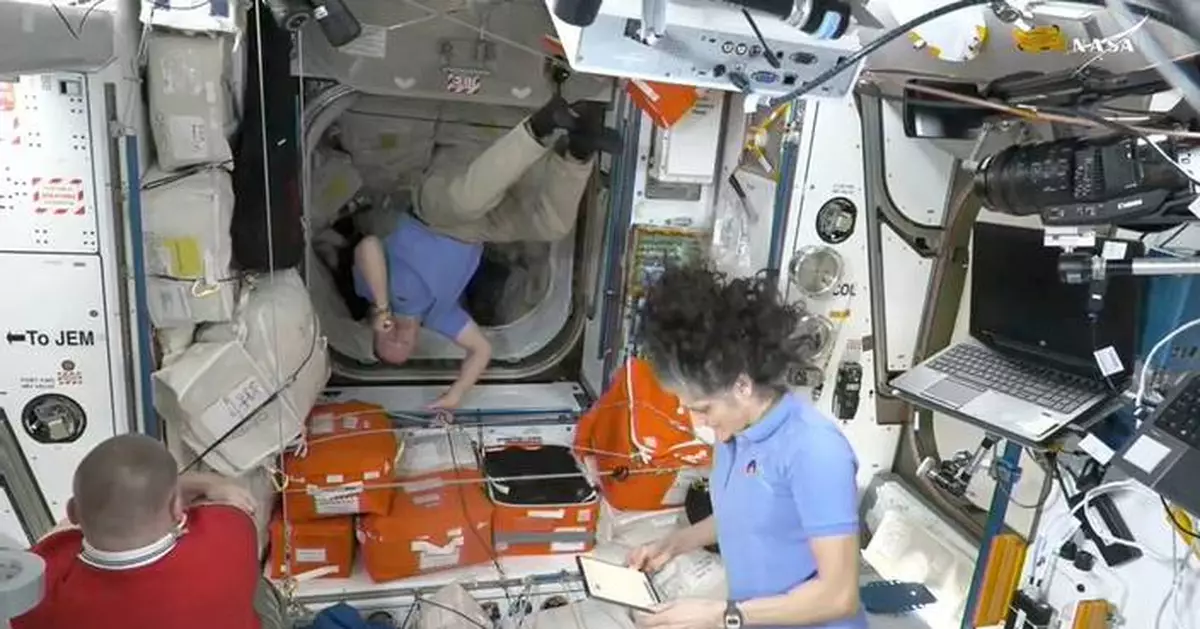
This image made from video by NASA shows Russian astronaut Alexei Ovchinin, left, Butch Wilmore, center, and Suni Williams wait to greet newly arrived astronauts after the SpaceX capsule docked with the International Space Station, Sunday, March 16, 2025. (NASA via AP)
This image made from video by NASA shows Russian astronaut Alexei Ovchinin, left, Butch Wilmore, center, and Suni Williams wait to greet newly arrived astronauts after the SpaceX capsule docked with the International Space Station, Sunday, March 16, 2025. (NASA via AP)
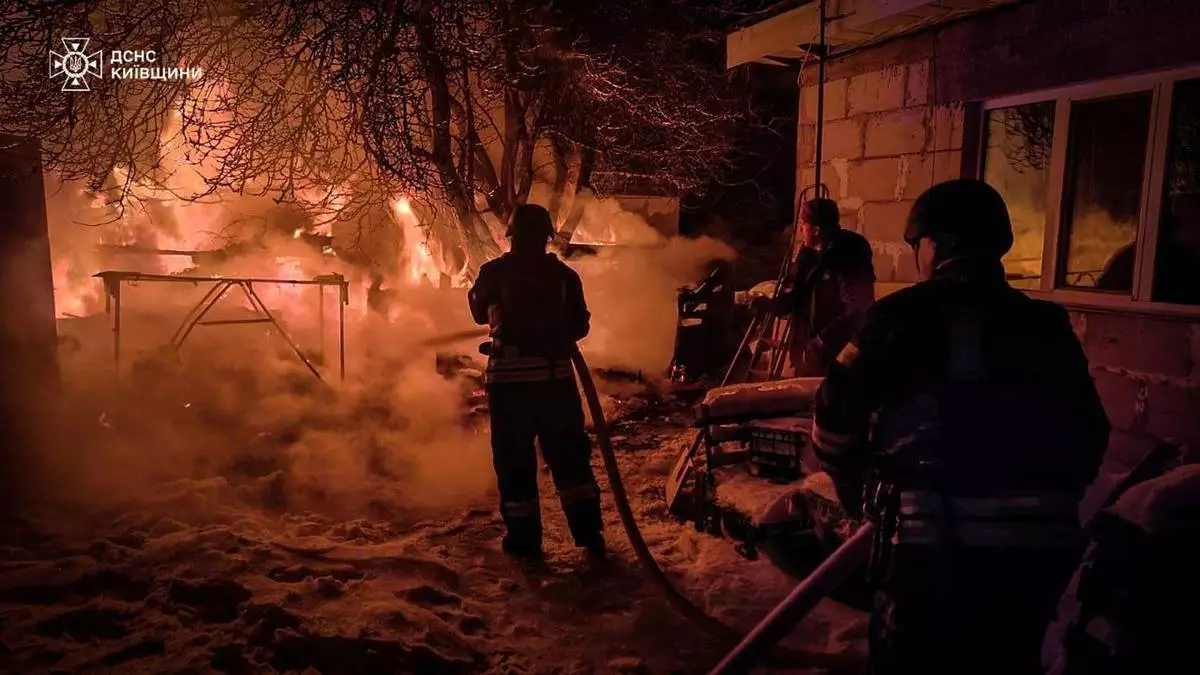
KYIV, Ukraine (AP) — Russia launched a second major drone and missile bombardment of Ukraine in four days, officials said Tuesday, aiming again at the power grid amid freezing temperatures in an apparent snub to U.S.-led peace efforts as Moscow's invasion of its neighbor approaches the four-year mark.

Russia fired almost 300 drones, 18 ballistic missiles and seven cruise missiles at eight regions overnight, Ukrainian President Volodymyr Zelenskyy said on social media.

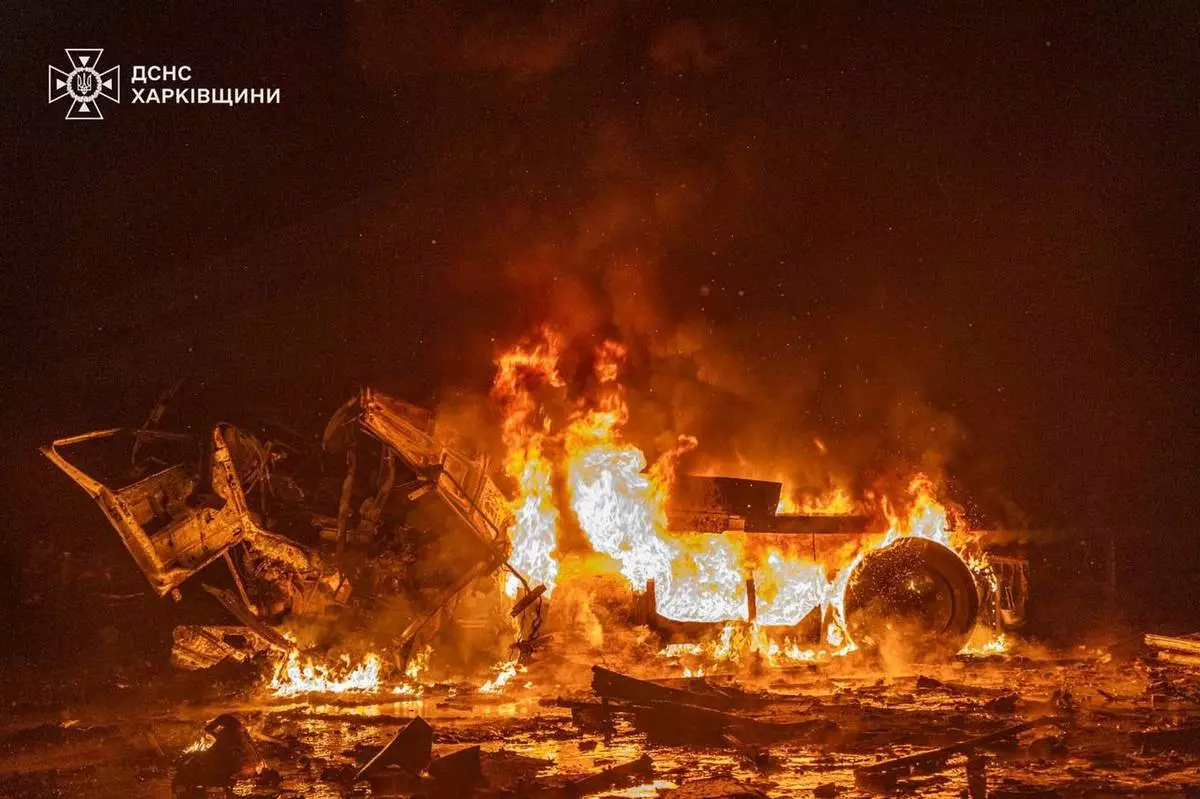
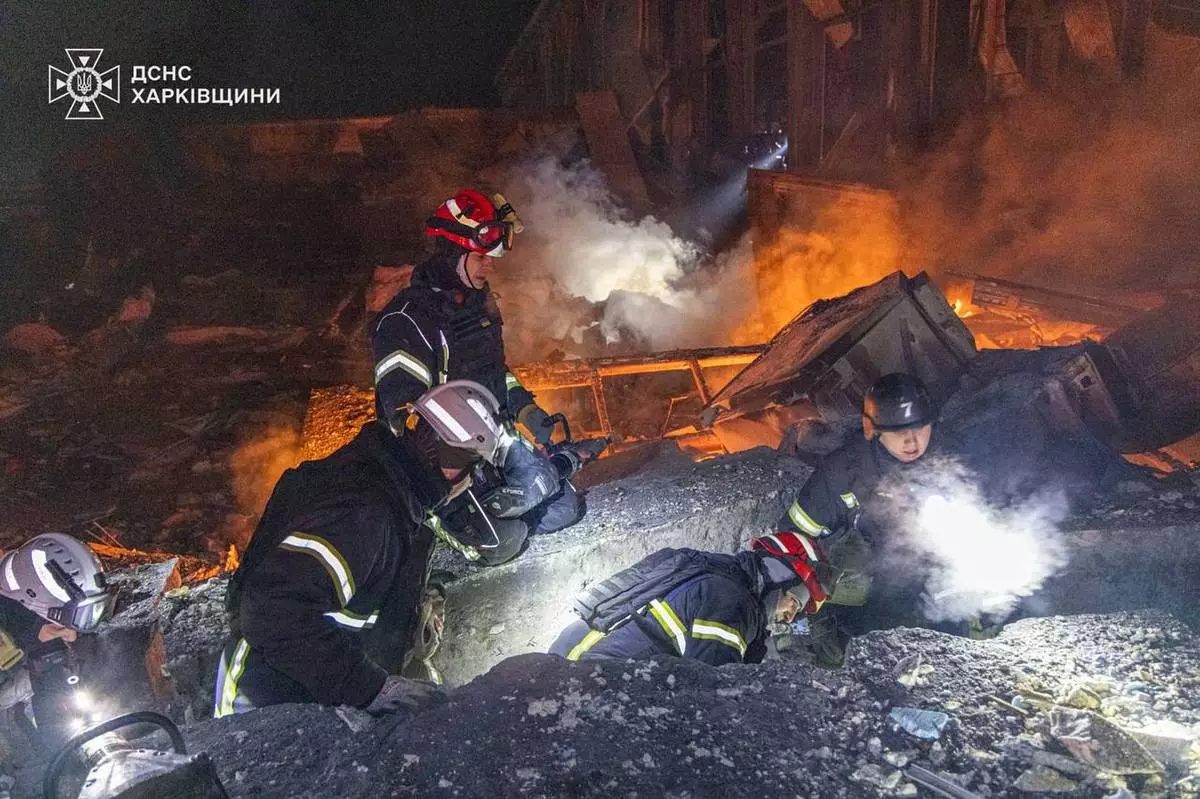
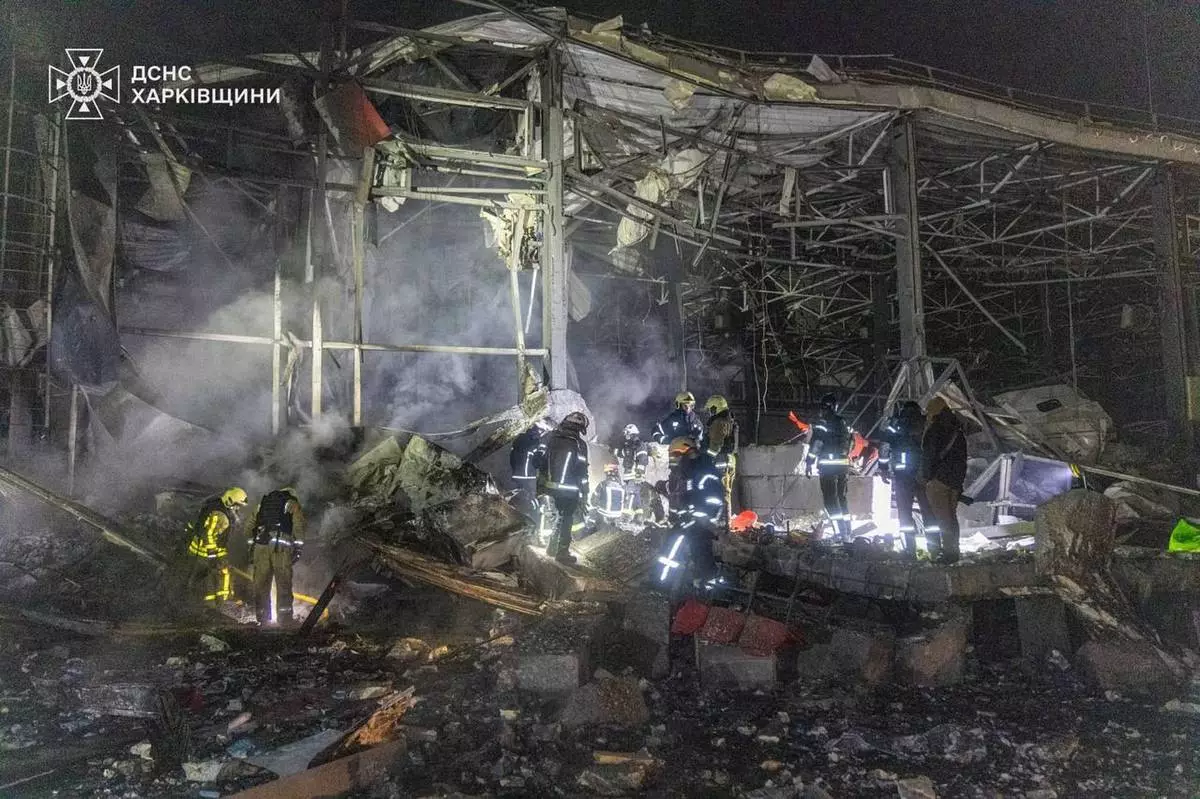
One strike in the northeastern Kharkiv region killed four people at a mail depot, and several hundred thousand households were without power in the Kyiv region, Zelenskyy said.

The daytime temperature in Kyiv, which has endured freezing temperatures for more than two weeks, was minus 12 degrees C (about 10 degrees F), with streets covered in ice and the rumble of generators heard throughout the capital.

Kyiv has grappled with severe power shortages for days, although Mayor Vitali Klitschko said Monday night's strikes caused the biggest electrical outage the city has faced so far.

More than 500 residential buildings remained without central heating Tuesday. Throughout the city, bare trees were weighed down with icicles and snow was piled up next to sidewalks.

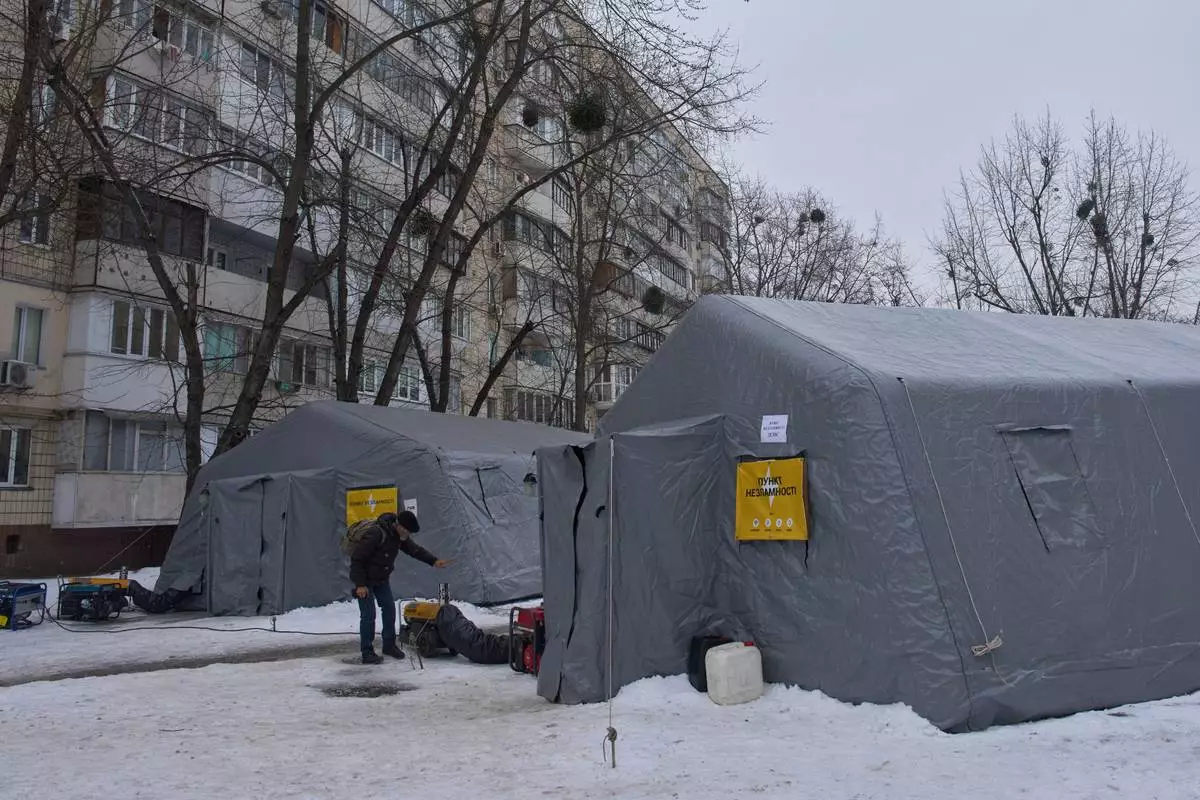
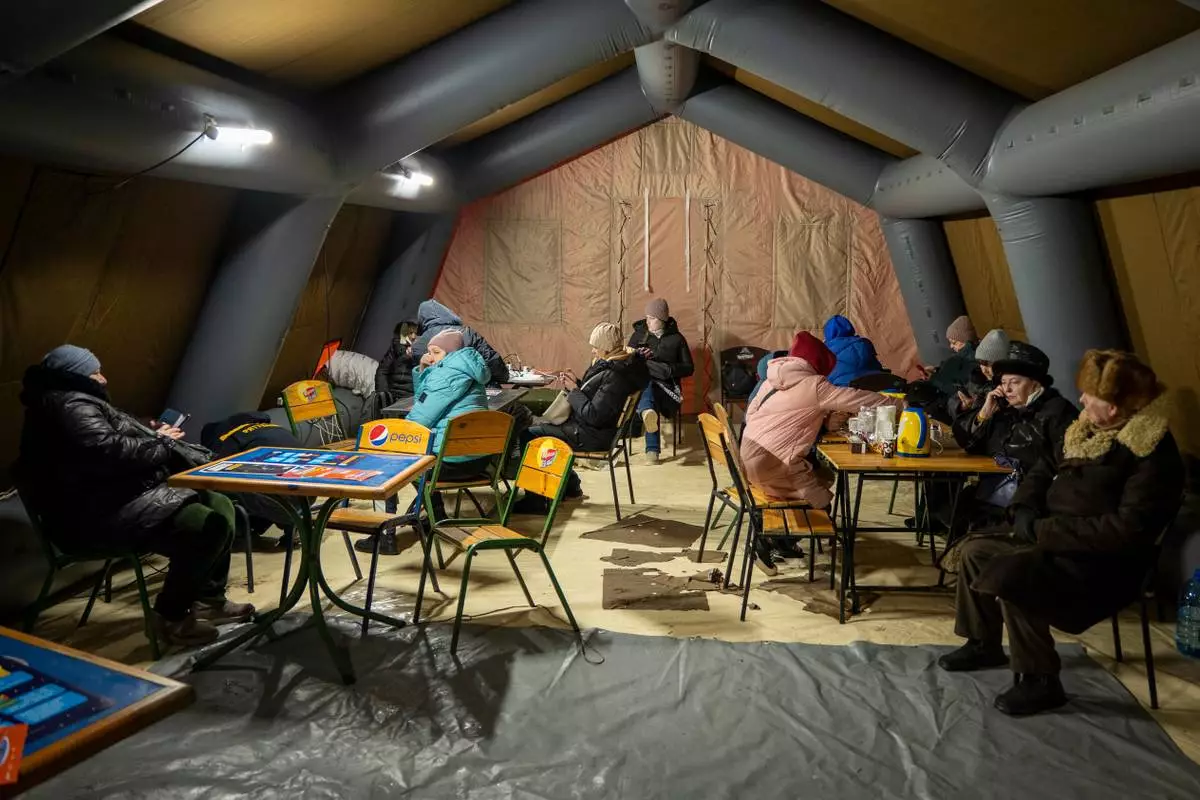
Olena Davydova, 30, charged her phone at what is called a ”Point of Invincibility" shelter in Kyiv’s Dniprovskyi district. The government-built temporary installations, often large tents on the sidewalk, provide food, drinks, warmth and electricity.

Davydova said she had been without power for nearly 50 hours. That forced her to adopt some new routines: sleeping in one bed with her child and two cats, storing fresh food on the balcony, and using candles after dark.

She says she is taking the changes in stride. “I still have enough patience. I’m not reacting to this in a very emotional way,” she told The Associated Press.

Elsewhere, friends and relatives gathered in apartments still with power or hot water, at least temporarily, to charge their phones, take showers, or share a warm drink.

Klitschko ordered the city to provide one hot meal per day to needy residents. He also announced that workers in the city’s water, heating and road maintenance services would receive bonuses for working “day and night” to restore critical infrastructure.

Four days earlier, Russia also sent hundreds of drones and dozens of missiles in a large-scale overnight attack and, for only the second time in the war, it used a powerful new hypersonic missile that struck western Ukraine in what appeared to be a clear warning to Kyiv’s NATO allies that it won’t back down.

On Monday, the U.S. accused Russia of a “ dangerous and inexplicable escalation ” of the fighting at a time when the Trump administration is trying to advance peace negotiations.

Tammy Bruce, the U.S. deputy ambassador to the United Nations, told an emergency meeting of the U.N. Security Council that Washington deplores “the staggering number of casualties” in the conflict and condemns Russia’s intensifying attacks on energy and other infrastructure.

Russia has sought to deny Ukrainian civilians heat and running water over the course of the war, hoping to wear down public resistance to Moscow’s full-scale invasion, which began on Feb. 24, 2022. Ukrainian officials describe the strategy as “weaponizing winter.”

The attack in Ukraine’s Kharkiv region also wounded 10 people, local authorities said.

In the southern city of Odesa, six people were wounded in the attack, said Oleh Kiper, the head of the regional military administration. The strikes damaged energy infrastructure, a hospital, a kindergarten, an educational facility and a number of residential buildings, he said.

Last year was the deadliest for civilians in Ukraine since 2022 as Russia intensified its aerial barrages behind the front line, according to the U.N. Human Rights Monitoring Mission in the country.

The war killed 2,514 civilians and injured 12,142 in Ukraine — 31% higher than in 2024, it said.

“The sharp increase in long-range attacks and the targeting of Ukraine’s national energy infrastructure mean that the consequences of the war are now felt by civilians far beyond the front line,” Danielle Bell, the agency’s head, said in a statement Monday.

Zelenskyy said Ukraine is counting on quicker deliveries of agreed upon air defense systems from the U.S. and Europe, as well as new pledges of aid to counter Russia’s latest onslaught.

Meanwhile, Russian air defenses shot down 11 Ukrainian drones overnight, Russia’s Defese Ministry said Tuesday. Seven were reportedly destroyed over Russia’s Rostov region, where Gov. Yuri Slyusar confirmed an attack on the coastal city of Taganrog, about 40 kilometers (about 24 miles) east of the Ukrainian border, in Kyiv's latest long-range attack on Russian war-related facilities.

Ukraine’s military said its drones hit a drone manufacturing facility in Taganrog. The Atlant Aero plant designs, manufactures and tests Molniya drones and components for Orion unmanned aerial vehicles, according to the General Staff of the Armed Forces of Ukraine. Explosions and a fire were reported at the site, with damage to production buildings confirmed, the General Staff said.

It wasn't possible to independently verify the reports.

Katie Marie Davies in Manchester, England, and Volodymyr Yurchuk in Kyiv contributed.

Follow AP’s coverage of the war in Ukraine at https://apnews.com/hub/russia-ukraine

A man gets warm at emergency tents where people can warm up following Russia's regular air attacks against the country's energy objects, that leave residents without power, water and heating in the dead of winter, in Kyiv, Ukraine, Tuesday, Jan. 13, 2026. (AP Photo/Efrem Lukatsky)

A man gets warm at emergency tents where people can warm up following Russia's regular air attacks against the country's energy objects, that leave residents without power, water and heating in the dead of winter, in Kyiv, Ukraine, Tuesday, Jan. 13, 2026. (AP Photo/Efrem Lukatsky)

People get warm and charge their batteries in a tent set up by the emergency service following Russia's regular air attacks against the country's energy objects, in Kyiv, Ukraine, Tuesday, Jan. 13, 2026. (AP Photo/Danyil Bashakov)

People get warm and charge their batteries in a tent set up by the emergency service following Russia's regular air attacks against the country's energy objects, in Kyiv, Ukraine, Tuesday, Jan. 13, 2026. (AP Photo/Danyil Bashakov)

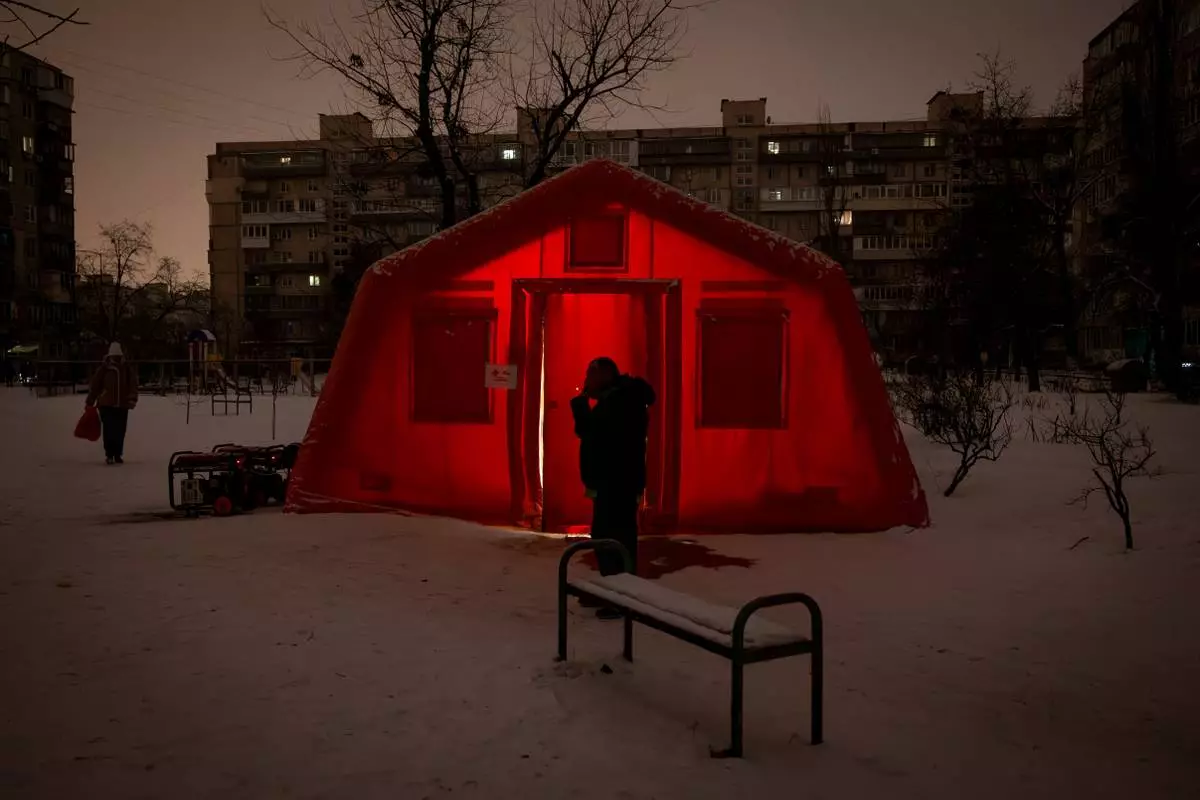
A man smokes outside of an emergency tent where people can warm up following Russia's regular air attacks against the country's energy objects, that leave residents without power, water and heating in the dead of winter, in Kyiv, Ukraine, Tuesday, Jan. 13, 2026. (AP Photo/Danyil Bashakov)

A man smokes outside of an emergency tent where people can warm up following Russia's regular air attacks against the country's energy objects, that leave residents without power, water and heating in the dead of winter, in Kyiv, Ukraine, Tuesday, Jan. 13, 2026. (AP Photo/Danyil Bashakov)

In this photo provided by the Ukrainian Emergency Service, emergency services personnel work to extinguish a fire following a Russian attack in Kharkiv, Ukraine, Tuesday, Jan. 13, 2026. (Ukrainian Emergency Service via AP)

In this photo provided by the Ukrainian Emergency Service, emergency services personnel work to extinguish a fire following a Russian attack in Kharkiv, Ukraine, Tuesday, Jan. 13, 2026. (Ukrainian Emergency Service via AP)

In this photo provided by the Ukrainian Emergency Service, emergency services personnel work to extinguish a fire following a Russian attack in Kharkiv, Ukraine, Tuesday, Jan. 13, 2026. (Ukrainian Emergency Service via AP)

In this photo provided by the Ukrainian Emergency Service, emergency services personnel work to extinguish a fire following a Russian attack in Kharkiv, Ukraine, Tuesday, Jan. 13, 2026. (Ukrainian Emergency Service via AP)

In this photo provided by the Ukrainian Emergency Service, emergency services personnel work to extinguish a fire following a Russian attack in Kharkiv, Ukraine, Tuesday, Jan. 13, 2026. (Ukrainian Emergency Service via AP)

In this photo provided by the Ukrainian Emergency Service, emergency services personnel work to extinguish a fire following a Russian attack in Kharkiv, Ukraine, Tuesday, Jan. 13, 2026. (Ukrainian Emergency Service via AP)

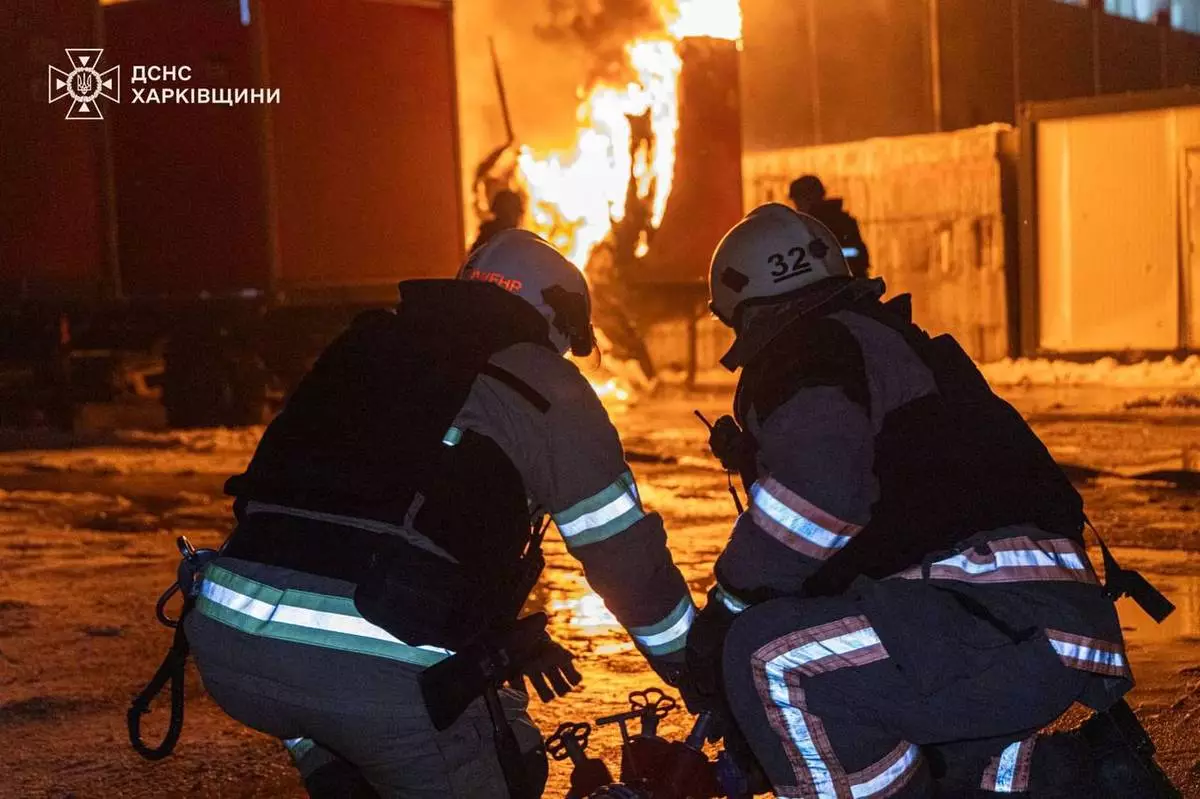
In this photo provided by the Ukrainian Emergency Service, emergency services personnel work to extinguish a fire following a Russian attack in Kharkiv, Ukraine, Tuesday, Jan. 13, 2026. (Ukrainian Emergency Service via AP)

In this photo provided by the Ukrainian Emergency Service, emergency services personnel work to extinguish a fire following a Russian attack in Kharkiv, Ukraine, Tuesday, Jan. 13, 2026. (Ukrainian Emergency Service via AP)

In this photo provided by the Ukrainian Emergency Service, emergency services personnel work to extinguish a fire following a Russian attack in Kyiv region, Ukraine, Tuesday, Jan. 13, 2026. (Ukrainian Emergency Service via AP)

In this photo provided by the Ukrainian Emergency Service, emergency services personnel work to extinguish a fire following a Russian attack in Kyiv region, Ukraine, Tuesday, Jan. 13, 2026. (Ukrainian Emergency Service via AP)

Recommended Articles