Skip to Content Facebook Feature Image

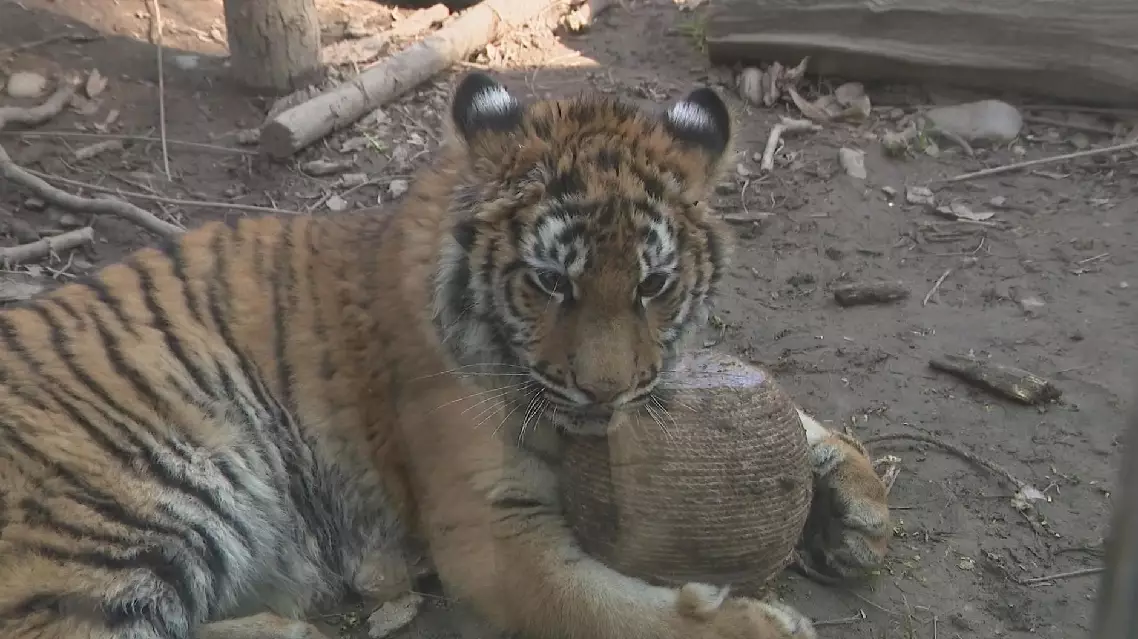
Tiger cub in Shanghai Zoo claws at heartstrings with struggle-to-stardom story

China

China

China

Tiger cub in Shanghai Zoo claws at heartstrings with struggle-to-stardom story

2025-03-20 03:21 Last Updated At:04:17

A seven-month-old Bengal tiger cub at Shanghai Zoo has captured the hearts of zoogoers and internet users with its feathery fur and cheery personality after overcoming a challenging start in life.

Named Hong Tang, meaning brown sugar, the female cub has been charming visitors with her adorably round face, reddish-brown stripes, and endless playful antics.

"I came here just to see her today. When I see this tiger, I feel like I'm looking at a muscle man acting cute," said a zoo visitor.

"She's a hit on the internet. I saw that she has developed a personality, so I wanted to see her in person," said another visitor.

"She's so cute, just like a big kitty-cat. I would love to pet her," another visitor said.

The fluffy cub was born on August 10, 2024. Tragically, she was rejected by her mother, which would have been a death sentence in the wild. Thankfully, zoo staff were miraculously able to nurse her, bringing her into healthy adolescence.

"She has a lively personality and acts cute for you. Every time we enter, she will lie at the door with her little head sticking out and looking at us. She particularly likes to watch the two striped hyenas quarreling next door," said Jiang Wenting, a zookeeper and caretaker for the cub.

Hong Tang's favorite foods are chicken and beef, according to the zookeeper. 

"She is fluffy now. She loves chicken and beef. We also provide beef bones for her to bite," said Jiang.

At seven months old, the cub has reached the equivalent of eight or nine human years. Female tigers generally reach maturity at around three years old.
Tiger cub in Shanghai Zoo claws at heartstrings with struggle-to-stardom story


Tiger cub in Shanghai Zoo claws at heartstrings with struggle-to-stardom story

The Langqi passenger terminal in Fuzhou of east China's Fujian Province officially commenced a new departure tax refund initiative for travelers heading on the "mini three links" route on Tuesday, with streamlined measures boosting the efficiency of tax refunds and speeding up customs clearance procedures.

The "mini three links" refers to direct trade, postal and transport services launched in 2001 between Fujian Province and the Taiwan-administered Kinmen and Matsu islands. It serves as a vital, convenient cross-strait passage for personnel exchanges and economic and trade interactions between the Chinese mainland and the Taiwan region.

At the heart of the upgraded service is an optimized procedure dubbed the "one document, one bag, one code" process, a simple and streamlined model designed to shorten clearance time for outbound passengers.

Under this framework, travelers who make purchases at designated pilot tax refund stores can have their qualified goods consolidated into a single sealed bag, with all corresponding tax refund information integrated into a unique QR code printed on the tax refund application form.

When departing via the Langqi passenger terminal, on-site customs officers only need to scan the QR code to retrieve and verify the details relating to the applicant's tax refund application. Travelers can then get quick customs clearance once the information is confirmed to be accurate, with no requirement to open their sealed shopping bags for repeated inspections.

Departure tax refund services launched at "mini three links" port in Fuzhou

Departure tax refund services launched at "mini three links" port in Fuzhou

Recommended Articles