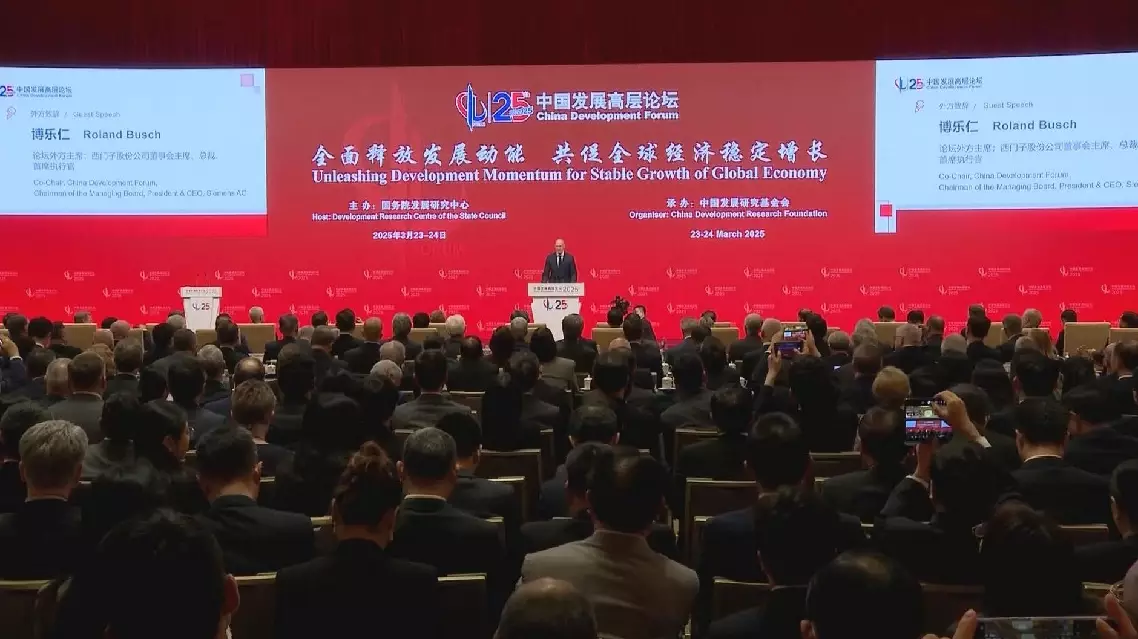
Hundreds of distinguished guests from across the globe have gathered for the annual China Development Forum (CDF) which kicked off on Sunday in Beijing, focusing on the prospects of both China's and global economic growth.
Under the theme "Unleashing Development Momentum for Stable Growth of Global Economy," this year's two-day CDF features 12 symposiums and several closed-door sessions, covering topics such as healthcare, consumption, AI and sustainable supply chains.
Delivering the opening address of the event, Premier Li Qiang reiterated China's commitment to openness and global collaboration, noting that more proactive fiscal policies will be implemented to hit the economic growth rate target of around 5 percent for 2025 announced earlier this year.
The forum has attracted over 100 representatives from major international organizations, leading multinational enterprises, and significant research institutions to gather in Beijing.
"We have to recognize that the world's economy is in the midst of a massive transformation which is driven by many aspects. And one of the most important ones might be technology and artificial intelligence in particular. You call it AI-jia (AI-plus). That holds true for China as well and China gave the answer for where growth would come from," said Roland Busch, President and Chief Executive Officer of Siemens AG, speaking at the event.
On the sidelines, business leaders said that recent indications from China's central authorities have affirmed the country's continued building of an investor-friendly environment.
"The messages that we got is China's open for business, China is set for growth, China is focusing on innovation in all verticals, but also in the green economy. And we now have a 360-degree strategy for China. In the next years, we're investing no less than 14 billion RMB into innovation, new technology and a whole host of new cars," said Ola Kallenius, chairman of the Board of Management of Mercedes-Benz Group.
Han Wenxiu, executive deputy director of the Office of the Central Committee for Financial and Economic Affairs, said while speaking at the event that China will unwaveringly advance high-level opening-up and steadily expand institutional openness, providing stability and certainty to the world, for the prosperity and development of the world.
"Since the beginning of this year, China's economy has continued to show a trend of rebounding and is expected to achieve a good start in the first quarter. Our macro policies still have significant room for counter-cyclical adjustment, and we are confident in seizing the momentum," Han said.
The CDF, sponsored by the Development Research Center of the State Council and organized by the China Development Research Foundation, has become a key platform for dialog and cooperation between China and the rest of the world since its inception in 2000.
Int'l guests to China Development Forum 2025 focus on pathways to further growth