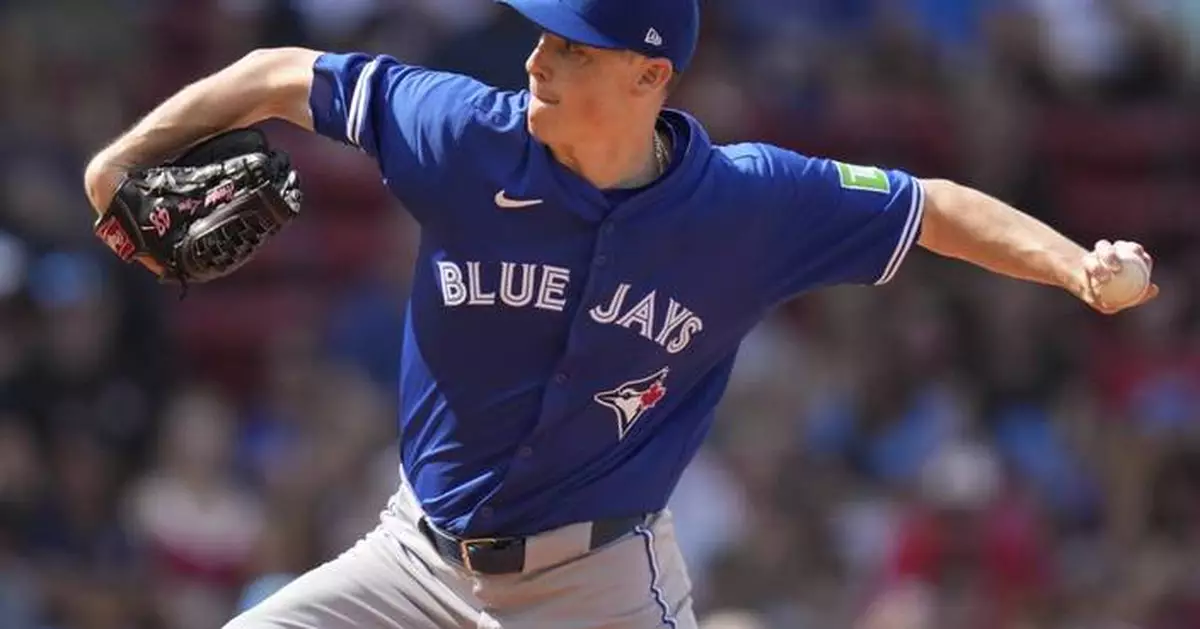
TAMPA, Fla (AP) — Ryan Yarbrough agreed to a $2 million, one-year contract with the New York Yankees on Monday, a day after he was released from a minor league deal with the Toronto Blue Jays.
A 33-year-old left-hander with a slight sidearm delivery, Yarbrough can earn an additional $250,000 in performance bonuses for innings.
“There were other teams, but this was by far the team I was most interested in," he was quoted as saying by The Athletic. "I’ve heard a lot from the pitching side (about) what they’ve been able to do with guys. That was exciting and intriguing to me.”
Yarbrough is 53-40 with a 4.21 ERA in 68 starts and 128 relief appearances over seven seasons with Tampa Bay (2018-22), Kansas City (2023), the Dodgers (2023-24), who acquired him on July 30 in the trade that sent outfielder Kevin Kiermaier to Los Angeles. He was 5-2 with a 3.19 ERA in 44 relief appearances last season.
Yarbrough throws a sinker (28.7% of his pitches last season), curveball (27.5%), four-seam fastball that averaged 86.7 mph (18.4%), changeup (15.5%) and cutter (9.9%).
His four-seam fastball velocity was the slowest in the major leagues among 138 pitchers who threw 1,500 or more pitches, 1 mph slower than Kyle Hendricks, who was 137th.
Yarbrough agreed to a minor league deal with Toronto on Feb. 21 and had a 4.05 ERA in 6 2/3 innings over four spring training appearances, striking out eight and walking one.
AL Rookie of the Year Luis Gil, a right-hander sidelined by a strained right lat muscle, was placed on the 60-day injured list.
AP MLB: https://apnews.com/hub/mlb

FILE - Toronto Blue Jays pitcher Ryan Yarbrough delivers during the sixth inning of a baseball game against the Boston Red Sox at Fenway Park, Aug. 26, 2024, in Boston. (AP Photo/Charles Krupa, file)
NEW YORK (AP) — Kamala Harris “wrote off rural America" during the 2024 presidential campaign and failed to attack Donald Trump with sufficient “negative firepower," according to a long-awaited post-election autopsy released on Thursday by the Democratic National Committee.
The committee's chair, Ken Martin, shared the 192-page report only after facing intense internal pressure from frustrated Democratic operatives concerned with his leadership. Martin had originally promised to release the autopsy, only to keep it under wraps for months because he was concerned it would be a distraction ahead of the midterms as Democrats mobilize to take back control of Congress.
On Tuesday, Martin apologized for his handling of the situation and conceded that the report was withheld because it “was not ready for primetime."
Although the autopsy criticizes Democrats' focus on “identity politics,” it sidesteps some of the most controversial elements of the 2024 campaign. The report does not address former President Joe Biden’s decision to seek reelection, the rushed selection of Harris to replace him on the ticket or the party's acrimonious divide over the war in Gaza.
“I am not proud of this product; it does not meet my standards, and it won’t meet your standards,” Martin wrote in an essay on Substack on Thursday. “I don’t endorse what’s in this report, or what’s left out of it. I could not in good faith put the DNC’s stamp of approval on it. But transparency is paramount.”
A spokesperson for Harris did not immediately respond to a request for comment.
The initial reaction from Democratic operatives was a mix of bafflement and anger over Martin's handling of the situation.
“Why not say this in 2024, or bring in more people to finish it, instead of turning this into the dumbest media cycle for 7-8 months?” Democratic strategist Steve Schale wrote on social media.
The postelection report, which was authored by Democratic consultant Paul Rivera, calls for “a renewed focus on the voters of Middle America and the South, who have come to believe they are not included in the Democratic vision of a stronger and more dynamic America for everyone.”
“Millions of Americans are suffering from poor access to healthcare, manufacturing and job losses, and a failing infrastructure, yet continue to be persuaded to vote against their best interests because they do not see themselves reflected in the America of the Democratic Party,” the report says.
The autopsy points to a reduction in support and training for Democratic state parties, voter registration shifts and “a persistent inability or unwillingness to listen to all voters.”
Thursday's release comes as Martin confronts a crisis of confidence among party officials who are increasingly concerned about the health of their political machine barely a year into his term. Some Democratic operatives have had informal discussions about recruiting a new chair, even though most believe that Martin’s job wasn't in serious jeopardy ahead of the midterm elections.
The report found that Harris and her allies failed to focus enough on Trump's negatives, especially his felony convictions. This was part of a broader criticism that Democrats' messaging is too focused on reason and winning arguments, “even in cycles when the electorate is defined by rage.”
“There was a decision in the 2024 Democratic leadership not to engage in negative advertising at the scale required,” the report states. “The Trump campaign and supportive Super PACs went full throttle against Vice President Harris, but there was not sufficient or similar negative firepower directed at Trump by Democrats.”
The report continues: “It was essential to prosecute a more effective case as to why Trump should have been disqualified from ever again taking office. The grounds were there, but the messaging did not make the case.”
Trump's attack on Harris' transgender policies were cited as a key contrast.
Specifically, the report suggested the Democratic nominee was “boxed” in by the Trump campaign's “very effective” ad that highlighted Harris' previous statement of support for taxpayer-funded gender-affirming surgeries for prison inmates.
Democratic pollsters believed that “if the Vice President would not change her position – and she did not – then there was nothing which would have worked as a response," the report said.
The report criticized Harris' outreach to key segments of America while condemning the party's focus on “identity politics.”
“Harris wrote off rural America, assuming urban/suburban margins would compensate. The math doesn’t work,” the report says. “You can’t lose rural areas by overwhelming margins and make it up elsewhere when rural voters are a significant share of the electorate. If Democrats are to reclaim leadership in the Heartland or the South, candidates must perform well in rural turf. Show up, listen, and then do it again.”
The report also references Democrats' underperformance with male voters of color.
“Male voters require direct engagement. The gender gap can be narrowed. Deploy male messengers, address economic concerns, and don’t assume identity politics will hold male voters of color,” it says.

President Donald Trump speaks during an event about loosening a federal refrigerant rule, in the Oval Office at the White House, Thursday, May 21, 2026, in Washington. (AP Photo/Jacquelyn Martin)

Former Vice President Kamala Harris speaks during a fireside chat on Thursday, May 7, 2026, in Las Vegas. (AP Photo/Ty ONeil)
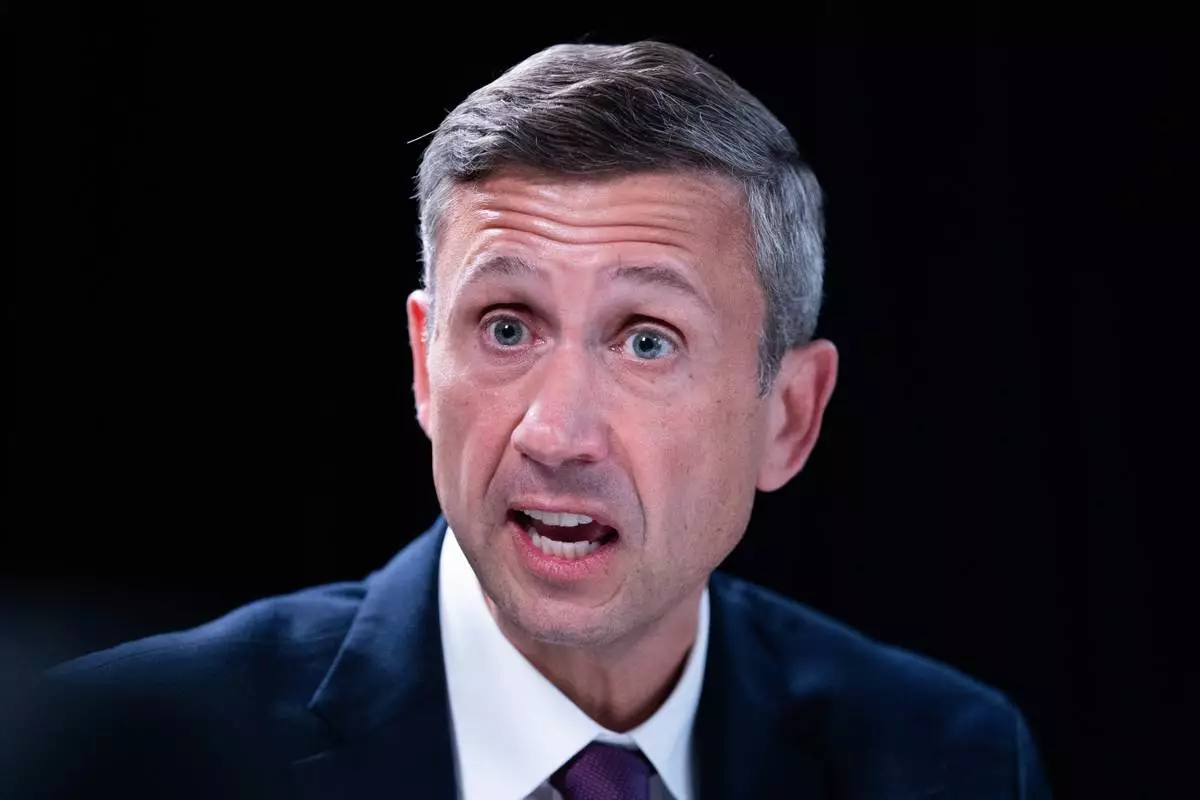
FILE - Democratic National Committee chair Ken Martin speaks during an interview with The Associated Press at DNC headquarters, Jan. 12, 2026, in Washington. (AP Photo/Allison Robbert, File)