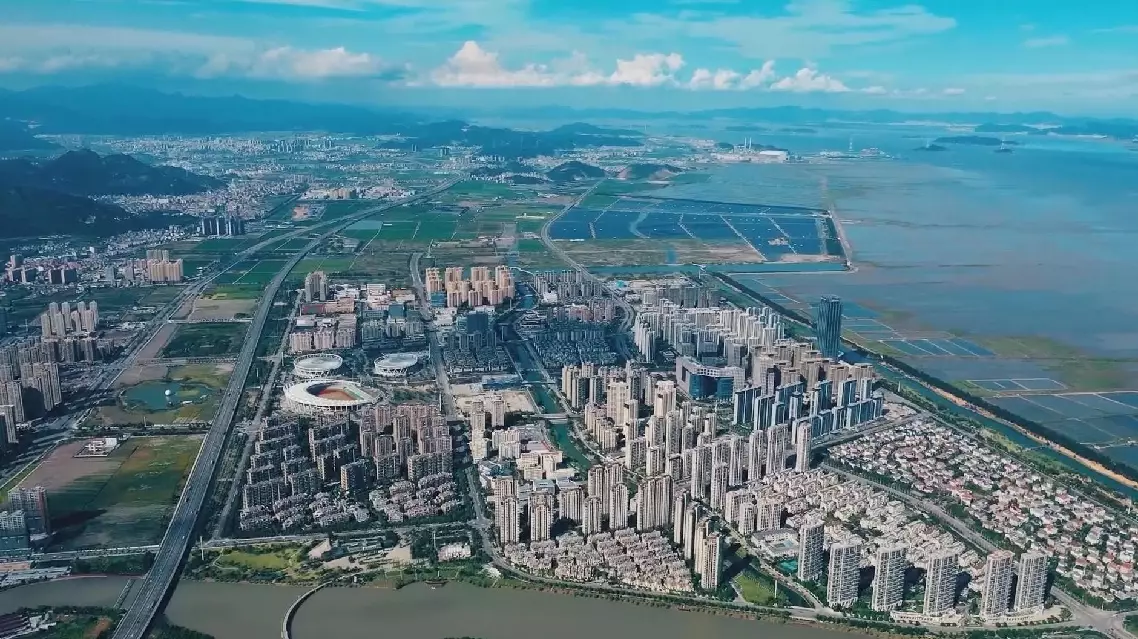
Authorities in Zhejiang Province, a key manufacturing hub in eastern China, are intensifying efforts to enhance the high-quality development of the province’s private economy by implementing policies to create a more favorable business environment for private enterprises, according to Wang Hao, Secretary of the Communist Party of China (CPC) Zhejiang Provincial Committee.
Zhejiang plans to further optimize its market-oriented, law-based, and internationalized business framework this year to support the high-quality development of private companies, said Wang.
In one measure to enhance the business environment, Zhejiang is swiftly advancing governance reforms in the bidding and tendering sector, focusing on dismantling hidden barriers.
The province is also refining mechanisms for timely settlement of outstanding payments owed to enterprises, efficiently addressing issues like commercial bribery and intellectual property infringements.
Zhejiang has outlined the "three 70 percents" policy, wherein over 70 percent of provincial industry fund investments should be directed towards private projects, at least 70 percent of annual new energy consumption indicators should support private investments, and over 70 percent of land is allocated for private investment projects.
"This year, we will reduce the burden on market entities by over 250 billion yuan (about 35 billion U.S. dollars) and provide approximately 400 billion yuan (about 55 billion U.S. dollars) in interest-free loan renewals. We will support private enterprises in actively participating in major national strategies and enhancing security capacity in key areas as well as in large-scale equipment upgrades and consumer goods trade-in programs. We will also ensure that pro-business policies are implemented efficiently and benefit all eligible enterprises, focusing on providing optimal services, minimizing costs, and maximizing efficiency to create a favorable environment for the development of the private economy," said Wang.
Wang emphasized the importance of maintaining open communication between the government and businesses, ensuring a supportive yet regulated and legal environment that effectively addresses challenges faced by private enterprises.
"We will steadfastly follow General Sectary Xi Jinping's guidance to support private enterprises and entrepreneurs in daring to make bold explorations and lead in innovation by fully leveraging their role as drivers of innovation. We will also support and guide them to pursue excellence, enhance quality and efficiency, further refine corporate governance structures, and strive to build modern enterprises and world-class corporations. Through these efforts, we aim to achieve new glories and make fresh contributions in advancing Chinese modernization," said Wang.
Zhejiang authorities push high-quality development of private economy with favorable policies
Record numbers of foreign travelers are pouring into China this summer, drawn by cool climate escapes, film-inspired cultural experiences, and irresistible shopping sprees.
In the first half of the year, inbound arrivals from overseas reached 22.91 million, a 20.4 percent year-on-year increase, according to the National Immigration Administration. Among them, 17.82 million entered visa-free, up 30.6 percent. The cross-border travel surge is emerging as a fresh engine for economic growth.
As a blistering heatwave sweeps Europe, Chinese air conditioners have flown off shelves for export. Large numbers of European travelers are also heading to China, where air conditioning is widely available indoors and naturally cool destinations await across the country.
This summer, European countries made up 30 percent of China's top 20 inbound source markets, with bookings jumping 275 percent from a year earlier, according to data from third-party travel platforms.
The southern tech hub of Shenzhen has seen a steady rise in overseas arrivals. Some travelers said that while temperatures outside can be high, the near-ubiquitous indoor air conditioning keeps things comfortably cool.
"We are thinking about doing some indoor skiing, some jet skiing, maybe. Snow is cold and water is cold, so it will cool me down," said Robin Owen, who traveled from Britain with his partner.
Meanwhile, China's varied terrain offers plenty of refreshing options.
In the northeast, the vast forested expanse of Changbai Mountain serves as a colossal natural canopy. Coastal cities like Dalian also provide breezy seaside retreats.
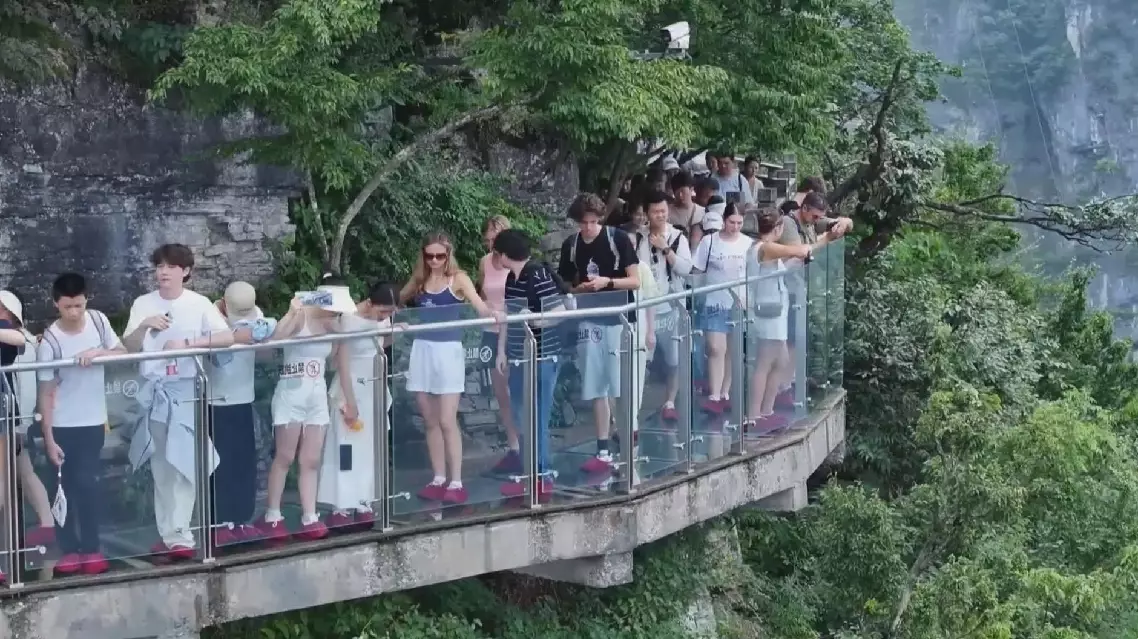
Central China's Tianmen Mountain, a landmark in the tourist city of Zhangjiajie, has drawn an increasing flow of overseas travelers seeking natural cooling. At an elevation of over 1,500 meters, the peak maintains a refreshing average temperature of 22 to 26 degrees Celsius during the hottest months.
"It was great actually for walks and everything, and I do think it could be a summer resort. I think it would be great. The temperatures are well regulated and the views are out of this world," said Dutch visitor Aida Sivic.
Box office hits are also fueling travel. The acclaimed Chaoshan-dialect film "Dear You", which follows Chinese immigrants in Thailand and explores themes of nostalgia and homecoming, has struck a deep chord across Southeast Asian countries with large Chinese communities. The film's success has since drawn waves of international tourists to its filming locations in the southern Chinese cities of Chaozhou, Shantou, Jiangmen and Jieyang.
"We flew all the way to Shantou specifically to see this movie. I truly enjoyed it. It reminded me so much of my father while I was watching," said a Singaporean viewer.
Beyond sightseeing, shopping has become a powerful lure. In Shenzhen's Huaqiangbei electronics district, best known as a wholesale hub for components and electronic products, foreign visitors flock to buy the latest gadgets.
French tourist Jocelyne, who had done her research before arriving, headed straight to Huaqiangbei after she touched down, where she picked up a spray fan, one of the season's hottest sellers.
"The mall is really good because air conditioning is everywhere. Here in the same place with so many choices," she said.
Since the start of summer, many overseas travelers have made special trips to hunt for bargains, and merchants have tailored their offerings to international tastes, rolling out misting fans and cooling towels for customers from different countries. Along Huaqiangbei's pedestrian street, foreign tourists are now a common sight, sipping cold drinks and wielding handheld fans as they browse.
With easier payment procedures and upgraded departure tax refund policies now in place, the shopping experience has become smoother than ever. Tourists' purchase lists have expanded far beyond traditional souvenirs to include drones, VR glasses, cultural creative goods and trendy toys, all of which are increasingly seen abroad as quintessential Chinese finds.
In 2025, inbound arrivals to China surpassed 150 million, up more than 17 percent year on year, with spending exceeding 130 billion U.S dollars, a nearly 40 percent increase, signaling that the country's appeal is resonating far beyond its borders.
Inbound tourism to China soars this summer as overseas visitors seek cool escapes