Skip to Content Facebook Feature Image

China promotes village tourism to advance rural revitalization

China

China

China

China promotes village tourism to advance rural revitalization

2025-04-06 21:09 Last Updated At:21:37

Villages and towns across China have leveraged their ecological, cultural and historical advantages to promote tourism as part of their efforts to advance rural revitalization.

In Liming Ancient Village, southwest China's Chongqing Municipality, rapeseed flowers are in full bloom.

The combination of the golden sea of ​​flowers and the traditional residential houses has attracted many tourists to the village.

Visitors stroll along the paths lined with blooming flowers, or ride a mini train through the rapeseed fields, to get pleasure from the spring season.

"It is very comfortable to ride trains shuttling through the rapeseed flowers. Spring is in the air," said Liu Dan, a tourist.

"Residential houses in Liming Ancient Village are well-arranged and clean, and the rapeseed flowers are beautiful," said Yang Yongsheng, another tourist.

In Gongzhuang Village, north China's Hebei Province, apricot trees are in full bloom along the Great Wall.

The coupling of the natural beauty and the ancient wonder has become a popular photo spot.

"In addition to seeing apricot blossoms, tourists can also climb the Great Wall. People can not only explore the history, but also view spring flowers blooming all over the mountains. It is really a rare experience," said Yang Yongsheng, a tourist.

In recent years, Gongzhuang Village has transformed itself into a popular tourist destination during the spring season by taking advantage of apricots and other natural resources, and improved its living environment.

"We work to make more people know the natural beauty of Gongzhuang, thereby driving up the business of the catering, accommodation and other industries in the village. We also use festivals to showcase the village's traditional culture and folk customs, so as to help promote agricultural products, and boost rural tourism," said Feng Mingxiao, secretary of Communist Party of China (CPC) branch at Gongzhuang Village.

During the ongoing three-day Qingming Festival holiday, Wanglinpo Village, east China's Shandong Province, has welcomed more than 10,000 vacationers each day, as it offers them a chance to connect with the past in a meaningful way.

The village not only recreates scenes of an old Chinese village, where corn cobs are hung out to dry in bundles and stone grinders are used, but also enables visitors to experience more than 10 traditional folk crafts.

"I was born in the 2000s. I have never seen this kind of traditional craft before, and I don't know the production process. This experience is very novel, allowing me to learn a lot about traditional folk crafts. It is very interesting," said Wang Zengrui, a tourist.

About one year ago, old houses were seen everywhere which had been idle for many years.

The CPC branch at Wanglinpo Village has used the houses to recreate traditional agricultural life, not only providing villagers with an extra source of income, but also attracting urban dwellers to experience rural life, traditional crafts, and traditional culture. "We have decorated and renovated old houses while maintaining its traditional appearance. Our purpose is to spark feelings of nostalgia amongst tourists who stroll around the old houses and streets," said Wang Hongjun, secretary of CPC branch at Wanglinpo Village.

Also during the Qingming Festival holiday, Baoan Town, central China's Hubei Province, has entertained travelers with nighttime performances.

The show displays local customs and culture in 16 fascinating settings, which integrate peach blossoms, where the town is famous for, and advanced stage lighting. "I often watch videos about the performance, and I have always wanted to experience it in person. After seeing the show on-site, I feel that I want to see it again," said a tourist.

The village's efforts have partly paid off.

During the three-day holiday, it received nearly 10,000 tourists a day, generating daily revenue of more than 700,000 yuan (about 96,311.25 U.S. dollars).

China promotes village tourism to advance rural revitalization
China promotes village tourism to advance rural revitalization

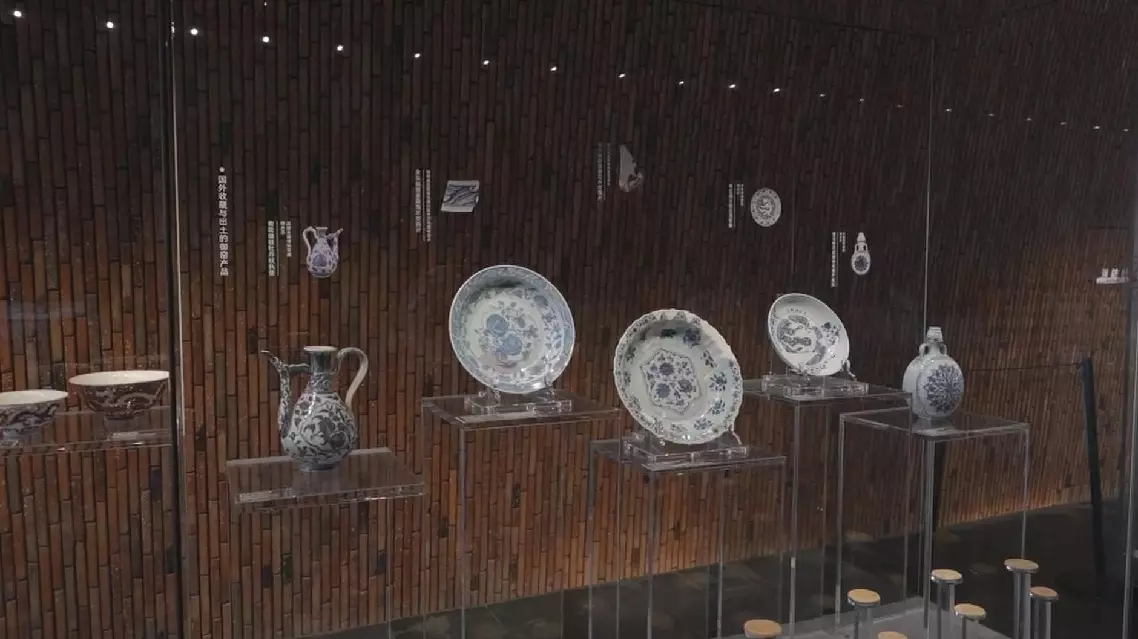
For more than 1,000 years, Jingdezhen, the "porcelain capital" in east China's Jiangxi Province, has shaped how the world understands porcelain, with even discarded shards preserving a living tradition.

Weng Yanjun, president of the Jingdezhen Imperial Kiln Institute, reflected on the scale and challenge behind Jingdezhen's historic creations.

"When I look at this gigantic dragon jar, I couldn't help going back to 600 years ago, when the emperor had this order to create something bigger than ever before. The failure rate of the dragon jar is so high. It could be nine out of 10. Even making failure products like this takes courage, takes techniques and takes commitment," said Weng.

Those failed attempts, once discarded, now preserve the evidence of how Jingdezhen pursued perfection.

For more than 1,000 years, Jingdezhen's porcelain industry has endured through the Song, Yuan, Ming and Qing dynasties (960-1911). What has survived is not only its porcelain, but also a living heritage of raw materials, workshops, kilns and specialized craftsmanship.

Those firings produced masterpieces as well as failures, with the discarded pieces forming another kind of archive.

At the Jingdezhen Imperial Kiln Institute, Weng told archaeology students that fragmented specimens sometimes provide more information than complete artifacts.

Weng leads the development of the world's first Ancient Ceramics Gene Bank, which extracts and catalogs the defining characteristics of each ceramic shard.

"For our institute alone, we have excavated more than 20 million pieces of shards for the past over 1,200 years. Among those shards, we do sorting, we do restoration, and we do scientific tests. And then we find, wow, a small shard can tell us much more information than even a whole piece," said Weng.

Using a standardized sample library and unified data framework, the project records each piece's shape, decoration, body material, glaze, color, firing marks and inscriptions, creating a valuable resource for authentication and research around the world.

"The whole city is a wonderful lab and space range makes Jingdezhen uniquely a wonderful example of how the handicraft ancient industry with porcelain as the focus survived even to today," Weng added.

Jingdezhen once helped establish benchmarks for how porcelain was made. Now, the gene bank is turning fragments into a language that can be read beyond the city. For French artist and researcher Yann Colleu, learning to read that language has also changed the way he creates.

"Since my childhood, my parents had these teapots, tea sets, plates and cups. I was very curious about the pattern, like the meaning, what was behind it? Actually when I discovered in Jingdezhen that it was a bat, because of 'fu' and 'fu' is fortune, but also you have the 'wufu,' like the five blessings. I was like a child with stars in the eyes, discovering the world for the first time," said Colleu, PhD candidate at Jingdezhen Ceramic University.

What once seemed abstract became part of Yann's own visual language. In his work, traditional Jingdezhen motifs and production scenes are reimagined through a contemporary, cross-cultural lens.

"Jingdezhen is a timeless city. The past, the present and even the future are tied together. This is one of illustration of 72 traditional steps developing during the Ming Dynasty (1368-1644). The difference is, instead of using Chinese characters, I use foreigners. I want to use the past to talk about the present and even the future with Jingdezhen," said Colleu.

The Jingdezhen Handicraft Porcelain Industry Sites were inscribed on the UNESCO World Heritage List on Saturday. The inscription recognizes not just a single kiln or masterpiece, but an entire production system, from its archaeological remains and traditional craftsmanship to its industrial knowledge and global influence.

Porcelain shards preserve Jingdezhen’s timeless legacy

Porcelain shards preserve Jingdezhen’s timeless legacy

Recommended Articles