As the bilateral cooperation between China and Cambodia on education and health care advances, a medical university in southwest China Yunnan Province has become a top choice for Cambodian medical students.
Kunming Medical University, one of the best medical institutes in the bordering province of Yunnan, has been a leading university in China-Cambodia education cooperation. To date, the university has enrolled about 60 Cambodian students. Among them is Toem Leakhena, a postgraduate majoring in cardiology, who got a Chinese name Lina here.
"Medicine is a broad field, and I want to dive deeper into one specific area. (What I am particularly interested in is) some of the advanced practices here, like cardiac ultrasound and catheter ablation for arrhythmia. I am particularly interested in these two," said Toem.
Many of the Cambodian graduates decided to return home. With sophisticated skills and advanced technologies, they have contributed to Cambodia's medical system, as well as the reputation of the Chinese university.
"We brought some innovative, minimally invasive surgical techniques from China, such as laparoscopic surgery. In the past, we had to make large incisions of about 10 centimeters to remove stones. Now, we are introducing standardized and minimized surgical treatments. This allows patients to receive much better medical care," said Chun Bunhak, a Kunming Medical University graduate who now works at a military hospital in Phnom Penh.
The stories of Chun and other alumni have been an inspiration for Lina and her colleagues.
"I hope to apply the knowledge and skills I've gained here to my future work, and I also aspire to contribute to the cooperation and exchange in the medical field between China and Cambodia," said Toem.
"After I graduate, I will return to Cambodia to work as a cardiologist," said her peer, Ly Sivfong.
The university vows further commitment to create more opportunities for young Cambodians and pioneer bilateral cooperation.
"In the future, we will leverage the South Asia and Southeast Asia Medical Education and Healthcare Alliance, led by Kunming Medical University, to integrate resources and enhance exchanges with member institutions, such as healthcare organizations and medical universities in Cambodia, to jointly advance talent development," said Liu Yajie, dean of the International Education School of Kunming Medical University.
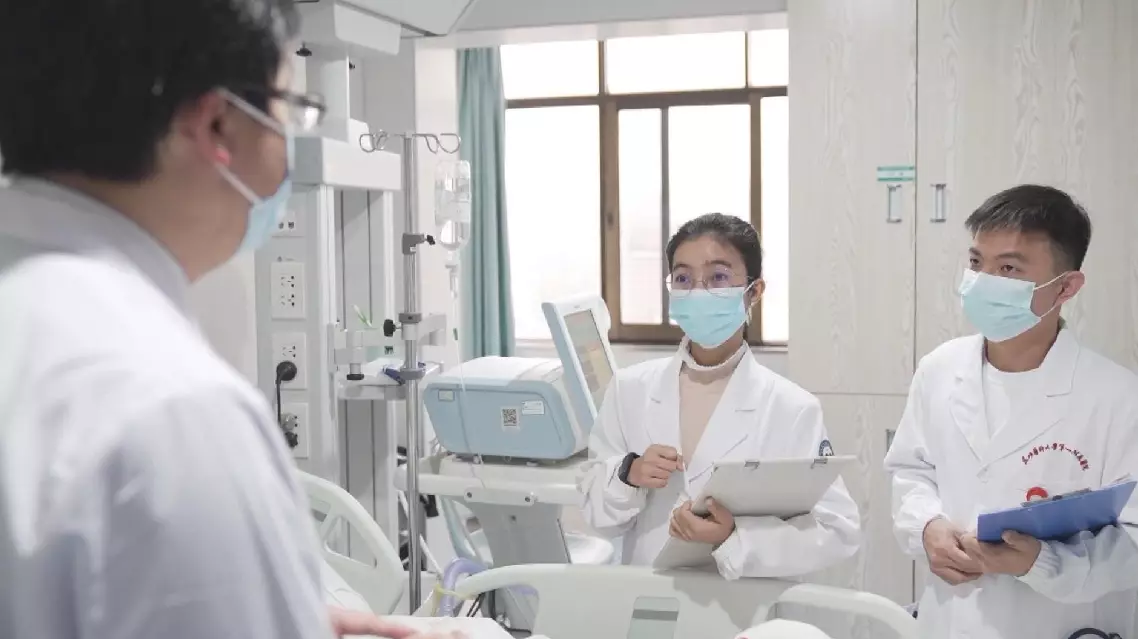
Chinese medical university attracts Cambodian students, promoting bilateral exchange

Highlighting the "Future Energy" as a key direction for China's strategic emerging industries, the country's nuclear energy development, guided by its three-step strategy, has seen major strides in the past year, said a member of the 14th National Committee of the Chinese People's Political Consultative Conference (CPPCC).
In a recent press briefing, Xin Feng, also deputy general manager of China National Nuclear Corporation (CNNC), updated the media on the progresses China has achieved under the strategy.
"China's three-step strategy for nuclear energy development -- from the thermal reactor to the fast reactor and the fusion reactor -- was formulated in 1983 as a medium- and long-term plan. For the thermal reactor, over the past year, our 2.0 version of the Hualong One technology has been approved. This is a unified and fully self-owned intellectual property based third-generation nuclear power technology solution. And the Linglong One small modular reactor also successfully completed its cold-state functional test last year and is expected to be put into commercial operation this year," he said.
For the second and third steps, Chinese researchers and engineers have achieved milestones in the past year with the government support, Xin noted.
"Then for the fast reactor, last year, a closed-cycle system for an integral fast reactor successfully achieved preliminary standard design. We will continue to solve its engineering technology challenges. As for the fusion reactor, in 2025, with national support, we established the China Fusion Energy Company in Shanghai. And our Huanliu-3, a platform for conducting research and development of fusion technology, made a big stride, with an iron temperature in it achieving 117 million Celsius and an electron temperature reaching 160 million Celsius. We will continue to adhere to the development strategy and focus on technological research and engineering technology development," Xin said.
The fourth session of the 14th NPC and the fourth session of the 14th National Committee of the CPPCC kicked off in Beijing on March 5 and March 4, respectively.
The "two sessions" -- which refer to the annual meetings of China's supreme organ of state power, the National People's Congress (NPC), and its top political advisory body, the National Committee of the CPPCC -- are a key event on the country's political calendar and offer a window into the country's development direction.
China's nuclear energy development makes great strides with three-step strategy: CPPCC member