China's economy showed robust growth momentum in the first quarter of 2025, laying a solid foundation for sustained high-quality future development, according to experts.
Data released Wednesday by the National Bureau of Statistics (NBS) revealed that China's GDP grew by 5.4 percent year on year in the first three months, reaching 31.88 trillion yuan (about 4.42 trillion U.S. dollars).
In separate interviews with China Central Television (CCTV), experts said the favorable performance reflected a "steady and sound" start to the year, underpinned by robust growth across multiple sectors.
"Judged by the performance in the first quarter, the economic operation has got off to a good start so far this year. Whether from investment, consumption and exports on the demand side, or from industry and emerging sectors on the production side, there have been bright performances. On the basis of the strong industrial growth last year, the growth momentum continued into the first quarter of this year. In particular, the consumption sector has shown a trend of steady recovery in goods consumption, and the contribution of consumption to overall economic growth clearly increased in the first quarter," said Huang Hanquan, head of the Academy of Macroeconomic Research at the National Development and Reform Commission (NDRC).
Experts noted that in the first quarter, China's economy got off to a steady and solid start, with multiple sectors, such as industry, consumption, and investment, gaining robust growth momentum.
This robust growth momentum has significantly boosted market confidence and injected powerful impetus into the country's high-quality economic development, they said.
"Investment in some high-tech sectors has also been particularly impressive. With breakthroughs in the development of large models and artificial intelligence, such as those led by DeepSeek, many companies have actively increased their investment in these fields. Additionally, in traditional strong sectors like new energy, there have actually been continued breakthroughs in technological development, with their investment thresholds keeping going low, leading to a steady rise in investment in these fields as well," said He Ping, vice dean of the School of Economics and Management at Tsinghua University.
"One factor is the fundamental of China's economy itself, which has shown signs of explosive growth driven by sci-tech innovation. In addition, the implementation of more proactive and effective macroeconomic policies, including strengthened fiscal and monetary measures, has played a positive and encouraging role in boosting confidence among both domestic and international market participants," said Feng Ming, director of the Macroeconomic Policy and Evaluation Research Office at the Chinese Academy of Social Sciences (CASS).

Multiple favorable factors boost economic growth in Q1: experts
United Nations High Commissioner for Human Rights Volker Turk on Friday urged the United States to promptly conclude its investigation into a strike on an elementary school in Iran and make public the findings, stressing that "there must be justice for the terrible harm done."
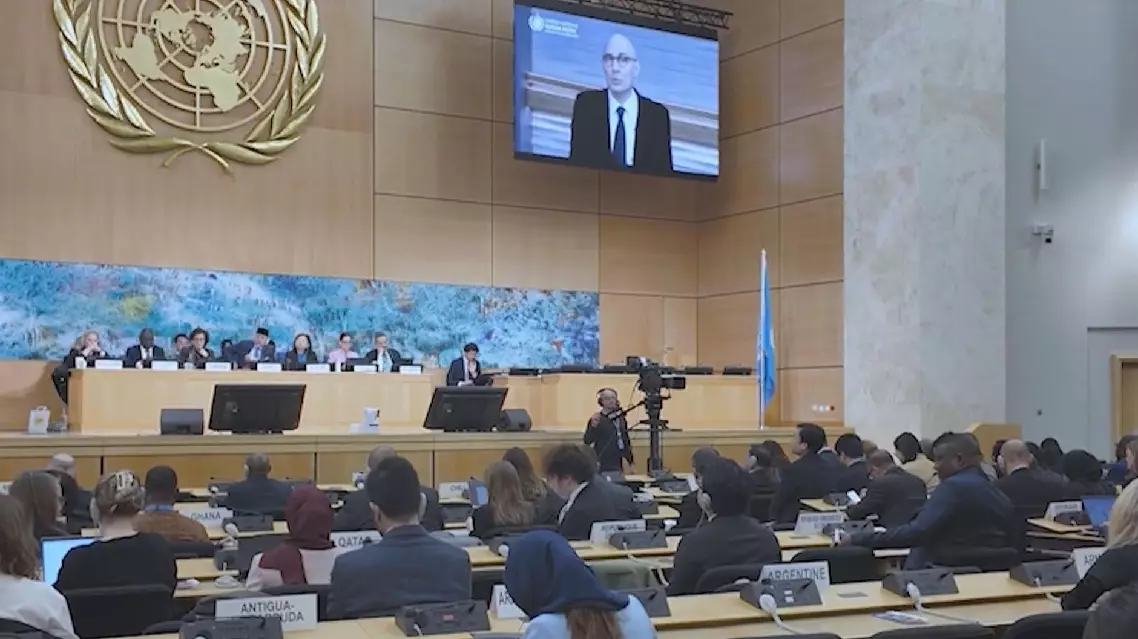
Turk was speaking via video link at an urgent debate during the 61st session of the UN Human Rights Council, noting that the bombing of an elementary school had evoked "visceral horror."
"The onus is on those who carried out the attack to investigate it promptly, impartially, transparently and thoroughly, to determine the facts and lay the basis for accountability. Senior U.S. officials have said the strike is under investigation. I call for that process to be concluded as soon as possible, and for its findings to be made public. There must be justice for the terrible harm done," he said.
He stressed that differences between countries will not be solved by "killing schoolchildren." Turk noted that attacks by the U.S. and Israel have increasingly targeted densely populated residential areas in Iran and destroyed civilian infrastructure, describing their strikes on Iran's nuclear facilities as "reckless beyond comprehension."
He called on the U.S. and Israel to end their attacks against Iran, and urged all parties to exercise restraint and return to negotiations.
The perpetrators of the school attack must be held accountable, said Ali Bahreini, Iranian Ambassador to the UN in Geneva, on the same day.
"The number of the victims has increased, unfortunately, because some of those injured have died, and now the number of students killed in that incident has increased to more than 175 students and a number of teachers have been killed in this incident," said Bahreini in an interview with China Global Television Network (CGTN).
The debate was held at the request of Iran, China and Cuba. Jia Guide, China's permanent representative and ambassador to the United Nations Office at Geneva and other international organizations in Switzerland, said that China strongly condemns all acts that violate international law and target civilians and non-military facilities indiscriminately.
Also on Friday, Iranian Foreign Minister Seyed Abbas Araghchi said that more than 600 schools across Iran have been demolished or damaged since the U.S. and Israel launched military actions against the country on Feb 28, with more than 1,000 students and teachers killed or injured.
Speaking via video link at the debate, Araghchi said the primary school in the southern Iranian city of Minab was hit in what he described as a "calculated" attack, leaving more than 175 students and teachers dead.
Araghchi said Iran is "amid the throes of an illegal war imposed" by the U.S. and Israel, calling it a "blatantly unjustified and brutal" war of aggression.
He stressed that targeting the school constituted "a war crime and a crime against humanity," and said the incident "was not a mere incident nor a miscalculation," but an act that "demands unequivocal condemnation" and accountability.
UN human rights chief urges U.S. to conclude probe into strike on Iranian school