Skip to Content Facebook Feature Image

Bei Dou system empowers China's tech future with global PNT services

China

China

China

Bei Dou system empowers China's tech future with global PNT services

2025-04-28 10:39 Last Updated At:11:27

China's independently developed Bei Dou Navigation Satellite System (BDS) has been providing accurate positioning, navigation, and timing (PNT) services to global users for years. Recognized as a world-class system, Bei Dou continues to shape China's technological future.

The BeiDou was initiated in 1994, with BDS-1 and BDS-2 completed in 2000 and 2012, respectively. On July 31, 2020, BDS-3 was put into service, making China the third country to have an independent global navigation satellite system.

Lin Baojun, the chief designer of Bei Dou-3, told China Global Television Network (CGTN) in a recent interview that with the final backup satellites launched last September, the system's research and construction are now complete. The entire network operates flawlessly, achieving centimeter-level PNT services precision across 70,000 kilometers.

"Its impact is substantial. Last year's related output exceeded 500 billion yuan. Today, the whole world utilizes Bei Dou," said Lin.

Bei Dou applications now span critical economic sectors, including transportation, energy, natural resources, and emergency response. According to Lin, over 200 countries employ the system across diverse fields like transportation, fisheries, and power grids.

A Shanghai-based company, Sinan Navigation, demonstrates Bei Dou's reach through high-precision chips, modules, and industrial solutions, including smart farming applications.

The integration of Bei Dou PNT services with 5G networks makes farming easier and more accessible, providing tractors with centimeter-level navigation.

"Our products are used in over 140 countries worldwide. For example, they are employed for surveying and mapping in Africa. In Europe, they are also used in robotics, in addition to surveying and mapping," said Zhai Chuanrun, deputy general manager of Sinan Navigation.

China's progress with Bei Dou does not end with BDS-3. By 2035, China plans to build a more ubiquitous, integrated, and intelligent PNT system, covering indoor to outdoor environments and from deep sea to deep space. This next-generation system will be stronger, safer, and more reliable, with Bei Dou as its core foundation.

Some companies are already making progress in such applications.

"These are our different types of transmitters. Because indoor environments can be quite complex -- such as parking lots, tunnels, and exhibition centers -- we have developed a range of transmitters tailored to different scenarios," said An Yang, president of Azimuth Technology.

Scientists, technicians, and suppliers agree that through collaboration and finding common solutions for future use, PNT systems like Bei Dou can help create a better world.

Bei Dou system empowers China's tech future with global PNT services

Bei Dou system empowers China's tech future with global PNT services

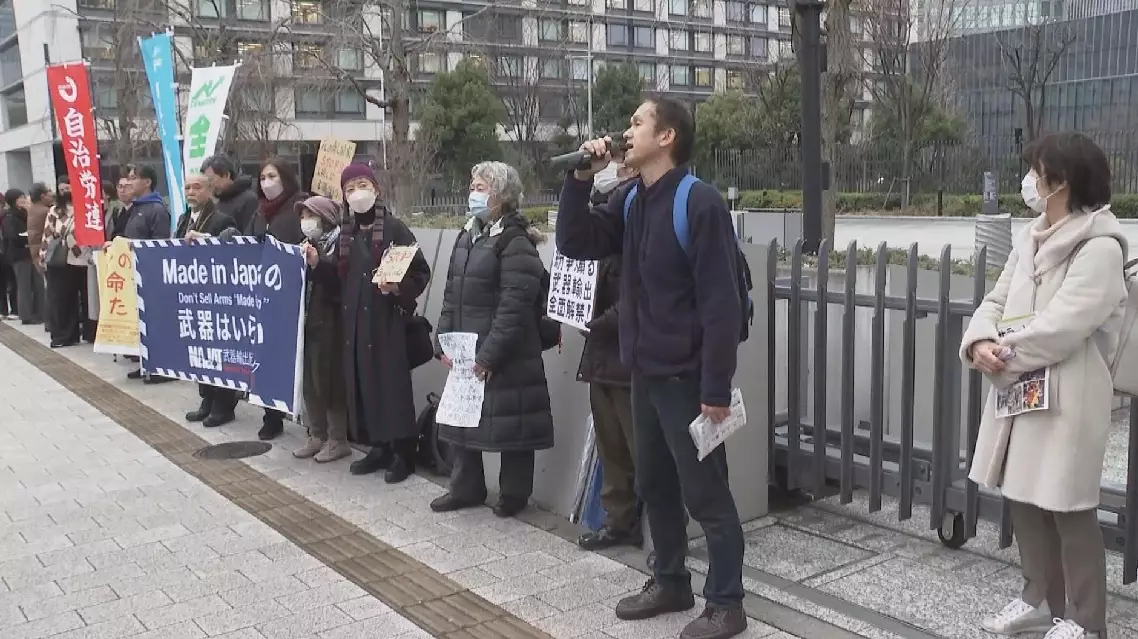
Representatives of 12 Japanese civil groups held a rally in Tokyo on Thursday, urging the government to ban all arms exports.

The demonstrators gathered in front of the Liberal Democratic Party headquarters and the National Diet building, where they submitted a formal petition. The ruling Liberal Democratic Party and its coalition partner, the Japan Innovation Party, agreed at a meeting on Monday to revise the implementation guidelines of the Three Principles on Transfer of Defense Equipment and Technology and lift restrictions that limit defense equipment transfers to five noncombat purposes. And they planned to submit the proposal to the cabinet in February next year.

The ruling coalition's plan to significantly relax restrictions on weapons exports has been met with strong opposition from domestic civil groups, as they warn that the move would put Japan on a dangerous path.

The demonstrators urged the government to strictly uphold Article 9 of Japan's pacifist constitution, which renounces the nation's right to engage in war or to resort to military force to resolve international conflicts.

"The Constitution clearly renounces war as a sovereign right and stipulates that Japan shall not possess land, sea, and air forces. However, despite the Constitution's existence as the cardinal law, they constantly adopt laws that hollow out and weaken the Constitution's spirit. And Japanese companies keep manufacturing and exporting weapons to make profits, which worries me tremendously. I keenly feel that Japan is already at a dangerous edge," said Yoko Sugiura, editor-in-chief of magazine Consumers Union of Japan.

"During the Diet debates, it was the Liberal Democratic Party that formulated the Three Non-Nuclear Principles, a system specifically embodying the ideals of Article 9 of the Constitution. The Japan Innovation Party's claim that Article 9 has nothing to do with arms exports ban and embargo is erroneous both factually and conceptually. And the issue is a very serious," said Koji Sugihara, a representative of the Network Against Japan Arms Trade, a local citizens' group.

"In the spirit of Article 9 of the Constitution, arms exports must be stopped, and the policy of prohibiting weapons must be restored. Given this clear shift to militarization, we fear that if it this goes on, there is no way to guarantee the safety of our lives. So we will continue to appeal to society to collectively ponder on how to stop this trend," said Misaki Nishimura, a representative of the Japan Peace Committee.

Japanese civil groups urge gov't to ban arms exports

Japanese civil groups urge gov't to ban arms exports

Recommended Articles