The US–China trade war continues, with Nvidia, the American chip giant, bearing the brunt of escalating tensions. According to Reuters, on May 1, Nvidia’s top executives met behind closed doors with the US House Foreign Affairs Committee. During the meeting, Nvidia CEO Jensen Huang voiced concerns about the rapid advancement of Chinese companies’ artificial intelligence (AI) capabilities, particularly the potential for firms like DeepSeek and future open-source Chinese models to run on domestically produced chips. Huang had previously warned that China is not behind the US in AI and is, in fact, “very, very close”, highlighting Huawei’s exceptional progress in computing and networking technologies. He called on the Trump administration to revise current restrictions on AI technology exports.
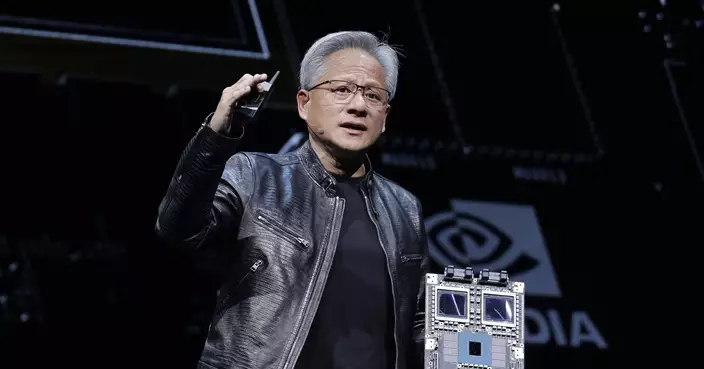
Huang warned that China is not lagging behind the US in AI, and is “very close.”
The meeting reportedly focused on Chinese AI chips and the possibility that restricting Nvidia’s exports could make Chinese chips more competitive. A congressional source noted that if models like DeepSeek R1 are trained on Chinese chips, or if future Chinese open-source models become highly compatible with domestic chips, this could create global demand for Chinese semiconductors.
A Nvidia spokesperson stated that Huang’s meeting with the committee centered on the strategic importance of AI as national infrastructure and the need to invest in US manufacturing. Nvidia reiterated its full support for government efforts to promote American technology and interests worldwide.
Bloomberg, citing insiders, reported that the US is considering easing restrictions on Nvidia chip exports to the UAE. Trump has questioned why chips can’t be sold to a country already cleared to buy American F-35 fighter jets, and may announce starting negotiations on the subject during his Middle East trip from May 13 to 16.
Nvidia chips have long been a target of US export controls, as they are essential for developing chatbots, image generators, and other AI systems. Since the Biden administration’s 2022 crackdown, restrictions have steadily tightened, banning Nvidia from selling its most advanced products to Chinese customers. In April, the Trump administration halted sales of Nvidia’s “China-specific” H20 chips, a move Nvidia said would cost it $5.5 billion. Washington has since signaled further restrictions, even as demand from China for such chips grows due to low-cost AI models like DeepSeek.
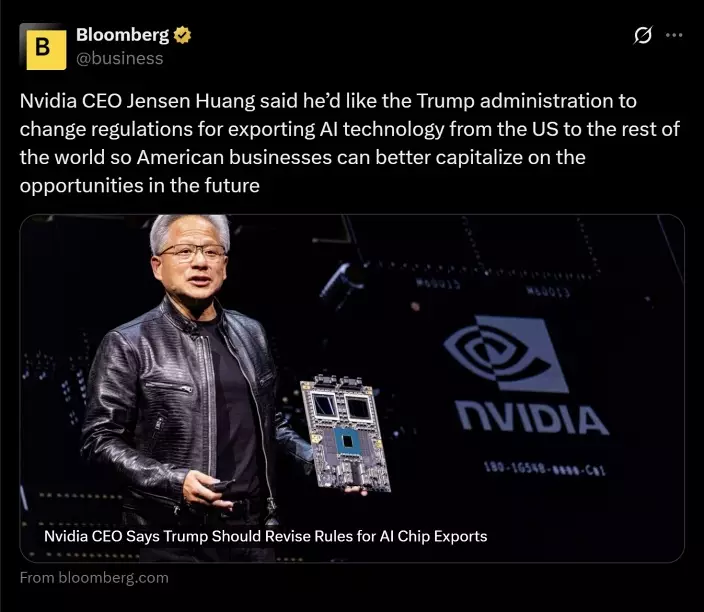
Bloomberg reported that Huang is urging the Trump administration to revise AI export rules. (X)
On April 30, Huang attended the Hill & Valley Forum in Washington, D.C., where he urged the Trump administration to change chip export rules, arguing that “the world has fundamentally changed.” He stressed, “China is not behind – China is right behind us. We’re very, very, very close.”
Huang emphasized that China is quickly becoming a formidable competitor in technology, singling out Huawei for its advances in AI chip design. “Huawei excels in computing and networking – both are essential for advancing AI,” he said. “Just as we make physical cars today, or anything physical in the future, there’ll be a digital version of it. So you need an AI factory to create the AI model that runs in the car.”
He described the AI race as a long-term, infinite race, urging the US government to support domestic companies to compete globally. “This is an industry that we will have to compete for,” Huang declared.
Nvidia has criticized the Biden administration’s so-called “Interim Final Rule on Artificial Intelligence Diffusion” as “highly misleading,” warning that US policy should focus on boosting domestic competitiveness. Restricting chip sales to China and other countries, Nvidia argues, only threatens America’s technological lead.
The Wall Street Journal reported on April 29 that US export controls have failed to curb China’s AI ambitions, instead hampering Nvidia and other American firms while creating opportunities for competitors in China, South Korea, Japan, and Europe.
The report described “AI factories” as one-stop shops selling AI chips, software, design, and network infrastructure. Huang believes these AI factories will become standard for US companies, and that AI-powered data centers under construction will create new jobs in fields like construction and IT.
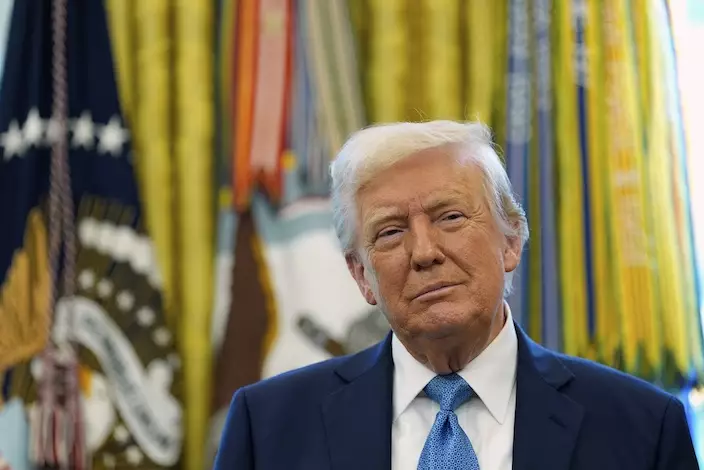
When Trump met Huang at the White House, he praised Nvidia’s $500 billion AI investment plan.(AP Photo)
On the same day, Huang attended a White House event where Trump, referring to him as “my friend,” praised Nvidia’s $500 billion investment in US AI infrastructure. Huang, in turn, lauded Trump’s efforts to revive American manufacturing, saying it would help Nvidia develop next-generation technologies. “I’m delighted that the administration is really encouraging and supporting the industry with on-shore manufacturing,” Huang said. “If we don’t get good at manufacturing, we’re going to leave behind a giant industry”, he added.
Recently, Huang completed his second trip to China this year. On April 28, Zhao Ping, spokesperson for the China Council for the Promotion of International Trade, said China is committed to serving as a bridge for communication with the US and global business, voicing opposition to tariffs and unilateralism. Zhao called on the US to stop using tariffs as a weapon and to resolve issues through equal-base dialogue, aiming for stable, healthy, and sustainable bilateral economic relations.
Zhao also stressed that decoupling, tariff barriers, and politicizing economic issues are unpopular with the global business community. She highlighted China’s policy transparency, market potential, and comprehensive industrial system. Just like Huang’s remark during his visit: “The China market is very important to us, and it's important to our growth.”
Deep Throat
** 博客文章文責自負,不代表本公司立場 **