WASHINGTON (AP) — A newly declassified U.S. intelligence assessment confirms that analysts at American spy agencies found no coordination between Tren de Aragua and the Venezuelan government, contradicting statements the Trump administration used to justify invoking the Alien Enemies Act and deporting Venezuelan immigrants.
The redacted memo from the National Intelligence Council said there was no indication that Venezuelan President Nicolas Maduro or other senior government officials are directing the actions of Tren de Aragua, a gang that originated in a prison in Venezuela. That is even as some mid- to low-level Venezuelan officials may have ties to the gang for financial gain, the document says.
“While Venezuela's permissive environment enables TDA to operate, the Maduro regime probably does not have a policy of cooperating with TDA and is not directing TDA movement to and operations in the United States,” the memo reads. “Furthermore, most of the IC judges that intelligence indicating that regime leaders are directing or enabling TDA migration to the United States is not credible.”
Trump has invoked the Alien Enemies Act to speed the deportations of people his administration has labeled members of the gang. The 18th century wartime law was created to give the president the power to imprison or deport noncitizens in a time of war. It has been used three times, most recently when Japanese Americans were detained during World War II.
Tren de Aragua has been linked to a series of kidnappings, extortion and other crimes throughout the Western Hemisphere. Those activities are tied to a mass exodus of millions of Venezuelans as their country’s economy unraveled over the past decade.
The National Intelligence Council helps coordinate the work of the nation's intelligence services, and its conclusions reflect the findings of individual agencies.
While the assessment found no evidence of significant coordination between Maduro and the gang, it noted that FBI analysts had reason to believe some Venezuelan officials may have helped some gang members move to the U.S. and other countries “to advance what they see as the Maduro regime's goal of destabilizing governments and undermining public safety,” according to the assessment.
A spokesperson for Director of National Intelligence Tulsi Gabbard rejected claims that the assessment contradicted the White House and noted that it did find some ties between mid- and low-level officials in Maduro's government and the gang.
Gabbard wrote on social media last month that her office, which oversees and coordinates the work of the nation's 18 intelligence agencies, “fully supports the assessment that the foreign terrorist organization, Tren De Aragua, is acting with the support of the Maduro Regime, and thus subject to arrest, detention and removal as alien enemies of the United States."
Gabbard's spokesperson, Alexa Henning, referenced the post Tuesday in response to questions about the assessment.
The memo, which includes significant redactions, was released this week after the Freedom of the Press Foundation filed an open records request, and it was first reported by The New York Times. The Associated Press reported on the assessment's findings last month.
Lauren Harper, who holds the Daniel Ellsberg Chair on Government Secrecy at the foundation, said it is critical to push for government transparency, especially as the Trump administration signals it may subpoena reporters to investigate government leakers.
“The public deserves to read this document,” Harper said of the assessment.
Two federal judges have found that Trump is improperly using the Alien Enemies Act and barred the administration from removing immigrants under it.
District Court Judge Alvin K. Hellerstein in New York said Tuesday that the 1798 law cannot be used against Tren de Aragua because it is not attacking the United States. “TdA may well be engaged in narcotics trafficking, but that is a criminal matter, not an invasion or predatory incursion,” Hellerstein wrote.
Democrats in Congress welcomed the assessment's release and questioned why Gabbard has supported Trump's justification for deportations, given her knowledge of the assessment.
In a statement, Reps. Jim Himes of Connecticut and Joaquin Castro of Texas said Gabbard needs to explain why her public comments don't match the assessment of her own agencies.
“The most basic responsibility of the director of national intelligence is to speak truth to power and, where possible, the American people,” said the lawmakers, who both serve on the House Intelligence Committee. “Misrepresenting intelligence in public causes grave damage.”
Associated Press writer Michelle L. Price in Washington contributed to this report.
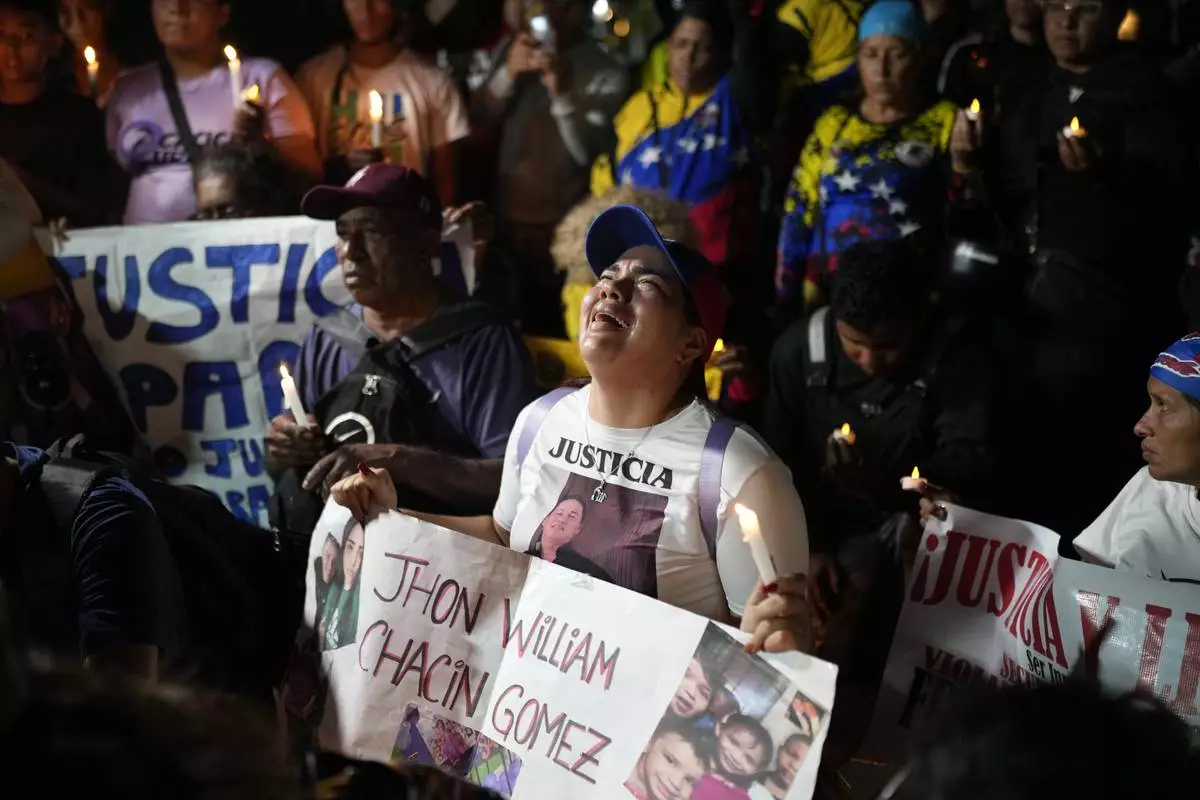
People with photos of their relatives who were deported from the U.S. to a prison in El Salvador, for being alleged members of the Tren de Aragua gang, cry and pray outside El Salvador's embassy in Caracas, Venezuela, April 2, 2025. (AP Photo/Ariana Cubillos)

Tulsi Gabbard, President Donald Trump's choice to be the Director of National Intelligence, arrives to appear before the Senate Intelligence Committee for her confirmation hearing on Capitol Hill Thursday, Jan. 30, 2025, in Washington. (AP Photo/John McDonnell)
HAMIMA, Syria (AP) — A trickle of civilians left a contested area east of Aleppo on Thursday after a warning by the Syrian military to evacuate ahead of an anticipated government military offensive against Kurdish-led forces.
Government officials and some residents who managed to get out said the Kurdish-led Syrian Democratic Forces prevented people from leaving via the corridor designated by the military along the main road leading west from the town of Maskana through Deir Hafer to the town of Hamima.
The SDF denied the reports that they were blocking the evacuation.
In Hamima, ambulances and government officials were gathered beginning early in the morning waiting to receive the evacuees and take them to shelters, but few arrived.
Farhat Khorto, a member of the executive office of Aleppo Governorate who was waiting there, claimed that there were "nearly two hundred civilian cars and hundreds of people who wanted to leave” the Deir Hafer area but that they were prevented by the SDF. He said the SDF was warning residents they could face “sniping operations or booby-trapped explosives” along that route.
Some families said they got out of the evacuation zone by taking back roads or going part of the distance on foot.
“We tried to leave this morning, but the SDF prevented us. So we left on foot … we walked about seven to eight kilometers until we hit the main road, and there the civil defense took us and things were good then,” said Saleh al-Othman, who said he fled Deir Hafer with more than 50 relatives.
Yasser al-Hasno, also from Deir Hafer, said he and his family left via back roads because the main routes were closed and finally crossed a small river on foot to get out of the evacuation area.
Another Deir Hafer resident who crossed the river on foot, Ahmad al-Ali, said, “We only made it here by bribing people. They still have not allowed a single person to go through the main crossing."
Farhad Shami, a spokesman for the SDF, said the allegations that the group had prevented civilians from leaving were “baseless.” He suggested that government shelling was deterring residents from moving.
The SDF later issued a statement also denying that it had blocked civilians from fleeing. It said that “any displacement of civilians under threat of force by Damascus constitutes a war crime" and called on the international community to condemn it.
“Today, the people of Deir Hafer have demonstrated their unwavering commitment to their land and homes, and no party can deprive them of their right to remain there under military pressure,” it said.
The Syrian army’s announcement late Wednesday — which said civilians would be able to evacuate through the “humanitarian corridor” from 9 a.m. to 5 p.m. Thursday — appeared to signal plans for an offensive against the SDF in the area east of Aleppo. Already there have been limited exchanges of fire between the two sides.
Thursday evening, the military said it would extend the humanitarian corridor for another day.
The Syrian military called on the SDF and other armed groups to withdraw to the other side of the Euphrates River, to the east of the contested zone. The SDF controls large swaths of northeastern Syria east of the river.
The tensions in the Deir Hafer area come after several days of intense clashes last week in Aleppo city that ended with the evacuation of Kurdish fighters and government forces taking control of three contested neighborhoods.
The fighting broke out as negotiations have stalled between Damascus and the SDF over an agreement reached last March to integrate their forces and for the central government to take control of institutions including border crossings and oil fields in the northeast.
Some of the factions that make up the new Syrian army, which was formed after the fall of former President Bashar Assad in a rebel offensive in December 2024, were previously Turkey-backed insurgent groups that have a long history of clashing with Kurdish forces.
The SDF for years has been the main U.S. partner in Syria in fighting against the Islamic State group, but Turkey considers the SDF a terrorist organization because of its association with Kurdish separatist insurgents in Turkey.
Despite the long-running U.S. support for the SDF, the Trump administration has also developed close ties with the government of interim Syrian President Ahmad al-Sharaa and has so far avoided publicly taking sides in the clashes in Aleppo.
Ilham Ahmed, head of foreign relations for the SDF-affiliated Kurdish-led administration in northeast Syria, at a press conference Thursday said SDF officials were in contact with the United States and Turkey and had presented several initiatives for de-escalation. She said that claims by Damascus that the SDF had failed to implement the March agreement were false.
——
Associated Press journalist Hogir Al Abdo in Qamishli, Syria, contributed.
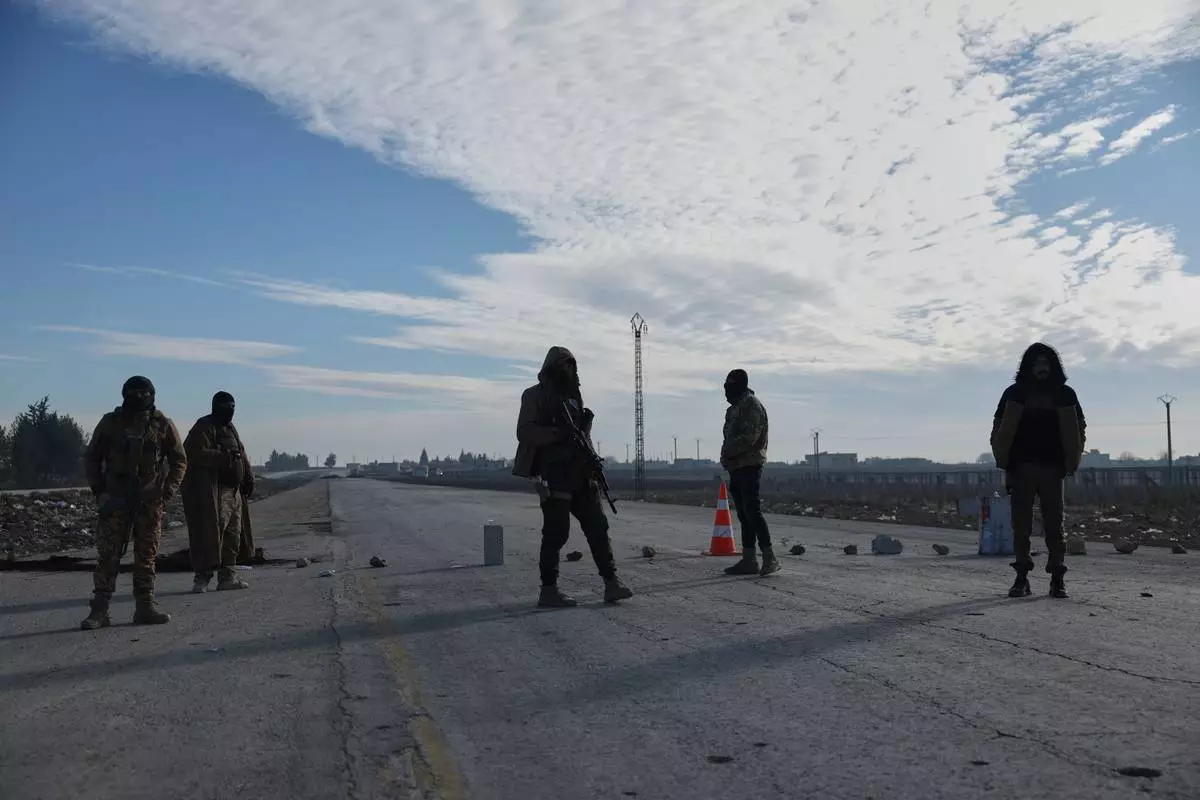
Members of the Syrian military police stand at a humanitarian crossing declared by the Syrian army in the village of Hamima, in the eastern Aleppo countryside, near the front line with the Kurdish-led Syrian Democratic Forces in Deir Hafer, Syria, Thursday, Jan. 15, 2026. (AP Photo/Ghaith Alsayed)
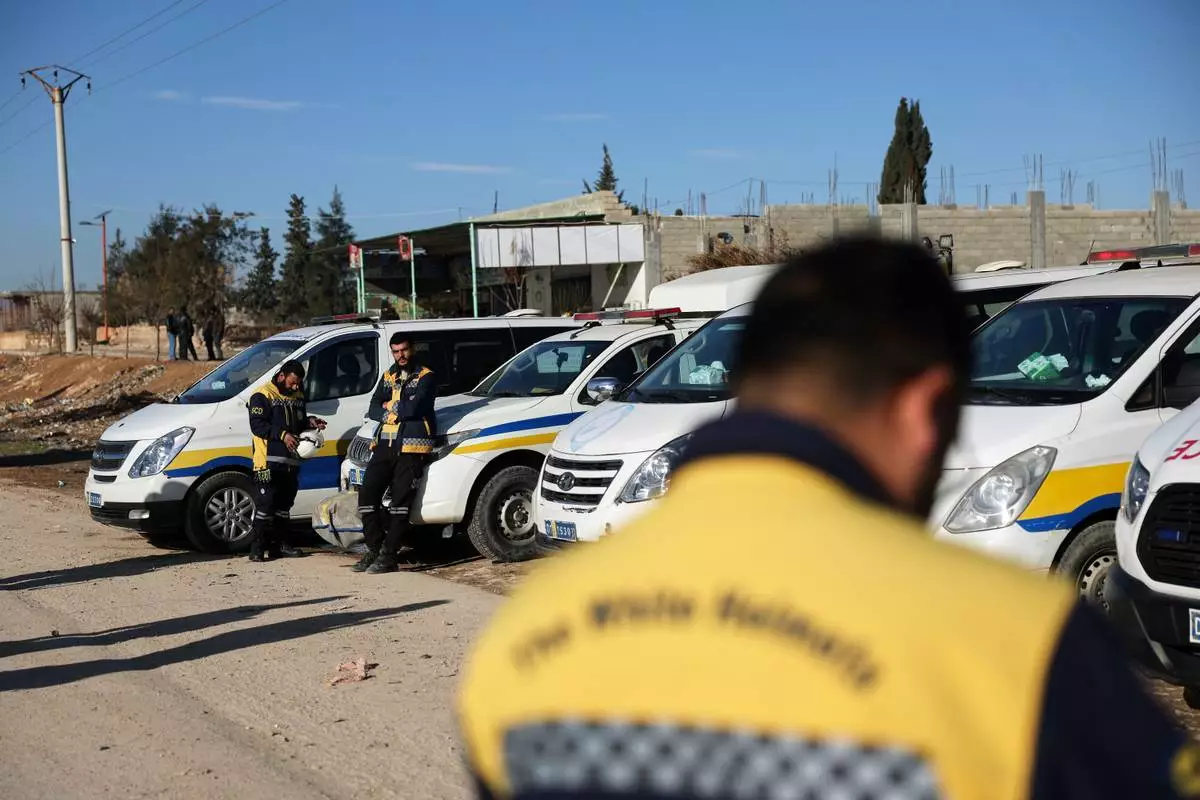
Members of the Syrian Civil Defense, stand next to their vehicles at a humanitarian crossing declared by the Syrian army in the village of Hamima, in the eastern Aleppo countryside, near the front line with the Kurdish-led Syrian Democratic Forces in Deir Hafer, Syria, Thursday, Jan. 15, 2026. (AP Photo/Ghaith Alsayed)

A displaced Syrian family rides in the back of a truck near a humanitarian crossing declared by the Syrian army next to a river in the village of Rasm Al-Abboud, in the eastern Aleppo countryside, near the front line with the Kurdish-led Syrian Democratic Forces in Deir Hafer, Syria, Thursday, Jan. 15, 2026. (AP Photo/Omar Albam)
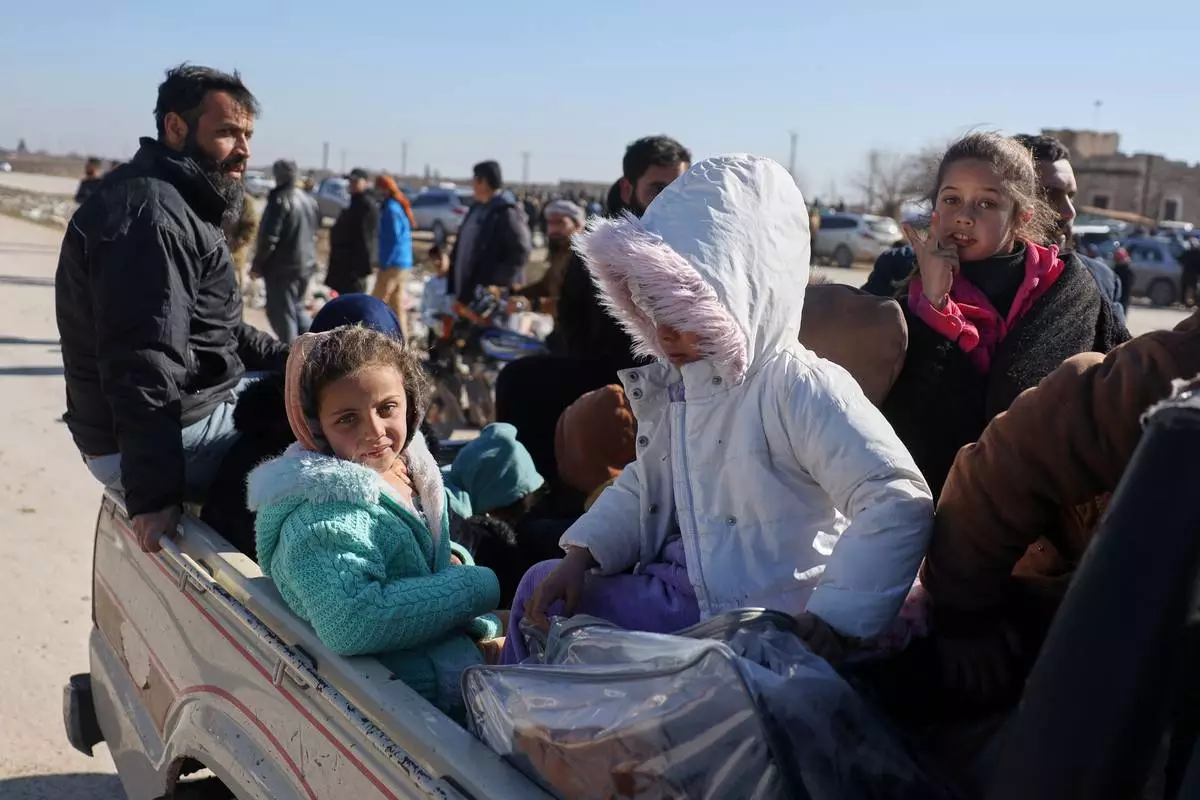
Displaced Syrian children and women ride in the back of a truck near a humanitarian crossing declared by the Syrian army in the village of Hamima, in the eastern Aleppo countryside, near the front line with the Kurdish-led Syrian Democratic Forces in Deir Hafer, Syria, Thursday, Jan. 15, 2026. (AP Photo/Omar Albam)
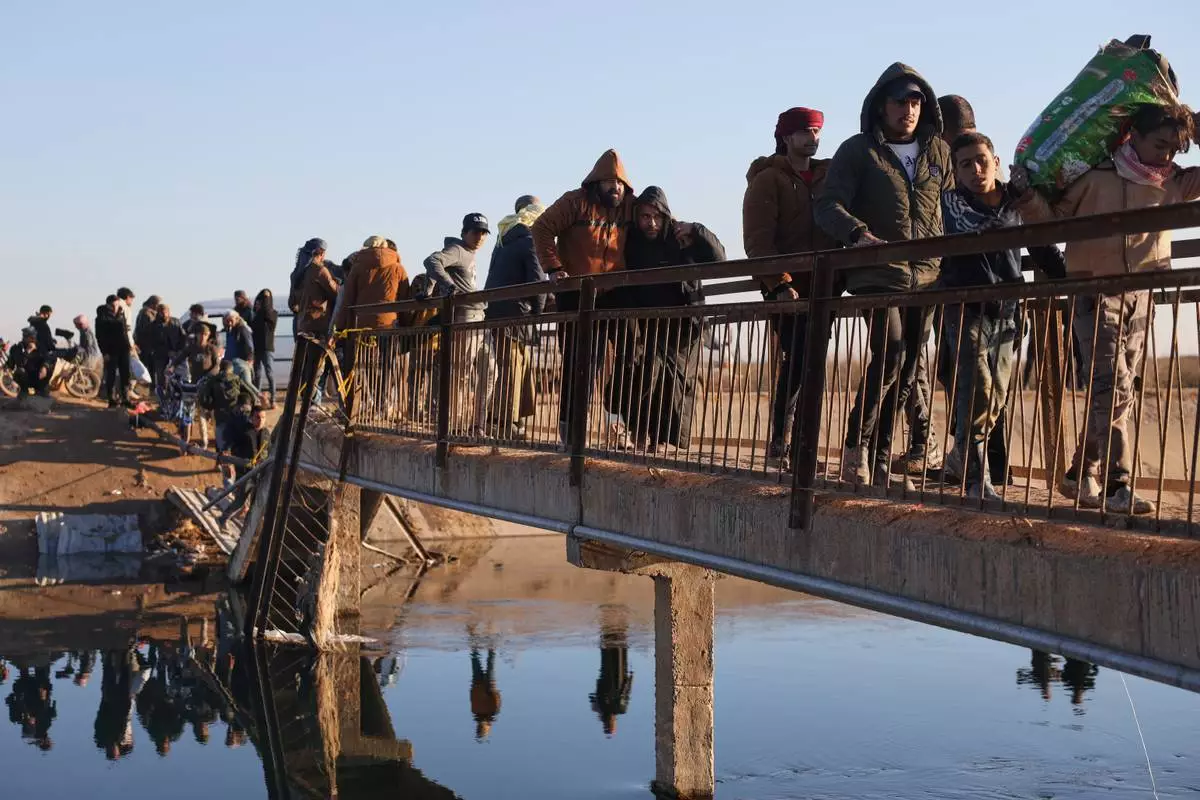
Displaced Syrians at a river crossing near the village of Jarirat al Imam, in the eastern Aleppo countryside, near the front line with the Kurdish-led Syrian Democratic Forces in Deir Hafer, Syria, Thursday, Jan. 15, 2026. (AP Photo/Omar Albam)