Skip to Content Facebook Feature Image

Israeli airstrikes paralyze Yemen's Sanaa airport

China

China

China

Israeli airstrikes paralyze Yemen's Sanaa airport

2025-05-08 15:45 Last Updated At:16:07

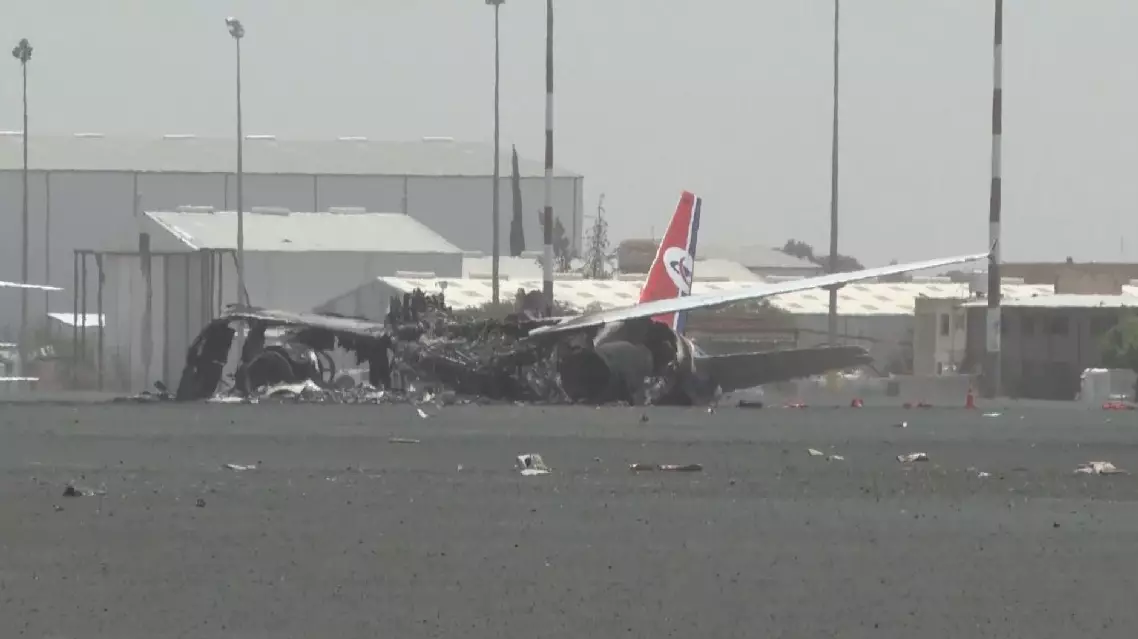
Israeli airstrikes have severely damaged Sanaa International Airport on Tuesday afternoon, destroying the departure lounge and its runway, three passenger planes, and critical infrastructure, rendering the facility inoperable.

The terminal building was still burning until Wednesday, sending columns of black smoke into sky. The entire hall has been destroyed. All communication and navigation equipment at the airport has been wiped out. There is nothing left. Everything has been destroyed, and nothing is usable anymore.

At the same time, the airport runway was also hit by airstrikes, leaving multiple large craters. The destroyed civilian aircraft, once served as vital means of international travel for the elderly, the sick, and expatriates, are now lying at the edge of the runway.

"Three operational passenger aircraft, an Airbus A330 and two Airbus A320s, were directly hit. In addition, several decommissioned aircraft were damaged, including an Airbus A310, a Boeing 727, and a cargo plane. The airstrikes have caused us tremendous losses. Preliminary estimates put the damage at over 500 million U.S. dollars. Aside from the aircraft, some of the company's ground facilities, such as hangars, maintenance workshops, and ground support equipment, were also completely destroyed," said Khalil Jahaf, acting chairman of the board of directors of Yemenia Airways.

Sana'a airport is the largest airport in Yemen, and prior to this attack, it was the only large airport still operational within Houthi-controlled territory. Over the past decade, it has served as a crucial hub for humanitarian aid shipments, particularly for medical supplies. It has also been a vital entry and exit point for the United Nations, international organizations, and negotiating parties.

"All flights from Sanaa International Airport to its only destination, Jordan, have been suspended. This route once provided humanitarian service to patients, students, and foreign nationals. Moreover, UN aircraft and planes used by international organizations to deliver humanitarian aid have also stopped operating," said Ali Tayseer, deputy minister of Justice and Human Rights of the Houthis.

The Houthis, who now control much of northern Yemen, have been launching drones and missiles toward Israel since November 2023, citing solidarity with Palestinians amid the war in Gaza.

The group lacks modern air defence systems and has limited civil protection infrastructure. Cities under Houthi control, including Sanaa, are without public shelters, and key facilities such as the Sanaa airport serve as vital links for civilians, humanitarian operations, and diplomatic access.
Israeli airstrikes paralyze Yemen's Sanaa airport

Israeli airstrikes paralyze Yemen's Sanaa airport

China's outline of the 15th Five-Year Plan (2026-2030), adopted on Thursday, maps out a systematic path toward high-quality development by building new growth drivers through the fostering of emerging and future industries.

In the latest five-year blueprint, the emerging strategic industries China will nurture have been expanded to include new sectors like intelligent connected new-energy vehicles (NEVs) and robotics. It also outlines plans to establish emerging strategic industry clusters tailored to local conditions, each with its own distinctive features and complementary strengths.

Experts suggested that this marks a shift for emerging industries -- from isolated breakthroughs to scaled, clustered development.

"During the 15th Five-Year Plan period, we aim to further promote and expand emerging industries in both scale and quality. The development of industrial clusters is a clear reflection of economies of scale. Building on the existing foundation, this will further sharpen the international competitiveness of our emerging industries. The blueprint's emphasis on new application scenarios and innovative business models will also help steer these industries toward a higher quality of development," said Wei Qijia, a researcher at the State Information Center, which is under China's National Development and Reform Commission.

The plan also identifies key frontiers to reach, including quantum technology, biomanufacturing, hydrogen and nuclear fusion energy, brain-computer interfaces, embodied artificial intelligence (AI) and 6G. Moving beyond mere technological roadmaps, it also stresses the need to build a full-chain incubation system for future industries.

"This forward-looking approach reflects a keen sense of foresight. The plan introduces mechanisms for identifying and monitoring emerging industries and making dynamic adjustments accordingly. If a particular new area or arena shows potential to foster emerging future technologies, it needs to be identified as early as possible. The blueprint's specific references to initiatives such as pilot zones for future industries and research institutes dedicated to their development also signal an important direction in terms of working methodology -- providing clear guidance on how to nurture the industries of the future," he said.

China's five-year blueprint set to foster emerging, future industries

China's five-year blueprint set to foster emerging, future industries

Recommended Articles