Speakers at a high-level dialogue in New York City on Friday highlighted the importance of finding key sectors for China and the United States to collaborate while maintaining healthy competitions.
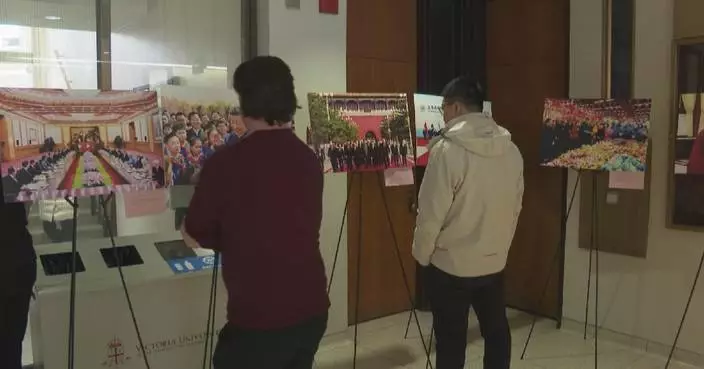
Nearly 100 guests from the Chinese and U.S. business, academic, and media sectors gathered at the dialogue to discuss new opportunities brought to the world by China's blueprint for high-quality development.
The "China in Springtime: China's Development Opportunities for the World" high-level dialogue, hosted by China Media Group, came after the "two sessions" concluded on Thursday in Beijing, an event watched closely by many industry leaders in the United States.
Chinese Ambassador to the United States Xie Feng greeted guests by telling them that this year would be an important one for the two countries, pointing to a number of high-level exchanges and opportunities to work together.
"China is always committed. We hope the U.S. side will work with us in the same direction, foster an enabling atmosphere, manage differences, and promote cooperation. Of course, China has its own principles and will firmly protect its sovereignty, security, and development interests," said Xie in a video speech.
That was a message echoed by China's Consul General in New York Chen Li.
"China is always committed and open. I believe that when the two sides treat each other with sincerity and good faith, we will be able to lengthen the list of cooperation and shorten the list of problems," said Chen.
China's national lawmakers on Thursday approved a development blueprint for the 2026-2030 period.
The outline of the 15th Five-Year Plan (2026-2030) for national economic and social development sets a slew of goals, with high-quality development high on the agenda. Key indicators span areas including economic development, innovation, public well-being, green transition, and security. Many of the indicators focus on people's livelihoods, sending a clear signal that development is ultimately meant to benefit the people.
Robert Lawrence Kuhn, a commentator on China's political and economic affairs, summarized what he viewed as the key points from the 15th Five-Year Plan.
"High-quality development, new quality productive forces, modern industrial upgrading, technology self-reliance, AI-driven optimization, not maximization, but optimization targeted, demographic adaptation as births and the elderly, greener, low-carbon growth, continuing open up and tighter integration of development with security," said Kuhn.
Anthony Chan, a former chief economist at JP Morgan, spoke about China's economic growth and the opportunities of investing in China.
"They're going to treat foreign corporations the same as domestic corporations. And they want these foreign companies to go in there and focus on the things that are important and that are outlined in the five-year plan as sectors that are important," said Chan.
The attendees were optimistic that both countries can overcome their differences and work together, while still protecting national security and their own interests.
"I still think we have to come back to what both sides talk about: the people-to-people side. We can't lose sight of the connectivity at cultural level, at educational level, at economic level. We're already intertwined," said James B. Heimowitz, a senior adviser to the South China Morning Post and former president of China Institute in America, a U.S. nonprofit organization dedicated to deepening the world's understanding of China through programs in aspects including art, business, culture and education.
"The U.S., we need to catch up. We really need to start thinking strategically the way China has," said Bob Ridings, chief data officer at Bank of China.

High-level dialogue in New York highlights China-US cooperation opportunities as China launches 15th Five-Year Plan