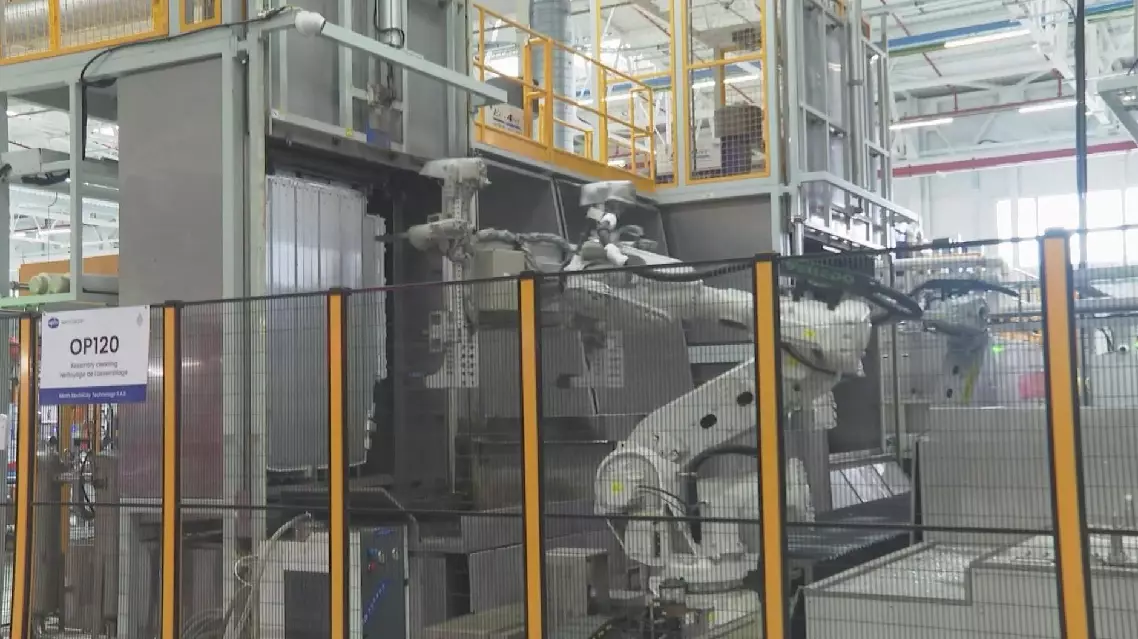
A complete industrial chain centered on new energy vehicle (NEV) battery production is taking shape in northern France's "battery valley," driven by deep involvement from Chinese enterprises in local NEV and battery projects.
In the Hauts-de-France region of northern France, stretching from the Port of Dunkirk to Douai, battery materials and NEV projects are rapidly clustering. This region has been dubbed "battery valley" by the French industry.
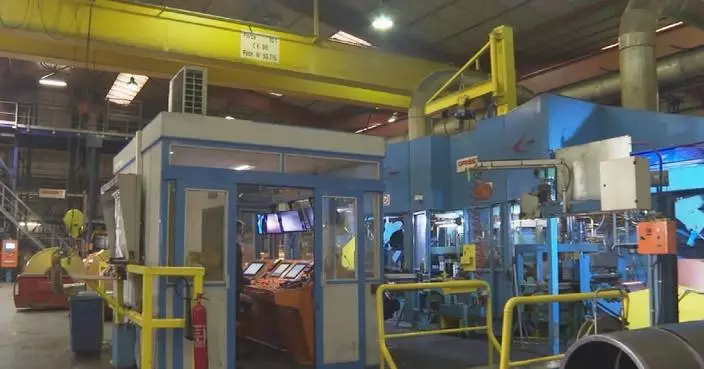
A power battery plant funded by a Chinese company near an NEV plant of French carmaker Renault Group in Douai is operating steadily. Battery modules roll off the automated production line after assembly and testing and are shipped directly to the nearby plant for NEV assembly.
"We've already delivered 10,000 cars to Renault and step by step we will ramp it up. At the end of the year, it will be approximately 75,000 cars delivered from our plant," said Sebastien Rouaud, head of the power battery plant.
Supporting facilities for power battery production are also emerging across northern France. In Douai, Chinese firms have partnered with French carmakers to manufacture battery casings for NEVs, which serve as essential structural components that house and protect battery modules.
At the Port of Dunkirk, a battery materials project -- a collaboration between Chinese and French enterprises -- is in the planning and construction phase. Once completed, the first phase is expected to produce 40,000 tons of lithium-ion battery cathode materials, enough to support battery production for 500,000 NEVs.
"There are currently gaps in France's battery materials and recycling. So, both sides have chosen Hauts-de-France in France as the project location to fill the gaps in battery material, battery precursors, and recycling. This aims to offer the market and customers a comprehensive range of upstream services," said Liu Wentao, regional director for Europe and North America at the Chinese enterprise.
Chinese firms fuel growth in France's NEV battery chain
The recent strikes on Kharg Island have not put pressure on Iran but will affect American and European-linked oil companies, a former commander in the Islamic Revolutionary Guard Corps (IRGC) said on Saturday.
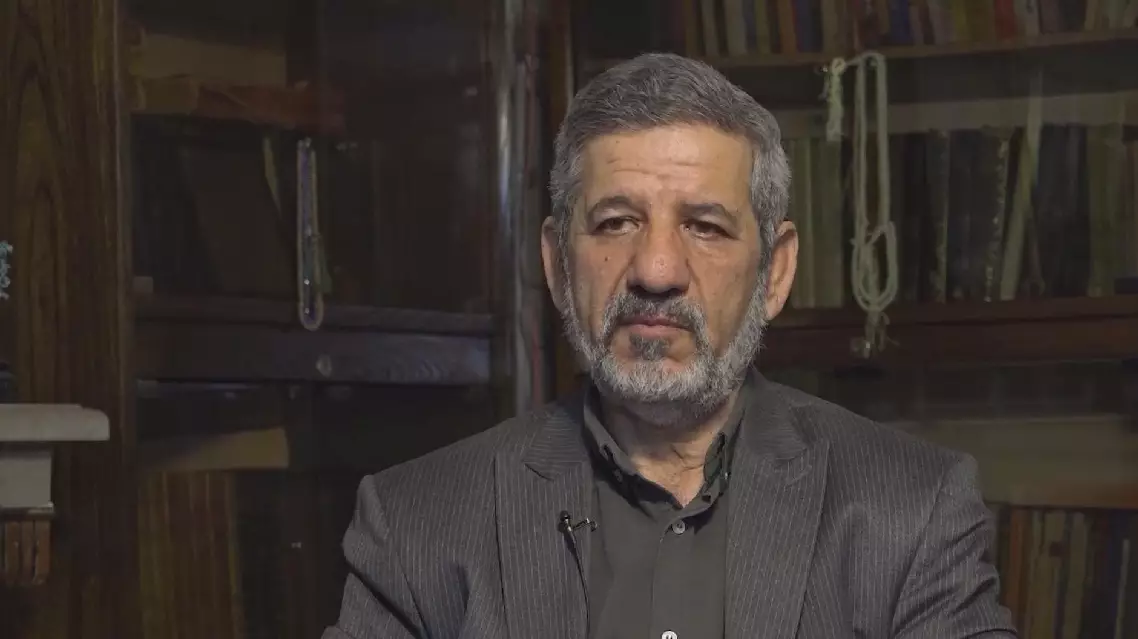
Speaking in an exclusive interview with China Global Television Network (CGTN) on Saturday, Hossein Kanani Moghaddam, who is also a military analyst, said that Iran had made preparations in advance to reduce dependence on the Strait of Hormuz, well before the U.S. strikes on Iranian islands, including the Kharg, which was targeted and hit by the U.S. forces.
"As you know, these measures date back many years; after the Iran-Iraq war, we took steps to reduce our dependence on the Strait of Hormuz and on exporting oil from the islands. To achieve this, we built oil pipelines in different regions so that we can export oil easily by land and sea without relying on the Strait of Hormuz. Even if they strike, as they have already done by attacking Abu Musa, they will gain nothing from it. On the contrary, it will intensify the oil crisis. Once the region enters into war, we have already declared that we would target all ports, as well as American banks and companies. In a way, this has given us a freer hand to take broader action, and that process has already begun," said Moghaddam.
"For this reason, they think that by striking Kharg or some of the islands, they can put pressure on us. On the contrary, all the pressure will fall on the U.S. and European-linked oil companies. That's why we face no problem in this regard. Even if they were to seize Kharg, we would respond as it is our territory, but in reality, it would not create any obstacle for our oil exports," he added.
Kharg Island lies about 25 km off Iran's northwestern Gulf coast. Roughly 6 km long and 3 km wide, it handles about 90 percent of Iran's crude exports.
The island contains storage tanks, pipelines, and deep-water jetties that allow supertankers to load crude. Many facilities are concentrated and exposed, making them vulnerable to attack.
On Friday, U.S. President Donald Trump said that the U.S. forces had carried out heavy strikes on Kharg Island while deliberately sparing its oil facilities.
Trump warned that any interference with shipping through the Strait of Hormuz, by Iran or any other party, would prompt him to "immediately reconsider" that decision, leaving open the possibility of future strikes on the island's energy infrastructure.
Striking Kharg Island only affects US, European-linked oil companies: former IRGC commander