WILLIAMSTOWN, Ky. (AP) — Some people thought the 1925 Scopes monkey trial marked a cultural defeat for biblical fundamentalism.
But a century after what was dubbed the Trial of the Century, the issue is far from settled. Many American adults still embrace creationism — a belief in the literal truth of the Genesis account of the origins of the Earth and humanity.
To be sure, Tennessee public schoolteacher John Scopes was convicted in 1925 for violating a state law against teaching human evolution. But it appeared to be a pyrrhic victory for creationists.
That's because the star of the prosecution team — populist politician William Jennings Bryan — faltered when he took the stand as an expert witness. He struggled to defend the Bible's miraculous and mysterious stories.
But creationist belief is resilient. Polls generally show that somewhere between 1 in 6 and 1 in 3 Americans hold beliefs consistent with young-Earth creationism, depending on how the question is asked.
That belief is most evident in a region of northern Kentucky that hosts a Creation Museum and a gargantuan replica of the biblical Noah's Ark. They draw a combined 1.5 million visits per year.
This trend alarms science educators, who say the evidence for evolution is overwhelming and see creationism as part of an anti-science movement affecting responses to serious problems like climate change.
Ken Ham began speaking in support of creationism 50 years ago — halfway between the Scopes trial and today — as a young schoolteacher in Australia. He's expanded that work by founding Answers in Genesis, a vast enterprise that includes books, videos and homeschool curricula.
The organization opened the Creation Museum in Petersburg, Kentucky, near Cincinnati, in 2007. Visitors are greeted with a diorama depicting children and dinosaurs interacting peacefully in the Garden of Eden — life-forms that scientists say are actually separated by tens of millions of years. The museum features an array of exhibits, some of them added in recent years, that argue for a literal interpretation of the biblical creation narrative.
Most dramatically, Answers in Genesis opened the Ark Encounter theme park in nearby Williamstown, Kentucky, in 2016. Its main attraction is the massive ark replica — “the biggest freestanding timber frame structure in the world,” says Ham. It's 510 feet (155 meters) long, or one and a half football fields in length; 85 feet (26 meters) wide and 51 feet (16 meters) high.
Like the museum, the park includes numerous exhibits arguing for the plausibility of the ark — that Noah, his wife, his three sons and their wives had the skill and means to sustain thousands of animals in their care. The park also includes theme-park attractions such as a zoo, zip lines and virtual-reality theater. Similar theaters are planned for tourist hubs Pigeon Forge, Tennessee, and Branson, Missouri.
“The main message of both attractions is basically this: The history in the Bible is true," Ham says. "That’s why the message of the Gospel based on that history is true.”
Core beliefs of Christian creationism include:
— God created the heavens and the Earth by fiat in six literal days, with humans as the crown of creation.
— The Earth is just a few thousand years old.
— Humans sinned, and that brought death and suffering into the world (and, ultimately, the necessity of salvation through Jesus Christ).
— God drowned almost all people and breathing animals in a global flood because of human wickedness. God spared Noah and his family, instructing him to build a large ark and bring aboard pairs of each animal kind to preserve them from extinction.
— The flood explains geological phenomena such as the Grand Canyon.
According to the vast, long-standing scientific consensus, the above biological and geological claims are absurd and completely lacking in evidence.
The consensus is that the Earth is billions of years old; that humans and other life forms evolved from earlier forms over millions of years; and that mountains, canyons and other geological features are due to millions of years of tectonic upheaval and erosion. A 2014 Pew Research Center poll found 98% of American scientists accept evolution.
“Evolution and the directly related concept of deep time are essential parts of science curricula," says the Geological Society of America.
Evolution is “one of the most securely established of scientific facts,” says the National Academy of Sciences. The academy urges that public schools stick to the scientific consensus and that creationism is not a viable alternative. Creationists, it said, “reverse the scientific process” by beginning with an inflexible conclusion, rather than building evidence toward a conclusion.
Creation and evolution may not be front-burner issues today, but the Scopes trial set a template for other culture-war battles over school books and gender policies. William Jennings Bryan’s words from his era would sound familiar at a modern school board meeting: “Teachers in public schools must teach what the taxpayers desire taught.”
The Scopes case involved the 1925 conviction of schoolteacher John Scopes in Dayton, Tennessee, for violating a state law against teaching in public schools “any theory that denies the story of the Divine Creation of man as taught in the Bible, and to teach instead that man has descended from a lower order of animals.”
Tennessee repealed that law in 1967, and the U.S. Supreme Court ruled in 1968 that a similar Arkansas law was an unconstitutional promotion of religion. The high court in 1987 overturned a Louisiana law requiring creationism to be taught alongside evolution. A 2005 federal court ruling similarly forbade the Dover Area School District in Pennsylvania from presenting “intelligent design,” as an alternative to evolution, saying it, too, was a religious teaching. Though distinct from young-Earth creationism, intelligent design argues that nature shows evidence of a designer.
A 2023-2024 Pew Research Center survey found that 17% of U.S. adults agreed that humans have existed in their present form since “the beginning of time.”
A 2024 Gallup survey found that 37% agreed that “God created human beings pretty much in their present form at one time within the last 10,000 years or so.”
The differences may be due to the phrasing of the question and the circumstances of the survey.
Both surveys found that majorities of Americans believe humans evolved, and of that group, more believe God had a role in evolution than that it happened without divine intervention.
Catholics and many Protestants and other religious groups accept all or parts of evolutionary theory.
But many conservative evangelical denominations, schools and other institutions promote young-Earth creationist beliefs.
Associated Press religion coverage receives support through the AP’s collaboration with The Conversation US, with funding from Lilly Endowment Inc. The AP is solely responsible for this content.

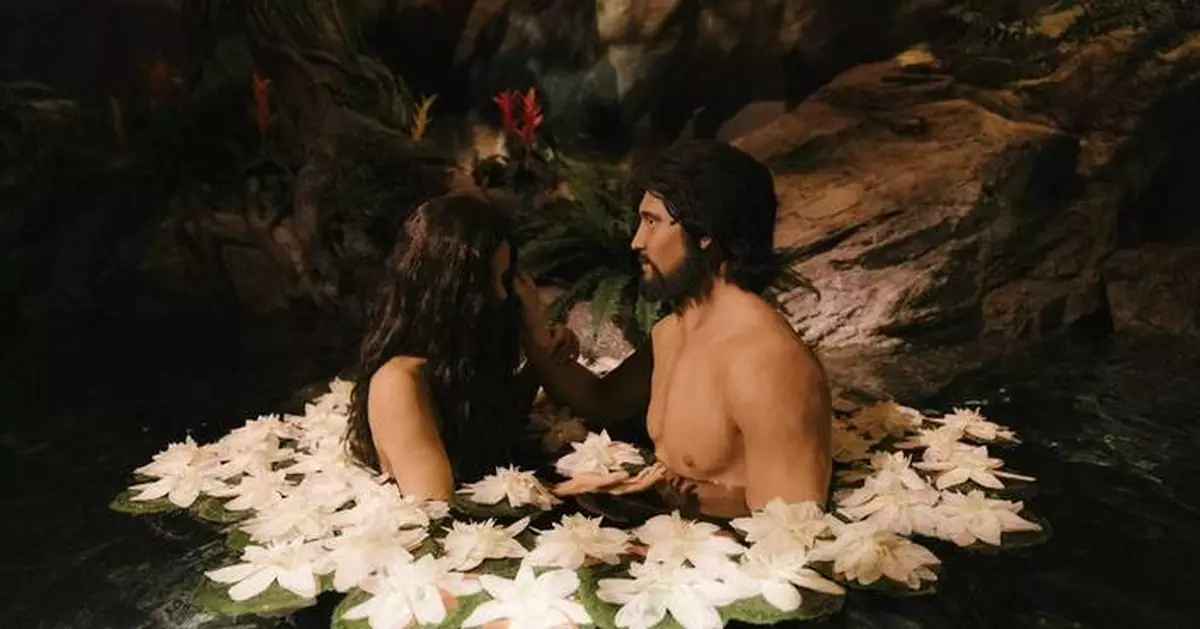
Visitors looks at a display at the Ark Encounter in Williamstown, Ky., Friday, March 21, 2025. (AP Photo/Madeleine Hordinski)
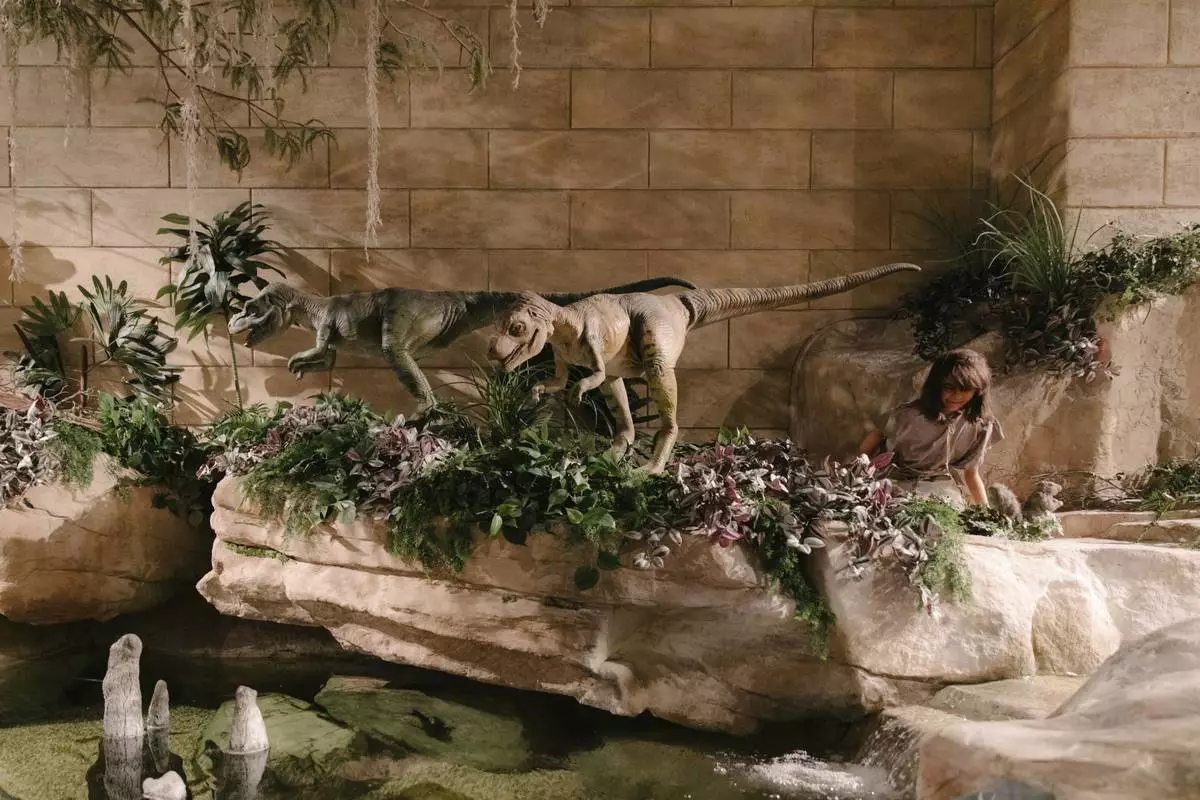
Replicas of dinosaurs and an early human -- which according to evolutionary scientists are separated by tens of millions of years -- are displayed side-by-side in the main hall of the Creation Museum in Petersburg, Ky., Friday, March 21, 2025. (AP Photo/Madeleine Hordinski)
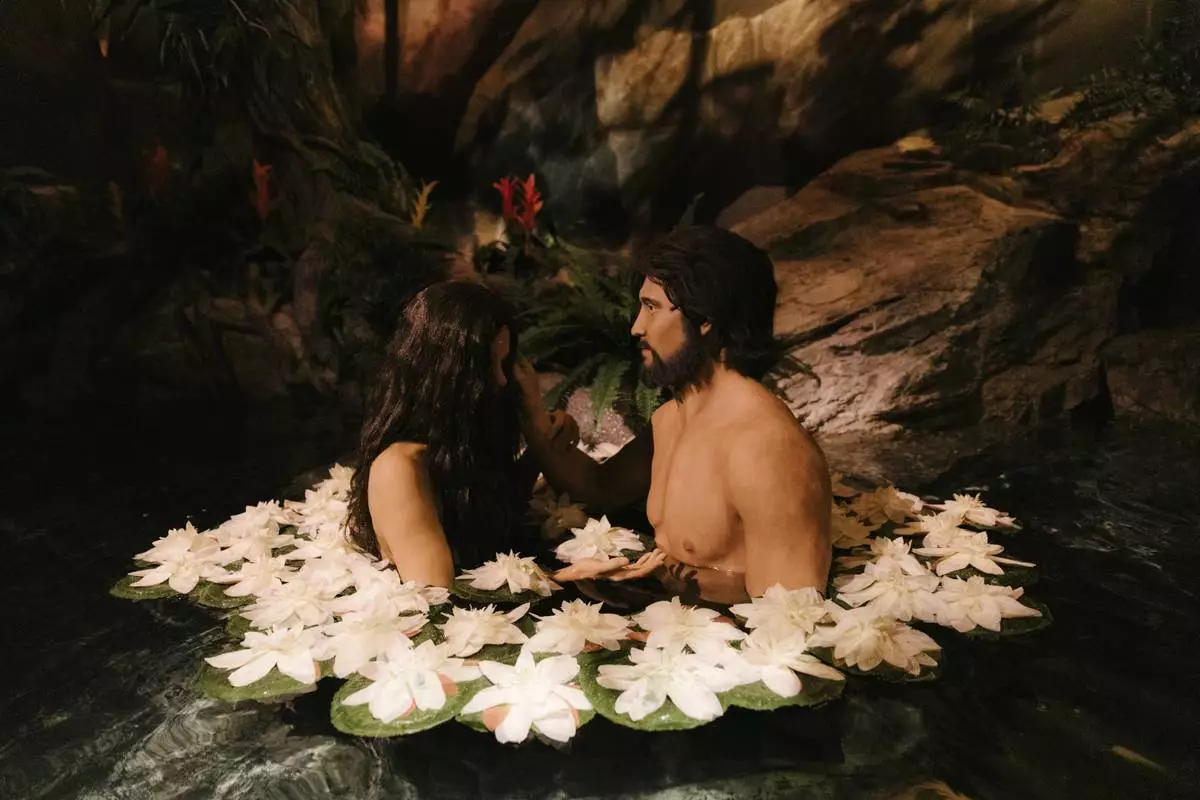
An exhibit of Adam and Eve is seen at the Creation Museum in Petersburg, Ky., Friday, March 21, 2025. (AP Photo/Madeleine Hordinski)