Skip to Content Facebook Feature Image

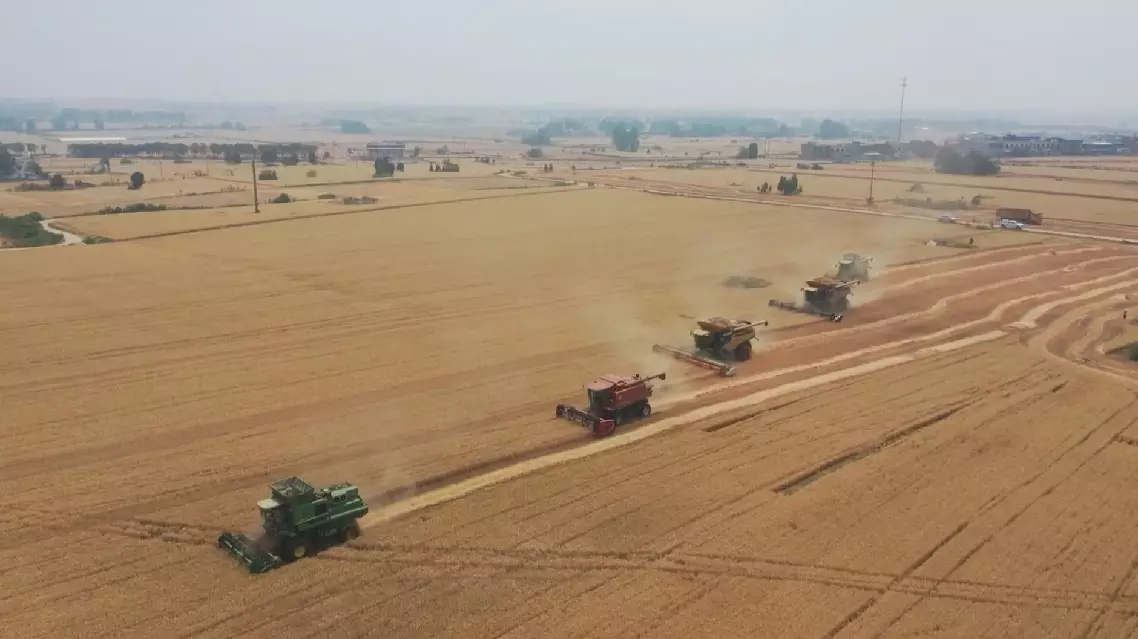
Mechanized summer harvest in full swing across China

China

China

China

Mechanized summer harvest in full swing across China

2025-05-27 05:03 Last Updated At:14:07

The grain harvest is in full swing across China, with more than 266,667 hectares of winter wheat being reaped by agricultural machinery every day and almost 20 percent of the crop already harvested, according to the Ministry of Agriculture and Rural Affairs.

The harvest in wheat-growing areas in the southwest and in the central province of Hubei is coming to an end, while in Henan and Anhui, the main wheat production provinces in the Huang-Huai-Hai region, harvesting is at its peak.

In Henan's Zhumadian City, local authorities have deployed more than 30,000 combine harvesters to help farmers bring in 733,300 hectares of wheat.

"The wheat yield is around 1,200 to 1,300 jin per mu (9,000 to 9,750 kilograms per hectare), and is growing well," said Feng Pingxin, a local farmer.

More than 2.87 million hectares of wheat planted in Anhui is ready to harvest with 160,000 high-performance combine harvesters working in the fields, and local authorities coordinating operations across 567 drying centers to ensure that every grain can be collected and safely stored.

"There will be light rain in the following days, but we don't need to worry at all. Because there are 44 dryers [in the dry center], and they can process over 1,300 tons of wheat every day," said Li Peigen, a grain farmer in Auhui's Huoqiu County.

In Xuyi County, the first place in east China's Jiangsu Province to harvest wheat this year, over 5,000 combine harvesters have been urgently mobilized ahead of rain forecast in the next few days.

Local authorities have allocated agricultural machinery using big data analysis to support farmers bring in the harvest.

Four million hectares of wheat in the eastern province of Shandong is nearing harvest time, with dry land wheat in the southern part of the province gradually ripening.

Drought-resistant and high-yield wheat is the main variety grown locally in Shandong's Zhangshanzi Town. With fully mechanized reaping operations, the yield of dry land wheat is projected to increase by more than 10 percent compared to previous years.

Over 17 million agricultural machines will be put into use nationwide during this year's "three summer period," which refers to the summer harvest, summer sowing and summer management activities usually carried out from mid-May to June.

More than 800,000 combine harvesters are expected to be involved this summer, including 200,000 harvesters operating cross-regionally, to reap 22.7 million hectares of wheat planted across the country during the summer harvest season that will last for around three weeks.

In China, the main grain and oil crops harvested in summer are wheat and rapeseed sown in the previous autumn and winter.
Mechanized summer harvest in full swing across China


Mechanized summer harvest in full swing across China
The Japanese society should do soul-searching regarding its history of aggression and adhere to the pacifist constitution, said Shiradori Hiroshi, a professor of the Hosei University, in an interview with China Central Television (CCTV) in Tokyo on April 30.

He said the government's recent move to discuss revising the three security documents deserve particular attention as the country's foreign and security policies have already witnessed major changes.

"People outside of the country hold that Japan's post-war image as a 'peace state' is now facing a major shift. Against the backdrop of tremendous changes in its foreign and security policies, the revision of the three security documents deserves particular attention. There lacks public debate in terms of the procedure, with policy changes decided unilaterally at Cabinet meetings. It is necessary to fully explain to the public as to whether such a practice is proper," said Hiroshi.

The Japanese government held its first expert panel meeting to discuss revisions to the three security documents at the Prime Minister's Office on April 27, local media reported.

Japan's current National Security Strategy and two related documents, formulated in 2022, were designed to cover the next 10 years, but the government led by Prime Minister Sanae Takaichi has decided to move up the timetable to accelerate the revision process.

Increasing defense spending is one of the key topics of the meeting, according to Kyodo News.

Hiroshi said this year marks the 80th anniversary of the opening of the International Military Tribunal for the Far East, or Tokyo Trials, and the Japanese society must do soul-searching regarding its history of aggression in WWII, when it brought enormous catastrophes on Asian countries.

"Eighty years have passed since the opening of the Tokyo Trials. Japan inflicted enormous suffering on Asian countries during WWII, which should serve as an opportunity for the soul-searching. It is exact on the basis of countless sacrifices that Japan's post-war pacifism and its identity as a 'peace state' took shape. On this 80th anniversary, it is necessary for Japan to re-examine and do soul-searching regarding its history," said Hiroshi.

The Japanese government's effort to revise the pacifist constitution is widely opposed by the public.

On Sunday, around 50,000 people gathered at Tokyo Rinkai Disaster Prevention Park, chanting slogans and holding banners against the government's push for constitutional revision and military expansion, the largest turnout of its kind in recent years.

Japan should adhere to pacifist constitution: scholar

Japan should adhere to pacifist constitution: scholar

Recommended Articles