Skip to Content Facebook Feature Image

Iran's FM says U.S. "economic terrorism" threatens global economy, national sovereignty

HotTV

HotTV

HotTV

Iran's FM says U.S. "economic terrorism" threatens global economy, national sovereignty

2026-08-21 03:59 Last Updated At:12:12

Iranian Foreign Minister Seyed Abbas Araghchi said Thursday U.S. "economic terrorism" threatens global economy and the sovereignty of nations worldwide.

The remarks came after U.S. President Donald Trump announced on Wednesday "the most crushing economic operation ever taken" against any country providing a lifeline to Iran.

"This will be Economic Warfare and Isolation on an unprecedented scale," Trump posted on Truth Social, calling the move "an ECONOMIC D-DAY."

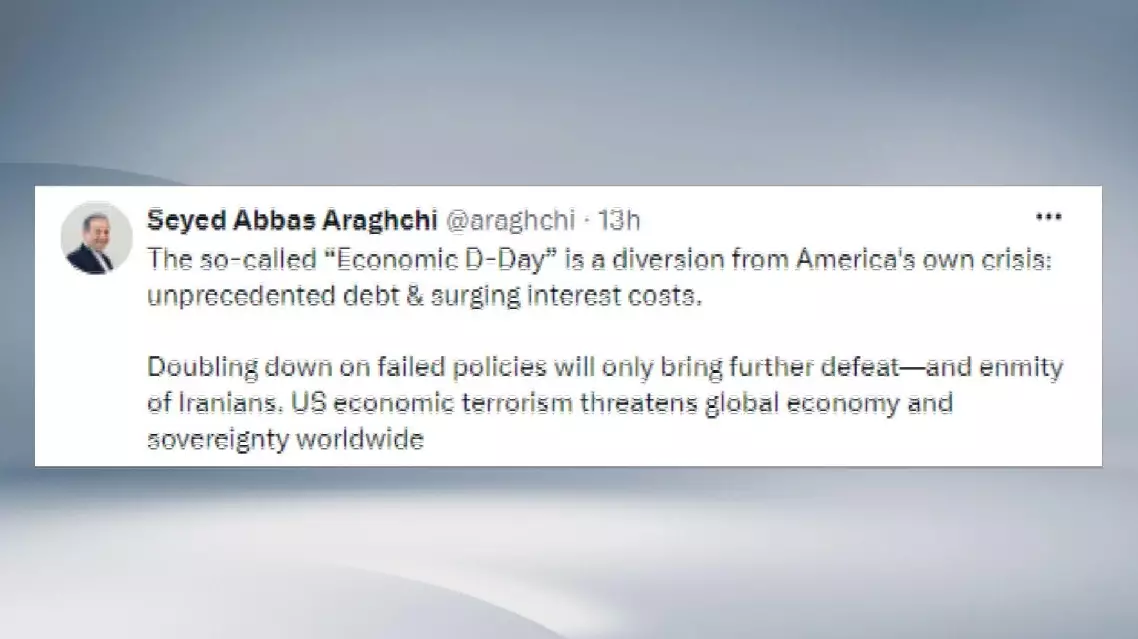
In response, Araghchi said on X that the so-called "Economic D-Day" is a diversion from Washington's own crisis: "unprecedented debt and surging interest costs."

"Doubling down on failed policies will only bring further defeat -- and enmity of Iranians. U.S. economic terrorism threatens global economy and sovereignty worldwide," he added.

On June 18, Iran and the United States signed a memorandum of understanding (MoU) on ending their war in the region on all fronts. Under the MoU, the two countries were scheduled to hold negotiations within a period of 60 days, which ended on Monday, to reach a final agreement. However, the fate of the talks remains unclear following an escalation between the two countries last month.

Washington's anti-Tehran "economic operation" comes as Iran is already under U.S. unilateral sanctions and naval blockade.

Iranian Deputy Foreign Minister for Legal and International Affairs Kazem Gharibabadi said Thursday that the United States is now further pressuring Iran under the label of an "economic war," which he views as an attempt to cover up Washington's previous failure.

Gharibabadi said in a social media post that while the United States claims Iran is "on the verge of collapse," it is reaching out to all its allies for help, Iran's official news agency IRNA reported.

To cover up its failure, the United States has to create an even bigger failure, Gharibabadi said, adding that the military war had failed to deliver results, and Washington was now calling the next defeat an "economic war."

Trump announced on social media Wednesday that the United States would launch "the most crushing economic operation ever taken against any country" against Iran.

Iran's Islamic Revolution Guard Corps (IRGC) has said the country will use more "devastating" weapons if a new war begins against it.

Following the 12-day and 40-day wars imposed against the country in June last year and late February by the United States and Israel, Iran has expanded its military capabilities, IRGC spokesperson Hossein Mohebbi said in an interview with Iran's Defa Press news agency, which was published on Thursday.

"If another war begins, our weapons will definitely be different ... in terms of the generation of missiles' warheads, as well as their precision and range," Mohebbi said.

The spokesperson emphasized that Iran has never stopped its armaments production, adding, "The destruction power of the warheads used in the IRGC's (new) missiles is far greater than the models used in the previous wars."

On Feb. 28, Israel and the United States launched joint attacks on Tehran and other Iranian cities, killing the country's then-Supreme Leader Ali Khamenei, military commanders and civilians. Iran responded with waves of missile and drone attacks targeting Israel and U.S. bases and assets in the region.
Iran's FM says U.S. "economic terrorism" threatens global economy, national sovereignty

Iran's FM says U.S. "economic terrorism" threatens global economy, national sovereignty

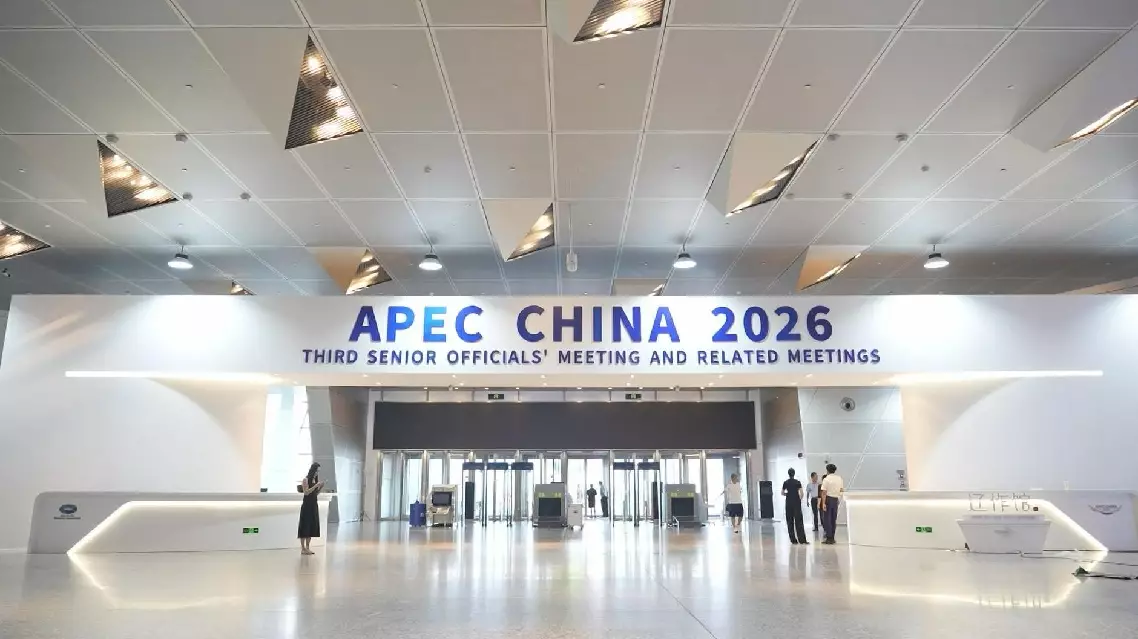
The Asia-Pacific Economic Cooperation (APEC) Energy Think Tank Forum was held in Dalian City, northeast China's Liaoning Province on Thursday, bringing together more than 100 representatives from 17 member economies of the APEC, international organizations, think tanks, and research institutions.

Participants engaged in in-depth discussions on energy security and regional resilience, energy technology and innovation cooperation, and multilateral cooperation and think tank network building, aiming to pool intellectual consensus for deepening practical regional energy cooperation and promoting shared prosperity in the Asia-Pacific.

Energy serves as a cornerstone of Asia-Pacific economic prosperity.

Faced with the current complex and volatile international energy situation, participants reached a consensus that Asia-Pacific economies should further eliminate barriers through institutionalized cooperation, coordinate energy security with green transition, strengthen collaborative innovation in key core technologies, promote interconnectivity in regional energy markets, and build an open and resilient Asia-Pacific energy security system.

However, uneven energy development within the region remains prominent. Energy access for remote areas and low-income groups still has shortcomings, and the energy transition process must also guard against excessively rapid increases in energy costs for people's livelihoods.

"We should adhere to a people-centered approach and integrate the concept of inclusive benefit throughout all aspects of energy cooperation, continuously promoting the extension of energy infrastructure to underdeveloped regions, and enhancing the stability and coverage of basic energy services," said Xiong Minfeng, Deputy Director General of the International Cooperation Department of the National Energy Administration of China.

The forum released a report on China and APEC energy cooperation.

The report shows that since joining the APEC in 1991, China has continuously aligned its energy development strategies with those of other economies, with cooperation covering traditional energy, new energy, electricity, and other fields, spanning the entire chain of investment, trade, and infrastructure. This has formed an energy cooperation pattern featuring complementary supply and demand, green empowerment, interconnection and supply chain stability, and collaborative governance, contributing Chinese strength to regional energy common security and sustainable development.

"The report targets 2030 and 2050. We need to persist in energy cooperation, which has formed an international practice and international consensus," said Lu Ruquan, Director of the Economics and Technology Research Institute of the China National Petroleum Corporation.

The 16th APEC Energy Ministerial Meeting is scheduled to be held in Beijing from Sept 10 to 11.

APEC Energy Think Tank Forum held to advance regional cooperation

APEC Energy Think Tank Forum held to advance regional cooperation

Recommended Articles