FRANKFURT, Germany (AP) — Top officials at the European Union's executive commission says they're pushing hard for a trade deal with the Trump administration to avoid a 50% tariff on imported goods. Trump had threatened to impose the tariffs on June 1, but has pushed back the deadline to July 9, repeating an oft-used tactic in his trade war.
European negotiators are contending with Trump’s ever-changing and unpredictable tariff threats, but “still, they have to come up with something to hopefully pacify him," said Bruce Stokes, visiting senior fellow at the German Marshall Fund of the United States.
Stokes also sees more at play than just a disagreement over trade deficits. Trump’s threats “are rooted in frustration with the EU that has little to do with trade,’’ Stokes said. “He doesn’t like the EU. He doesn’t like Germany."
What exactly does Trump want? What can Europe offer? Here are the key areas where the two side are squaring off.
Over and over, Trump has bemoaned the fact that Europe sells more things to Americans than it buys from Americans. The difference, or the trade deficit in goods, last year was 157 billion euros ($178 billion). But Europe says that when it comes to services — particularly digital services like online advertising and cloud computing — the U.S. sells more than it buys and that lowers the overall trade deficit to 48 billion euros, which is only about 3% of total trade. The European Commission says that means trade is “balanced.”
One way to shift the trade in goods would be for Europe to buy more liquefied natural gas by ship from the U.S. To do so, the EU could cut off the remaining imports of Russian pipeline gas and LNG. The commission is preparing legislation to force an end to those purchases -- last year, some 19% of imports — by the end of 2027.
That would push European private companies to look for other sources of gas such as the U.S. However the shift away from Russia is already in motion and that “has obviously not been enough to satisfy," said Laurent Ruseckas, a natural gas markets expert at S&P Global Commodities Insights Research.
The commission doesn't buy gas itself but can use “moral suasion” to convince companies to turn to U.S. suppliers in coming years but “this is no silver bullet and nothing that can yield immediate results,” said Simone Tagliapietra, an energy analyst at the Bruegel think tank in Brussels.
Europe could buy more from U.S. defense contractors as part of its effort to deter further aggression from Russia after the invasion of Ukraine, says Carsten Brzeski, global chief of macro at ING bank. If European countries did increase their overall defense spending — another of Trump's demands — their voters are likely to insist that the purchases go to defense contractors in Europe, not America, said Stokes of the German Marshall Fund. One way around that political obstacle would be for U.S. defense companies to build factories in Europe, but "that would take time,'' he said.
The EU could also reduce its 10% tax on foreign cars— one of Trump's long-standing grievances against Europe. “The United States is not going to export that many cars to Europe anyway ... The Germans would be most resistant, but I don't think they're terribly worried about competition from America,'' said Edward Alden, senior fellow at the Council on Foreign Relations. ”That would be a symbolic victory for the president.''
The U.S. has long complained about European regulations on food and agricultural products that keep out hormone-raised beef and chickens washed with chlorine. But experts aren't expecting EU trade negotiators to offer any concessions at the bargaining table.
“The EU is unwilling to capitulate,” said Mary Lovely, senior fellow at the Peterson Institute for International Economics. “The EU has repeatedly said it will not change its sanitary rules, its rules on (genetically modified) crops, its rules on chlorinated chickens, things that have been longtime irritants for the U.S.’’
Backing down on those issues, she said, would mean that “the U.S. gets to set food safety (standards) for Europe.’’
One of Trump's pet peeves has been the value-added taxes used by European governments, a tax he says is a burden on US companies.
Economists say this kind of tax, used by some 170 countries, is trade-neutral because it applies equally to imports and exports. A value-added tax, or VAT, is paid by the end purchaser at the cash register but differs from sales taxes in that it is calculated at each stage of the production process. In both cases, VAT and sales tax, imports and exports get the same treatment. The U.S. is an outlier in that it doesn’t use VAT.
There’s little chance countries will change their tax systems for Trump and the EU has ruled it out.
Trump's approach to negotiations has involved threats of astronomical tariffs - up to 145% in the case of China - before striking a deal for far lower levels. In any case, however, the White House has taken the stance that it won't go below a 10% baseline. The threat of 50% for the EU is so high it means “an effective trade embargo," said Brzeski, since it would impose costs that would make it unprofitable to import goods or mean charging consumers prices so high the goods would be uncompetitive.
Because the knottiest issues dividing the EU and U.S. — food safety standards, the VAT, regulation of tech companies — are so difficult “it is impossible to imagine them being resolved by the deadline,'' Alden said. ”Possibly what you could have — and Trump has shown he is willing to do this — is a very small deal'' like the one he announced May 8 with the United Kingdom.
Economists Oliver Rakau and Nicola Nobile of Oxford Economics wrote in a commentary Monday that if imposed, the 50% tariffs would reduce the collective economy of the 20 countries that use the euro currency by up to 1% next year and slash business investment by more than 6%.
The EU has offered the US a “zero for zero" outcome in which tariffs would be removed on both sides industrial goods including autos. Trump has dismissed that but EU officials have said it's still on the table.
Lovely of the Peterson Institute sees the threats and bluster as Trump's way of negotiating. “In the short run, I don’t think 50% is going to be our reality.’’
But she says Trump's strategy adds to the uncertainty around U.S. policy that is paralyzing business. “It suggests that the U.S. is an unreliable trading partner, that it operates on whim and not on rule of law,’’ Lovely said. “Friend or foe, you’re not going to be treated well by this administration.’’
Wiseman contributed to this report from Washington.
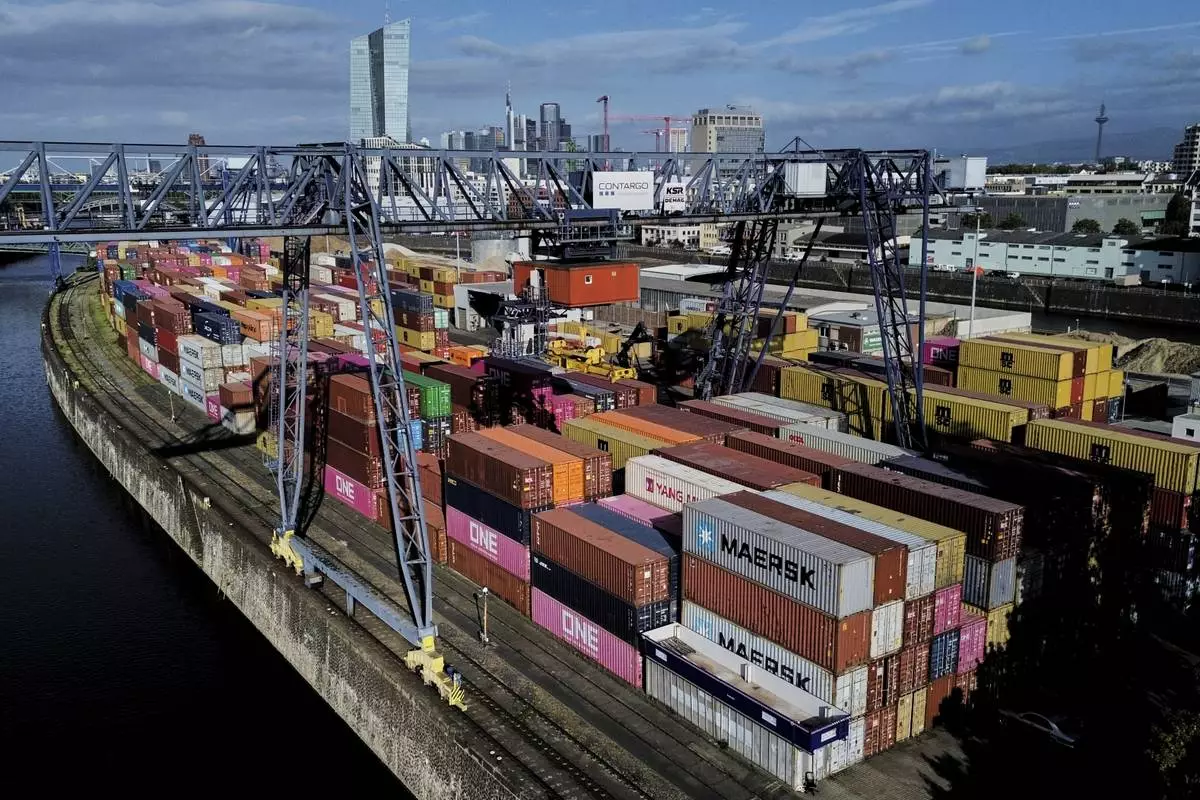
Containers are pictured at a cargo terminal in Frankfurt, Germany, Thursday, May 22, 2025. (AP Photo/Michael Probst)