People across China are gearing up for the upcoming Dragon Boat Festival, participating in or watching exciting dragon boat races and savoring creative delicacies in the run-up to this beloved cultural event.
The Dragon Boat Festival, also known as the Duanwu Festival, is celebrated on the fifth day of the fifth month on the Chinese lunar calendar to commemorate ancient Chinese patriotic poet Qu Yuan (about 340-278 BC). The festival falls on May 31 this year.
During the festival, people engage in various activities such as dragon boat races and eating zongzi -- sticky rice dumplings wrapped in broad bamboo leaves.
In Jinli Town of south China's Guangdong Province, thrilling dragon boat races were in full swing. Over 80 dragon boats from different villages in Jinli competed fiercely, with dragon boats slicing through waves, accompanied by the sounds of beating gongs and drums, splashing water, and enthusiastic cheers.
"It's my first time here. The crowd is large, and the atmosphere is fantastic. It's truly breathtaking," said Ms. Lan, a tourist.
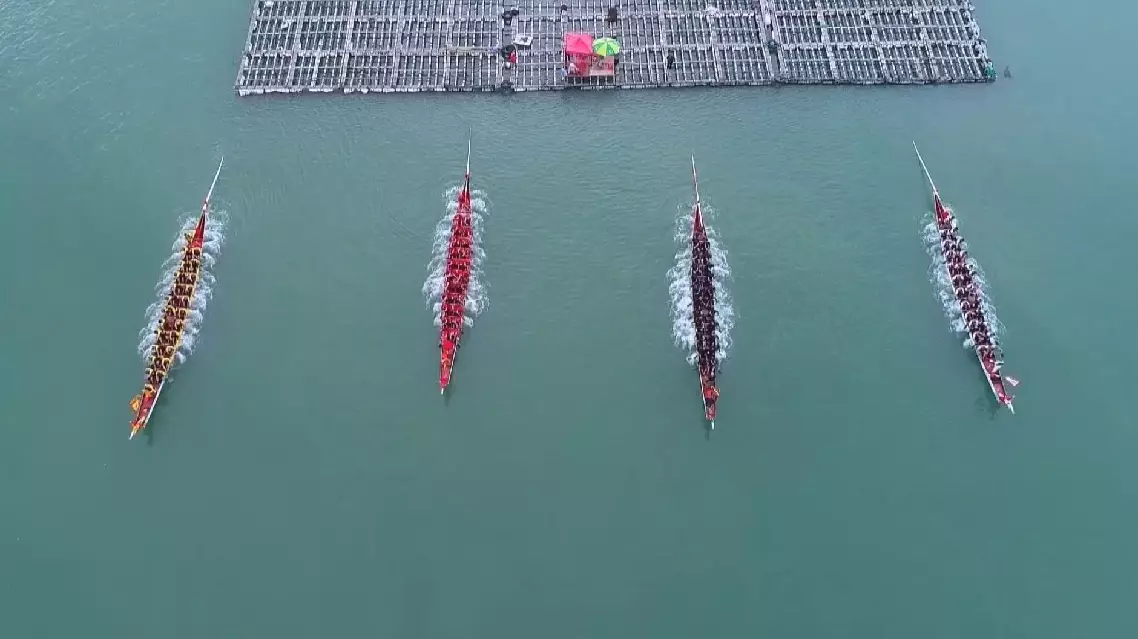
In Lianjiang County of east China's Fujian Province, thrilling sea dragon boat races have enhanced the festive spirit.
Early in the morning, local villagers launched four dragon boats from the village, making their way to the open sea. Residents gathered along the streets to greet them, pouring water over the dragon heads as a gesture of prayer for blessings.
When the race began, the four dragon boats sliced through the waves like arrows shot from a bow.
"Watching the dragon boat races on the vast sea truly evokes a sense of grandeur," said Feng Mubo, a tourist.
In the ethnic minority Shezhai Village of Fujian, a unique Dragon Boat Festival tradition involves making zongzi with glutinous rice that has a deep purple-black hue.
The rice for making zongzi of such a unique color would be soaked in the juice of sea bilberry leaves in preparation, which gives it the striking color and distinctive fragrance.
Though such zongzi appear black, they are delicious and are a favorite for both locals and tourists.
"My friend and I came to visit Shezhai Village today and are lucky to witness the local villagers making zongzi. I plan to take some back to share with my family members and friends," said Chen Hong, a tourist.
With China's national college entrance exam, also known as the gaokao, approaching on June 7, people in Yingshang County of east China's Anhui Province have made zongzi shaped like writing brushes to wish the test takers a good luck.
The writing brush-shaped zongzi, known as bizong, is recognized as a local intangible cultural heritage.
As this year's Dragon Boat Festival is just one day ahead of the International Children's Day, Nanchang City of east China's Jiangxi Province has organized a range of themed activities, enabling children to immerse themselves in the Dragon Boat Festival culture while learning traditional handicrafts such as weaving nets for eggs.
"This is the first time I have woven a net for eggs, and I feel proud of myself. I've also learned about some traditional culture and handicrafts related to the Dragon Boat Festival today," said Li Xinyan, a local primary school student.
Celebratory activities held across China in run-up to Dragon Boat Festival